
Key Takeaways
- Prescription peptide therapy is a broad marketing term; the key distinction is between FDA-approved peptide medicines for specific conditions and compounded products the FDA has never reviewed.
- If a clinic cannot plainly say whether a product is FDA-approved or compounded, treat that as a warning sign and ask which pharmacy prepares it and whether it is licensed.
- Approval for one condition, such as semaglutide or tirzepatide for diabetes or chronic weight management, does not prove benefit for unrelated wellness claims.
- Human evidence for popular peptides like BPC-157, MOTS-c, and ipamorelin is limited, and none should be assumed approved for recovery, anti-aging, or cognitive uses.
- Red flags include 'research use only' products offered to patients, guaranteed healing or fat-loss promises, and pressure to buy multi-month packages before labs or an exam.
- Verify current FDA guidance before relying on clinic claims, since 2026 compounding policy is shifting and advisory votes or enforcement pauses are not the same as FDA approval.
Search for prescription peptide therapy in Tampa and you will find clinics promising everything from faster recovery to a younger body. The phrase sounds precise, but it is really a broad marketing term. It can describe peptide-based medicines that the FDA has approved for specific conditions. It can also describe compounded products promoted for wellness goals that the FDA has never reviewed. Those two categories carry very different levels of evidence and oversight.
For busy professionals, young families, and wellness-minded adults in Tampa Bay, that difference matters. A clear diagnosis, an honest conversation about evidence, and a licensed clinician who knows your medical history should come first. This guide explains what prescription peptide therapy means, which products have approved uses, where the regulatory gray areas sit, and how to evaluate a provider before you start. It is written to help you ask better questions, not to promise results.

What Does "Prescription Peptide Therapy" Actually Mean?
Peptides are short chains of amino acids. Your body makes thousands of them, and many act as signals that influence hunger, blood sugar, growth, and tissue repair. Some peptide-based drugs are well studied and widely prescribed. Others are discussed mainly in wellness circles with limited human data.
"Prescription peptide therapy" is not one standardized treatment. In practice, the phrase usually points to one of three things:
- FDA-approved peptide medicines prescribed for specific conditions, such as certain diabetes and chronic weight-management indications.
- Compounded peptide products prepared by a pharmacy for an individual patient. These are not FDA-approved.
- "Research use only" products sold online or through unregulated channels. These are not intended for human use and are a safety concern.
Knowing which category your provider is describing is the single most useful step you can take. If a clinic cannot tell you plainly whether a product is FDA-approved or compounded, treat that as a warning sign.
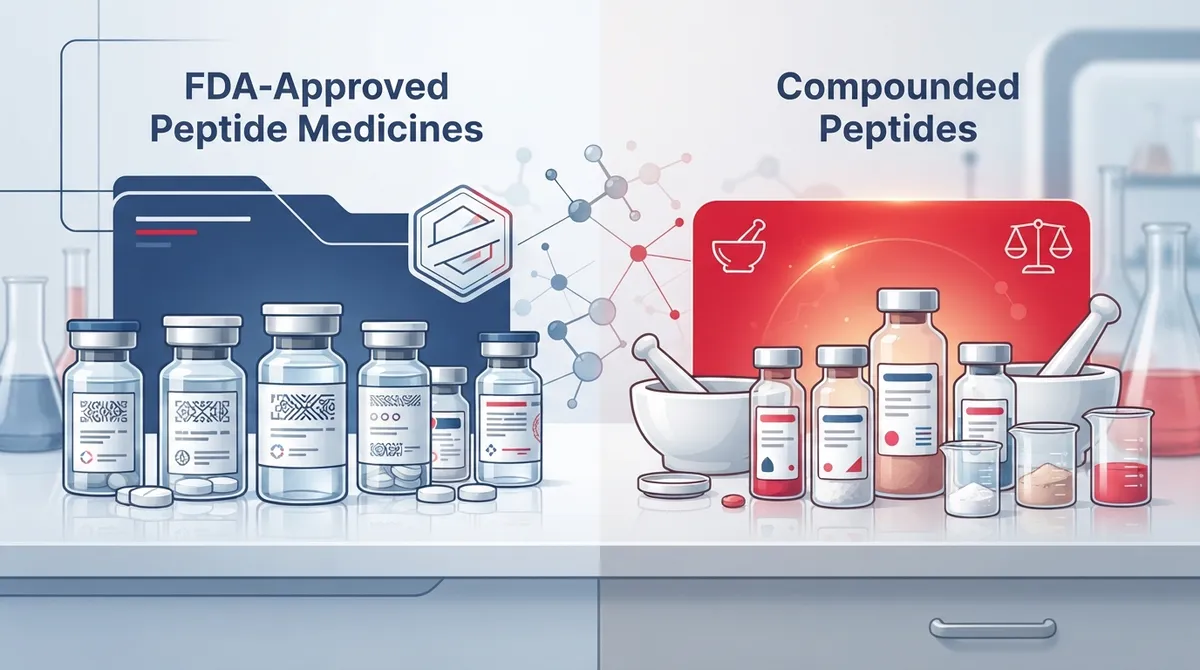
FDA-Approved Peptide Medicines vs. Compounded Peptides
The gap between these categories is wide. Approved drugs go through FDA review of safety, effectiveness, and manufacturing quality before they reach patients. Compounded drugs do not receive that same pre-market review.
|
Feature |
FDA-Approved Peptide Medicine |
Compounded Peptide Product |
|---|---|---|
|
FDA review before marketing |
Yes, for specific indications |
No |
|
Evidence base |
Product-specific clinical trials |
Varies widely; often limited |
|
Typical use |
Defined medical conditions |
Patient-specific need, sometimes wellness goals |
|
Quality oversight |
FDA manufacturing standards |
Depends on the pharmacy and its credentials |
|
Prescription required |
Yes |
Yes, for most legitimate compounds |
Approval for one use does not prove benefit for unrelated wellness claims. For example, semaglutide and tirzepatide have approved uses tied to diabetes and chronic weight management. Those results should never be stretched to cover other peptides. If you want to understand how these two medicines work, our guides on semaglutide's mechanism of action and how tirzepatide works inside your body are a good place to start.
Why Compounding Rules Matter in 2026
Compounding is a legitimate part of medicine when a patient has a specific need that a commercial product cannot meet. Federal law sets conditions around it. For many compounds, a patient-specific prescription is required. There are also limits on making products that are essentially copies of commercially available drugs.
Policy in this area has been shifting. Public discussion in 2026 has included advisory committee votes, interim compounding pathways, and enforcement policies that affect certain peptides. Some of the claims circulating online are conflicting or out of date. An advisory committee recommendation, or a temporary enforcement approach, is not the same as FDA approval. Before any clinic describes a named peptide as legally available, ask them to point you to current FDA guidance.
The FDA has also reported dosing errors and serious adverse events tied to some compounded GLP-1 products. That is one reason it is worth checking the dispensing pharmacy and asking how the product is prepared and labeled. For a closer look at this topic, see our comparison of FDA-approved vs. compounded peptides.
Peptides People Ask About in Tampa
Patients often arrive with a list of names they have seen online. Here is a plain summary of where the evidence and status stand for some of the most common ones.
- Semaglutide and tirzepatide: Peptide-based medicines with FDA-approved indications and substantial trial data. They require clinical evaluation and a prescription.
- BPC-157: Widely discussed for recovery, but human evidence is limited and its regulatory status is not settled. See our review of BPC-157 FDA approval status.
- MOTS-c: Studied mostly in laboratory and animal settings. Our article on what MOTS-c research really shows covers the gaps.
- Ipamorelin and CJC-1295: Growth hormone secretagogues with questions around approval and long-term safety. We explain this in 9 facts on Ipamorelin FDA approval status.
- KPV, GHK-Cu, Semax, and others: Promoted for inflammation, skin, or cognition, but evidence varies and none should be assumed to be approved for those uses.
No reliable Tampa-specific data on outcomes or pricing was available when this article was prepared, so be wary of any provider quoting precise local success rates. If cost is a concern, our guide to what monthly peptide therapy costs in Tampa explains what typically drives price.
How a Responsible Evaluation Should Work
Good peptide care looks like good primary care. It starts with listening, testing, and a clear goal, not with a product menu. Here is what a thorough visit should include:
- Medical history review. Your clinician should ask about chronic conditions, family history, and prior reactions to medications.
- Medication and supplement check. Peptides and other drugs can interact, so every prescription and supplement needs review.
- Relevant testing. Labs, body composition, or metabolic assessments help define the actual problem before a treatment is chosen.
- A stated diagnosis or goal. You should know exactly what you are treating and how success will be measured.
- Evidence and risk discussion. Your clinician should explain what is proven, what is uncertain, and what side effects to watch for.
- Scheduled follow-up. Monitoring and dose adjustments should be part of the plan from day one.
This is also where whole-body care helps. Poor sleep, thyroid issues, low testosterone, or an unmanaged metabolic condition can all mimic the symptoms people hope peptides will fix. A primary care team can rule those out first. If sleep is part of your concern, read how to know when to see a doctor for poor sleep.
Red Flags to Watch For
Not every clinic operates to the same standard. Be cautious if you notice any of the following:
- Products labeled "research use only" or "not for human consumption" offered to patients.
- Promises of guaranteed healing, fat loss, or anti-aging results.
- Vague answers about where ingredients come from or which pharmacy prepares them.
- No disclosure of whether a product is FDA-approved or compounded.
- Pressure to buy multi-month packages before an exam or lab work.
- No licensed physician or clinician involved in your prescription.
Our checklist of 15 questions to ask a peptide therapy clinic in Tampa and our list of 8 signs of a reputable peptide clinic can help you screen a provider before you book.
Questions to Ask Before You Start
Bring a short list to your appointment. These questions cut through marketing quickly:
- Is this product FDA-approved, and for what condition?
- If it is compounded, which pharmacy prepares it, and is it licensed?
- What does the evidence show in humans, not just animals?
- What are the likely side effects, and what should I report?
- How will you monitor my progress and safety?
- What happens if I want to stop?
Also confirm the clinician's Florida license. If you ever experience an unexpected reaction, contact your clinician right away and report suspected adverse drug events to the appropriate authorities. Peptide therapy works best, and is safest, when it sits inside a broader plan with a doctor who knows you.
Who May Benefit From a Peptide Conversation
Peptide-related care is not for everyone, and some people are better served by proven basics first. A conversation may make sense if you are:
- Managing weight alongside a medical condition and want to know whether an FDA-approved option fits.
- Living with blood sugar concerns and looking at approved therapies.
- Curious about wellness peptides and wanting an honest, evidence-based opinion.
- Already taking peptides from another source and wanting medical oversight.
If weight management is your main goal, you may also find it useful to read about why medical weight loss clinics work better and how to evaluate peptide therapy for wellness safely.
The InCare Approach in Tampa and Riverview
InCare is a personalized primary care and wellness clinic with locations in Tampa and Riverview, Florida. The team combines state-of-the-art technology with medical expertise and focuses on prevention and whole-body health. That includes weight loss programs, metabolic breath analysis, body composition analysis, and DNA gene testing, which can help clarify your starting point before any treatment decision is made.
The goal is to match your care to your data and your history, and to be transparent about what is approved, what is compounded, and what is still unproven. You can read more about the InCare peptide therapy approach in Tampa, and you can follow the clinic on Instagram, Facebook, and TikTok for updates. Patients also share their experiences on Google, so you can see what our InCare patients say on Google.
Final Thoughts on Prescription Peptide Therapy in Tampa
Prescription peptide therapy can mean very different things depending on the product and the provider. Approved medicines have defined uses and real evidence. Compounded and wellness peptides call for more caution, more questions, and a clinician who is willing to say "we do not know yet" when that is true. Regulations are still changing in 2026, so verify current FDA guidance rather than relying on promotional claims.
The safest path is to start with a thorough evaluation, a clear goal, and a licensed team that explains the trade-offs. If you are ready to talk through your options, book a visit with the InCare team or contact us with your questions. Educated patients get better care, and that is where every good treatment plan begins.
FAQs
Q: What does prescription peptide therapy mean?
A: It is a broad term, not a single standardized treatment. It may refer to FDA-approved peptide medicines prescribed for specific conditions, or to compounded products promoted for goals such as weight management or recovery. Evidence and regulatory status differ substantially by product.
Q: Are compounded peptides FDA-approved?
A: No. Compounded drugs are not FDA-approved, and the FDA does not review them for safety, effectiveness, or quality before marketing in the same way it reviews approved drugs. They may be appropriate for a patient-specific medical need, but they are not a general substitute for an approved product.
Q: Can a Tampa primary care provider prescribe peptide therapy?
A: A licensed Florida clinician can prescribe appropriate medications after evaluating your history, medications, and goals. Confirm the clinician's license, ask whether a product is FDA-approved or compounded, and verify the dispensing pharmacy's credentials.
Q: Is BPC-157 FDA-approved?
A: BPC-157 is not FDA-approved for treating any condition, and human evidence remains limited. Regulatory policy on peptides is changing in 2026, so verify current FDA guidance before relying on any clinic's claims.
Q: What should I ask a clinic before starting peptide therapy?
A: Ask whether the product is FDA-approved or compounded, which pharmacy prepares it, what human evidence exists, what side effects to expect, and how you will be monitored. A reputable clinic will answer these clearly and without pressure.