
Key Takeaways
- Chronological age counts years since birth and never changes, while biological age estimates how your body is functioning compared with age-related patterns in a reference group.
- Biological age is not one standardized measurement; blood-based, functional, and DNA-based methods can give different results, so scores from different tests cannot be compared directly.
- Biological age is a conversation starter about prevention and risk, not a diagnosis, and it should never change your screening or treatment plan on its own.
- Lifestyle factors in the American Heart Association's Life's Essential 8 (diet, activity, sleep, nicotine, weight, lipids, glucose, blood pressure) are linked to younger biological age, though the evidence is observational.
- Interpret a biological age gap (estimated age minus chronological age) only in the context of the specific test and its reference group, and retest with the same test and lab for fair comparison.
- Do not skip proven screenings or ignore symptoms because a biological age result looks favorable; routine care remains the established path to early detection.
You celebrate a birthday once a year, and the number goes up by one. That number is your chronological age. But two people who are both 45 can have very different health profiles. One may have healthy blood pressure, steady energy, and strong fitness. The other may be dealing with rising blood sugar, poor sleep, and low stamina. This gap is why many people now ask what the difference is between biological and chronological age.
Chronological age counts the years since you were born. Biological age is an estimate of how your body is functioning compared with others. It is not one agreed-upon measurement, and different tests can give different answers. In primary care, it can be a useful conversation starter about prevention and risk. It is not a diagnosis. This guide explains the difference, how biological age is estimated, how to read the results, and how to use them with a doctor you trust.
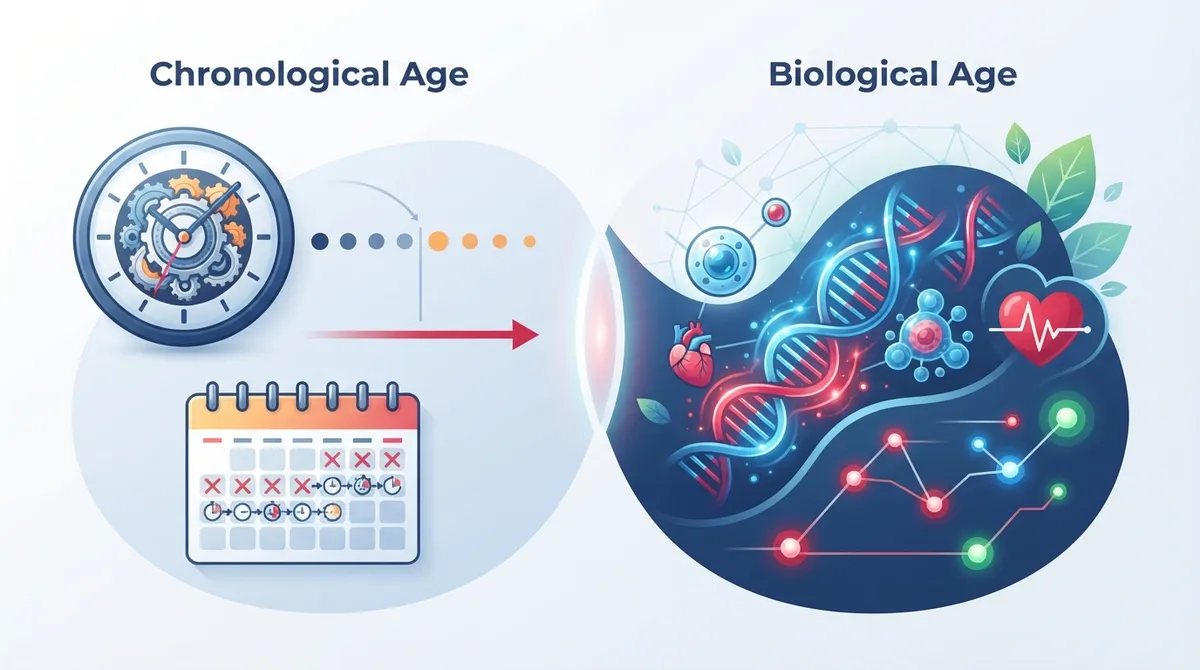
What Is the Difference Between Biological and Chronological Age?
Chronological age is simple. It is the number of years you have been alive. It never changes based on how you live, and it is the age used on your driver's license and medical chart.
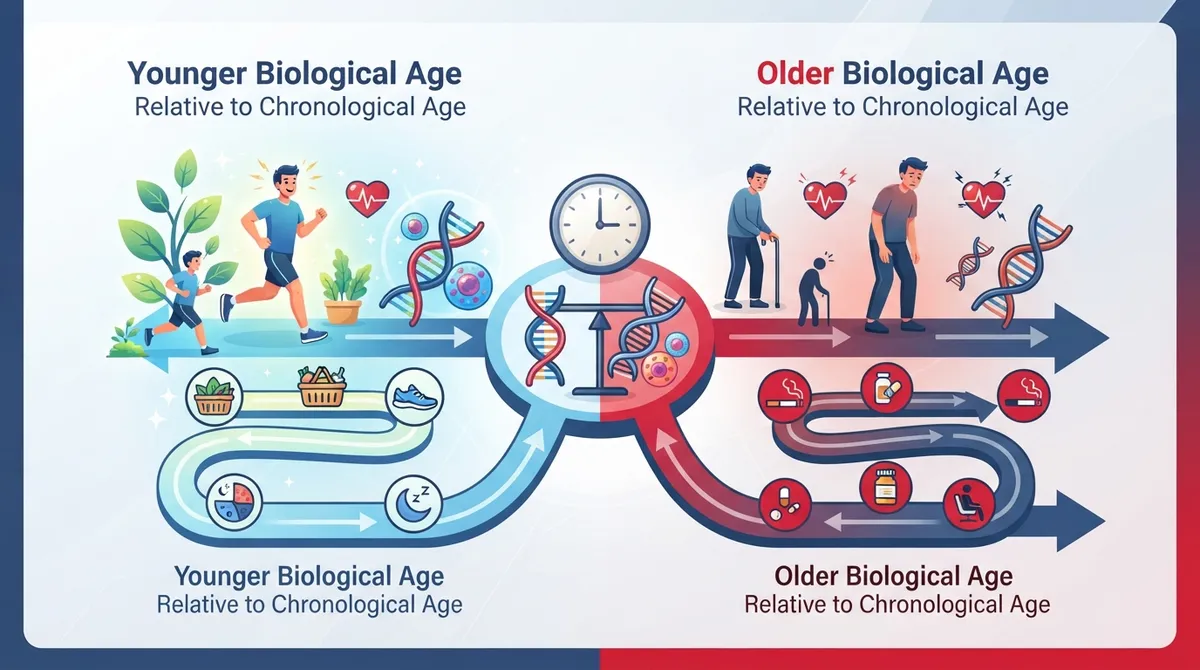
Biological age is different. It is an estimate of how your body's physiology compares with age-related patterns seen in a reference group. It is often expressed in years. If your estimate comes out lower than your actual age, your results look "younger" under that method. If it comes out higher, your results look "older."
Here is the key point. Biological age is not a single universal number. Methods vary, and each one captures a different part of aging. So the difference between biological and chronological age depends partly on which test you use.
|
Feature |
Chronological Age |
Biological Age |
|---|---|---|
|
What it measures |
Years since birth |
Estimated physiological condition |
|
Can it change with lifestyle? |
No |
Estimates may shift with health changes |
|
Is it standardized? |
Yes |
No, methods differ |
|
Medical use |
Screening schedules, dosing |
Risk conversation, prevention planning |
|
Is it a diagnosis? |
Not applicable |
No |
Why This Difference Matters for Your Health
Many guidelines use chronological age to decide when to start screenings. That works well for groups of people. But individuals age at different speeds, and risk factors build up in different ways. Biological age estimates try to describe that personal side of aging.
For busy adults, this idea can be motivating. For families, it highlights that habits matter at every age. For wellness seekers, it offers a way to track progress. Still, it is only one tool. A number from a test cannot replace a medical history, a physical exam, and proven screening guidelines.
How Biological Age Is Estimated
There are three common approaches. Each looks at the body from a different angle.
- Clinical biomarkers: These use routine blood work and health data, such as blood sugar, inflammation markers, and organ function.
- Physical and functional measures: These look at things like grip strength, walking speed, balance, and fitness.
- Molecular measures: These look at patterns in your DNA, such as DNA methylation, sometimes called epigenetic age.
Because each method looks at different signals, results may not match. One test might suggest you are younger than your years, while another suggests you are about average. That does not mean either is wrong. It means they measure different things.
Phenotypic Age: A Blood-Based Example
Phenotypic age is one well-known clinical approach. A commonly used algorithm combines your chronological age with nine blood biomarkers related to metabolism, inflammation, and organ function. It is a research estimate. It is not a definitive picture of your overall health.
Epigenetic Age: A DNA-Based Example
Epigenetic age looks at chemical tags on DNA that change over time. It is a molecular view of aging. It differs from phenotypic age, which relies on blood chemistry. If you want to learn more about how these tests work in practice, you can read about how biological age is measured.
How to Read Your Biological Age Results
Most reports show a gap, often called age acceleration. It is usually calculated as estimated biological age minus chronological age.
- Positive gap: Your estimate is older than your actual age under that method.
- Negative gap: Your estimate is younger than your actual age under that method.
- Near zero: Your estimate is close to your actual age.
How you interpret the gap depends on the test and the reference group it was built on. A score from one lab cannot be compared directly with a score from another. Treat any number as a starting point for a conversation, not a verdict. For a deeper look at what to expect from testing, see these biological age testing facts.
What the Research Says About Heart Health and Biological Age
Researchers have studied how everyday health habits relate to biological age. The American Heart Association's Life's Essential 8 covers eight targets: diet, physical activity, nicotine exposure, sleep, body weight, blood lipids, blood glucose, and blood pressure.
A 2023 American Heart Association report looked at more than 6,500 NHANES participants. People with the highest Life's Essential 8 scores had a phenotypic age about six years younger, on average, than those with the lowest scores. In the high-score group, the average chronological age was 41 and the average phenotypic age was 36. In the low-score group, the averages were 53 and 57.
A 2024 analysis of 18,261 adults found that each 10-point higher score was linked to a 1.19-year lower estimated biological age and a 1.63-year lower phenotypic age. Another 2024 analysis of 5,682 Framingham Heart Study participants found that each standard-deviation increase in score was linked to 35% lower cardiovascular disease risk.
Important Limits of These Findings
These studies are mostly observational. They show an association, not proof of cause and effect. A six-year gap in a large group does not mean one person can lower their biological age by six years. A change in a score also should not be treated as proof of a longer life or lower disease risk for you personally.
How to Use Biological Age in Primary Care
In a primary care setting, biological age estimates can support a prevention conversation. They work best alongside other information. A good visit pulls together several pieces:
- Your medical and family history
- A physical exam and vital signs
- Standard lab work and validated disease-risk tools
- Your daily function, such as strength, stamina, and sleep
- Age-based screenings, such as cancer screening guidelines by age and risk
Biological age should not change your screening or treatment plan on its own. Established recommendations still guide care. The estimate is best used to explain risk factors and to help you set clear, practical goals.
7 Steps to Put This Knowledge to Work
- Start with the basics. Schedule a wellness visit so your doctor can review your history, vitals, and standard labs. A yearly annual physical exam is a strong foundation.
- Know your numbers. Track blood pressure, cholesterol, blood sugar, and body weight. These are core Life's Essential 8 targets.
- Ask which test fits you. Talk with your doctor about whether blood-based, functional, or DNA-based testing makes sense for your goals.
- Treat the result as a conversation starter. Ask what is driving the number and which factors you can influence.
- Focus on habits with strong evidence. Eat well, move often, avoid nicotine, protect your sleep, and manage stress. If rest is a struggle, learn when to see a doctor for poor sleep.
- Use the same method to retest. If you repeat testing, use the same test and lab so comparisons are fair.
- Keep your screenings on schedule. Do not skip proven screenings because a biological age looks good.
Who May Find Biological Age Testing Useful?
Biological age discussions tend to interest several groups. Tech-savvy adults like data they can track over time. Wellness-minded patients want to see how habits show up in their results. Busy parents may want a clear picture of their own health so they can stay strong for their families. Young adults and women building a first relationship with a primary care provider often use it as a way to start a prevention-focused talk.
For all of these groups, the same rule applies. The most valuable part of the process is the follow-up. A number without a plan does little. A number paired with a doctor's guidance can point toward real steps.
Common Mistakes to Avoid
- Treating one number as a diagnosis. It is an estimate, not a medical finding.
- Comparing results across different tests. Methods are not interchangeable.
- Chasing a lower number at any cost. Quick fixes and unproven products do not replace sound habits.
- Ignoring symptoms. If you feel unwell, see a clinician no matter what your score says.
- Skipping routine care. Standard screenings remain the proven path to early detection.
How InCare Supports a Prevention-First Approach
At InCare, we combine primary care with modern wellness tools in Tampa and Riverview, Florida. Our team focuses on prevention and whole-body health. We offer services such as DNA gene testing, metabolic breath analysis, body composition analysis, cancer screenings, and personalized weight loss programs. These tools can help you and your provider build a clearer picture of your health.
Our approach is simple. We use technology to add detail, then rely on medical judgment to decide what matters. If you are curious about aging tests, you can also read about biological age testing options in Tampa. Patients rate us 4.8 out of 5 on Google, and you can see what InCare patients say on Google. You can also follow our updates on Instagram, Facebook, and TikTok.
Take the Next Step
The difference between biological and chronological age comes down to this: one counts your birthdays, and the other estimates how your body is doing. Neither tells the whole story. The best path is to pair thoughtful testing with solid primary care, steady habits, and proven screenings.
Ready to talk through your health goals with a team that puts prevention first? Book your appointment with InCare today, or contact our team with questions about our Tampa and Riverview locations.
FAQs
Q: What is the difference between biological age and chronological age?
A: Chronological age is the number of years since your birth. Biological age is an estimate of how your body's physiological condition compares with age-related patterns, often shown in years. It is not a single agreed-upon measurement, so results vary by method.
Q: Can a blood test tell you your biological age?
A: A blood test can be used to estimate biological age. One approach, called phenotypic age, combines your chronological age with nine blood biomarkers tied to metabolism, inflammation, and organ function. The result is a research estimate and should be reviewed with your doctor alongside your full health picture.
Q: Are biological age tests accurate and medically validated?
A: Biological age tests differ in method and quality, and results are not interchangeable between tests. They are not stand-alone diagnoses and do not replace evidence-based screening or care. They are best used as a conversation starter with a clinician.
Q: Can lifestyle changes lower biological age?
A: Research shows that healthier cardiovascular profiles are associated with younger biological age estimates, but most of this evidence is observational. It does not prove that a specific change will reverse your biological age or extend your life. Healthy habits still support better overall health and are worth pursuing.
Q: Should biological age affect my screening or treatment plan?
A: Biological age should not change your screening or treatment on its own. Your doctor should weigh it alongside your medical history, exam findings, validated risk tools, and established screening recommendations.