
Key Takeaways
- Biological age tests estimate aging patterns, but there is no single universal biological age, and each test uses its own method, so scores from different providers cannot be directly compared.
- Epigenetic clocks analyze DNA methylation patterns in blood or saliva, but they reflect only the sampled cells, not the aging of every organ such as your heart, brain, or liver.
- No test score should be used alone to diagnose disease, predict lifespan, or guide treatment, since no universal standard, reference values, or clinical cutoffs exist yet.
- Some aging-clock estimates may carry roughly three years of error, so a small gap between biological and chronological age should be interpreted with caution.
- Results can shift due to the algorithm, lab methods, sample type, or even a recent illness changing blood cell composition, so one result or a small change on retest may not reflect real health change.
- If a test says you are biologically older, review proven basics with a clinician, including blood pressure, blood sugar, cholesterol, sleep, activity, and standard preventive screenings, before reacting to the number.
You have probably seen the claim: your body may be older, or younger, than the number on your birth certificate. That idea is behind biological age testing, and interest in it is growing fast. If you are asking what is biological age testing, the short answer is this. It is a group of tests that estimate how your body is aging, not just how many years you have lived.
But the field is new, and the details matter. Different tests measure different things. Scores are not always comparable, and no single number can diagnose a disease or predict your lifespan. This guide walks through 13 facts that help you understand what these tests can and cannot tell you. It is written for curious, health-minded adults across Tampa Bay, from busy parents to wellness seekers who like data. As a primary care and wellness clinic, InCare believes testing works best when it supports, rather than replaces, proven preventive care.

The Basics: What Is Biological Age Testing?
1. It Estimates Aging Patterns, Not a Single True Age
Biological age testing estimates how your body is functioning or aging compared with your chronological age. Chronological age is simply the years since birth. Biological age is an estimate of aging-related features in your body.
There is no single, universally agreed biological age. Each test produces its own estimate using its own method. Think of it like a weather forecast: useful for planning, but not a guarantee.
2. Several Different Methods Exist
Not every biological age test works the same way. The main approaches include:
- DNA methylation tests (epigenetic clocks): These look at chemical tags on your DNA that change with age.
- Clinical biomarker tests: These use routine measures such as blood pressure and common lab results.
- Research-based combinations: In studies, scientists blend molecular, physical, and other data.
Because the methods differ, scores from one test are not interchangeable with another. A result from one provider cannot be compared directly with a result from a different method.
3. Epigenetic Clocks Are the Most Talked-About Option
An epigenetic clock reads patterns of DNA methylation, which shift as people age. Most commonly, these tests analyze a blood or saliva sample. A formula then turns the pattern into an age estimate.
This is the type most people mean when they search for biological age testing. It is also a type that is still being refined by researchers.
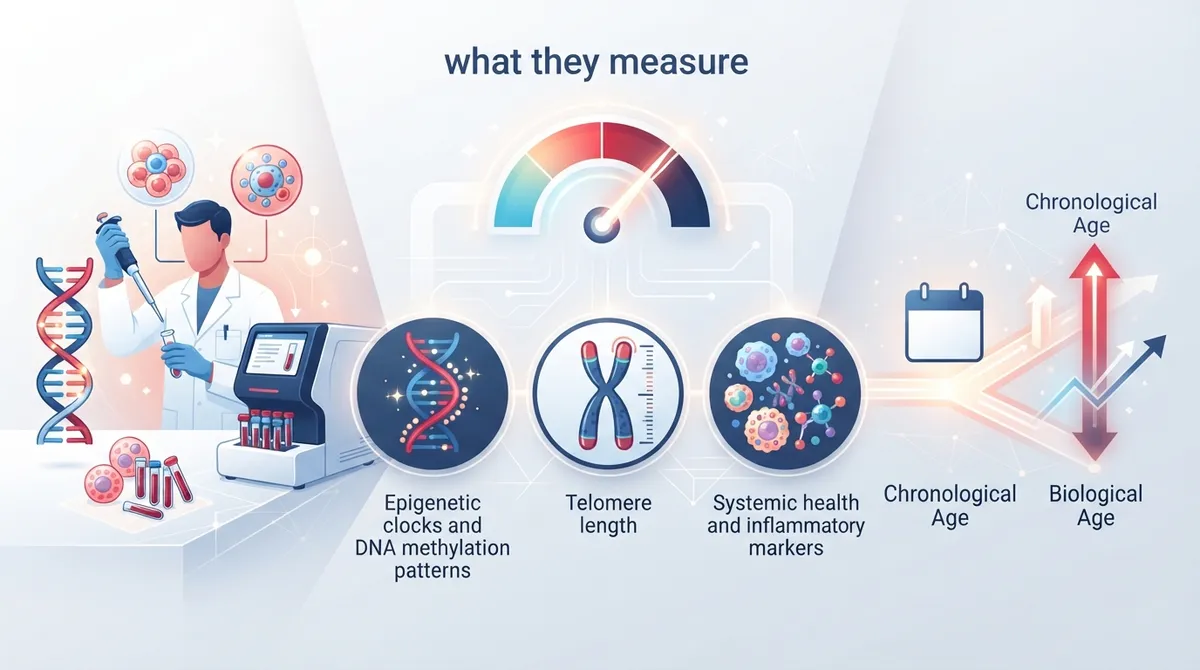
How the Tests Work and What They Measure
4. Blood and Saliva Samples Reflect Sampled Cells
An epigenetic test estimates patterns in the cells that were sampled. A blood-based result does not directly measure the aging of every organ or tissue. Your heart, brain, skin, and liver may each age at a different pace.
So a single score is a snapshot of one sample, not a full map of your body.
5. Not All Clocks Were Built for the Same Purpose
Some clocks were designed mainly to estimate chronological age. Others were trained to link with health outcomes or the pace of aging. This purpose shapes what a score can tell you.
A clock built to guess your birth age will not necessarily say much about disease risk. Always ask which kind of clock a test uses and why.
|
Test Type |
What It Looks At |
Typical Sample |
Key Limit |
|---|---|---|---|
|
Epigenetic clock |
DNA methylation patterns |
Blood or saliva |
Reflects sampled cells, methods vary |
|
Clinical biomarker age |
Lab values and vital signs |
Blood draw and exam |
Depends on which markers are chosen |
|
Research multi-data models |
Molecular, physical, and other data |
Varies |
Mostly used in studies, not routine care |
6. Results Can Vary for Technical Reasons
A score can change based on the algorithm, the sample type, the laboratory methods, and blood-cell composition. Other biological and technical factors also play a role. For example, a recent illness can shift the mix of blood cells in a sample.
This is why one result, or a small change on a repeat test, may not mean your health has truly changed.
What the Science Says and Where It Falls Short
7. Research Links Clocks to Population-Level Outcomes
Studies have linked some aging-clock measures with outcomes such as mortality and age-related disease across large groups. That is a real and interesting finding.
However, a link at the population level does not become a prediction for one person. These associations do not establish a diagnosis, forecast your lifespan, or prove that changing a score will improve your health.
8. Accuracy Has Limits
A 2026 article from Stanford Medicine on biological versus chronological age notes that some epigenetic-clock estimates may carry roughly three years of error. That figure is an estimate discussed in that article, not a rule for every test. Still, it shows why a small gap between your biological and chronological age should be read with caution.
9. There Is No Universal Standard Yet
Current reviews describe a lack of standardized protocols, reference values, and universal cutoffs for routine individual care. There is no consensus clinical protocol. Current evidence does not support using a commercial score alone to diagnose disease or guide treatment.
For deeper reading, a review on integrating biological age, epigenetic clocks, and telomere length explains how researchers are still working to compare these tools.
Using Biological Age Testing in Primary Care
10. It Is Best Seen as Optional and Educational
In primary care and wellness, biological age testing is best framed as an optional educational measure. It can start a useful conversation about sleep, nutrition, exercise, and stress. It should never replace established preventive care.
Standard care still comes first. That includes cancer screening guidelines by age and risk, blood pressure checks, and routine labs. A clinician should read any aging score alongside your symptoms, medical history, validated risk tools, and standard clinical tests.
11. A Clinician Adds Context to the Number
A raw score on a screen can feel alarming or flattering. A trained clinician puts it in context. If a result says you are "older" than your actual age, the next step is not panic. It is a review of the basics:
- Blood pressure, blood sugar, and cholesterol
- Sleep quality and daily activity
- Weight and body composition
- Family history and current medicines
This is where a primary care team adds the most value. If you want a closer look at how tests are selected and read locally, see this guide on how to choose a healthspan testing clinic in Tampa.
12. Lifestyle Habits Still Matter Most
Many people hope a test will show that their habits are working. It is fair to want that feedback, but timing matters. A small change after a few weeks may reflect normal variation rather than real progress, and research has not shown that moving a score improves health on its own.
The habits behind good health are well proven: regular movement, enough sleep, a balanced diet, stress management, and keeping up with checkups. A visit that covers what a wellness checkup in Tampa includes is a strong place to begin. If you are curious how often a repeat test makes sense, this resource on how often you should retest biological age offers helpful pointers.
13. Know What to Ask Before You Test
Before you pay for any biological age test, ask a few plain questions:
- Which method does the test use, and what was it designed to measure?
- What sample is needed, and how is it analyzed?
- How will the result be explained to me, and by whom?
- What will we do with the result, and will it change my care plan?
- How does the provider handle my data and privacy?
Clear answers are a good sign. Vague promises of "reversing your age" are a red flag. The goal is education and better preventive care, not a quick fix. You can also review five questions to ask who provides biological age testing near Riverview before you decide.
Who Might Find Biological Age Testing Useful?
Biological age testing can appeal to many people. Tech-savvy adults who enjoy tracking data may like the added insight. Wellness seekers who already invest in prevention may use it as one more input. Parents juggling busy schedules may want a simple way to start thinking about long-term health. Younger adults curious about their bodies may value the educational angle.
For all of these groups, the same rule applies. Use the result as a conversation starter, not a verdict. If you live near Tampa or Riverview, a primary care visit is the most reliable first step, and you can read more about biological age testing options in Tampa.
Conclusion: Test With Purpose, Not Pressure
Biological age testing offers an interesting look at aging patterns, but it is not a diagnosis, a forecast, or a replacement for routine care. The most useful tests are those explained by a clinician who knows your history. Keep the 13 facts above in mind, and treat any score as one piece of a bigger picture.
InCare combines primary care, preventive screenings, and advanced wellness services under one roof in Tampa and Riverview, so your results are never left without context. See what patients say by visiting us on Google: read InCare reviews on Google. You can also follow our updates on Instagram, Facebook, and TikTok. Ready to talk through your options? Book your visit now or contact our team with questions.
FAQs
Q: What is biological age testing, and how is it different from chronological age?
A: Biological age testing estimates how your body is aging based on markers such as DNA methylation or routine lab values. Chronological age is simply the number of years since birth. The two can differ, but there is no single agreed biological age, and each test gives its own estimate.
Q: Can a biological age test predict how long I will live?
A: No. Research links some aging-clock measures with outcomes like mortality across large groups, but that does not predict one person's lifespan. A score should never be used alone to diagnose disease or guide treatment.
Q: Are biological age tests accurate and clinically validated?
A: Accuracy varies by test, and no universal reference standard or clinical cutoff exists yet. A 2026 Stanford Medicine article notes some epigenetic estimates may have roughly three years of error. Results can also shift with the algorithm, sample type, and laboratory methods.
Q: What should I do if my biological age test says I am older than my actual age?
A: Do not panic, since a single result may not reflect a real change in health. Review the number with a clinician who can check your blood pressure, labs, sleep, activity, and history. Focus on proven habits and routine preventive care.
Q: Should I get a biological age test through my primary care provider?
A: It can be a helpful, optional educational tool when a clinician explains the result alongside your history and standard tests. It should not replace established screenings or preventive visits. A primary care team can help you decide whether testing fits your goals.