
Key Takeaways
- GLP-1 medications for obesity are generally treated as long-term therapy with no fixed end date, and the right duration depends on your response, tolerability, and goals.
- In the STEP 1 extension, semaglutide users regained about 11.6 percentage points of weight within 52 weeks after stopping, roughly two-thirds of their prior loss, so stopping without a plan carries real risk.
- Never stop or change your GLP-1 dose on your own; reasons like side effects, pregnancy planning, cost, or lack of benefit should be discussed with your prescriber first.
- Track weight, waist size, labs, and side effects at each visit so you and your clinician can decide whether to continue, adjust the dose, switch medicines, or plan a gradual transition.
- If you plan to stop, build habits in nutrition, protein intake, and strength training beforehand and schedule closer follow-up in the months after stopping.
- The STEP 1 findings apply to semaglutide in adults without diabetes with lifestyle support withdrawn, so they are a strong signal rather than a personal forecast for your own outcome.
Many people start a GLP-1 medication with one big question: how long do you stay on GLP-1 medications? The honest answer is that it depends on you. There is no single timeline that fits every patient. Still, the research gives us a clear picture. For weight management, these medicines are usually treated as ongoing therapy, not a quick fix.
This matters whether you are a busy parent, a young professional, or someone who wants to get ahead of health risks. You want a plan, not a guess. In this article, we compare two approaches: a short course and long-term therapy. We look at what the evidence shows, what happens when treatment stops, and how a primary care team can guide the decision. We also explain how to plan an exit if you and your clinician decide to stop. Use this as a starting point, then talk with your own prescriber about your goals and health history.
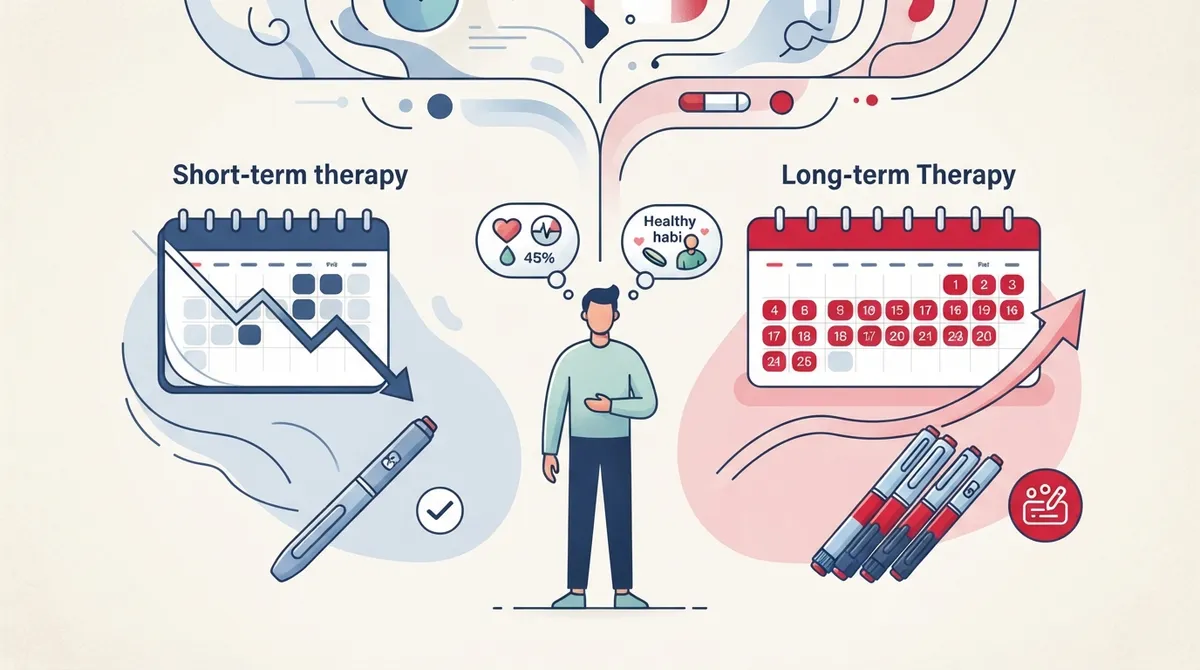
The Short Answer: How Long Do You Stay on GLP-1 Medications?
There is no fixed end date for GLP-1 treatment. For obesity, medicines such as semaglutide are generally considered long-term treatment. They work best alongside nutrition, physical activity, and regular follow-up with a clinician.
The FDA label for Wegovy describes its use to reduce excess body weight and to maintain weight reduction over the long term. That wording signals a maintenance mindset. The label lists adult injectable maintenance doses of 2.4 mg weekly (recommended) or 1.7 mg weekly. The right dose and the length of use depend on the person and the prescriber's judgment.
For type 2 diabetes, the picture is a little different. Duration depends on blood sugar control, other health benefits, how well you tolerate the drug, and your overall plan. A clinician may continue, adjust, or replace the medicine over time. The weight-management and diabetes uses are not interchangeable, and products and doses differ.
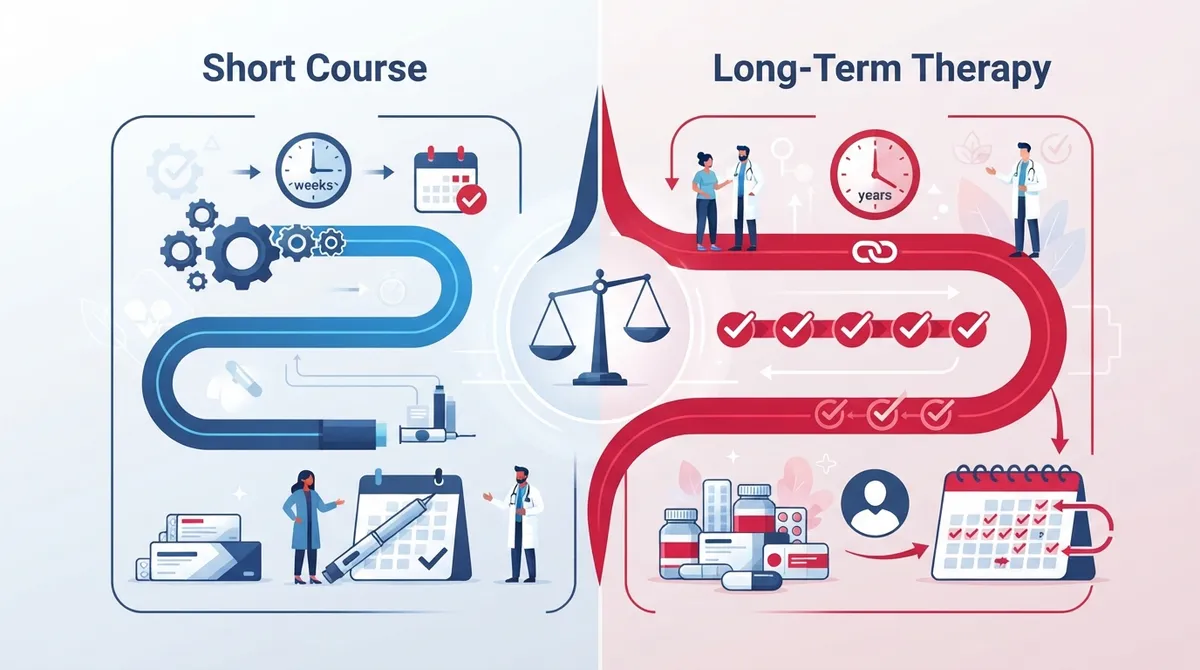
Two Approaches Compared: Short Course vs. Long-Term Therapy
When people ask how long you stay on GLP-1 medications, they often picture one of two paths. One is a time-limited course with a planned stop. The other is ongoing treatment with regular reviews. The table below compares them side by side.
|
Factor |
Short Course Approach |
Long-Term Approach |
|---|---|---|
|
Typical goal |
Jump-start weight loss, then stop |
Lose weight and keep it off |
|
What the evidence suggests |
Substantial weight regain after stopping |
Benefits tend to last while treatment continues |
|
Follow-up needed |
Close monitoring after stopping |
Regular reviews of benefit and side effects |
|
Best fit |
Patients with side effects, pregnancy plans, or access limits |
Patients who respond well and tolerate the drug |
|
Main risk |
Weight regain and drift of health markers |
Ongoing cost, side effects, and long-term commitment |
Neither path is automatically right. The better choice depends on your health, your goals, and your ability to stay on track. A planned conversation with your prescriber is the safest way to decide.
What Happens When You Stop? The STEP 1 Evidence
The strongest data on stopping comes from the STEP 1 trial extension. In STEP 1, 1,961 adults with overweight or obesity, but without diabetes, were randomized to semaglutide 2.4 mg weekly or a placebo. Both groups also received a lifestyle program. Treatment lasted 68 weeks, including 16 weeks of dose escalation.
Researchers then followed a subset of participants for 52 more weeks after treatment and the lifestyle program ended. The results were striking:
- The semaglutide group regained an average of 11.6 percentage points of body weight by week 120.
- The placebo group regained an average of 1.9 percentage points.
- At week 120, the semaglutide group was still 5.6% below its starting weight, compared with 0.1% below baseline in the placebo group.
- Researchers described the regain as about two-thirds of the prior weight loss.
- Some heart and metabolic improvements moved back toward baseline.
These findings were published by Wilding and colleagues in Diabetes, Obesity and Metabolism in 2022. They show why stopping without a plan can be risky for weight and health markers.
What the Study Does Not Tell Us
It is important to read this research carefully. The extension studied adults without diabetes. It also withdrew both the medicine and the structured lifestyle program at the same time. So the results do not predict exactly what will happen to every patient. They also do not prove a single ideal treatment length. They apply to semaglutide in this setting, not necessarily to every GLP-1 medicine or to diabetes care.
Think of the study as a strong signal, not a personal forecast. It tells us that weight management is a long game for many people. It does not tell you your exact path.
Why Obesity Is Treated Like a Chronic Condition
The idea behind long-term therapy is simple. Body weight is influenced by hormones, appetite signals, genetics, sleep, stress, and environment. A medicine that helps quiet appetite does not erase those forces. When the medicine stops, the underlying drivers can return.
This is similar to how we treat high blood pressure or high cholesterol. Doctors do not usually expect those conditions to disappear after a short course. They check in regularly, adjust the plan, and keep what works. Weight management often follows the same logic. If you want to understand the science behind the medicine, our guide on what GLP-1 is, how it works, and who it helps in 2026 is a helpful companion.
Reasons Treatment Might Change or Stop
Staying on a medicine long term is not always possible or wise. Many valid reasons exist for changing course. Common ones include:
- Side effects. Nausea, vomiting, or stomach discomfort can make treatment hard to continue. Our article on how to manage GLP-1 side effects safely in Tampa covers practical steps.
- Not enough benefit. If weight or blood sugar goals are not improving, your clinician may adjust the dose or try a different approach.
- Pregnancy planning. Patients who plan to conceive need to talk with their prescriber well in advance.
- Contraindications. New health conditions or medical history may make a medicine unsafe for you.
- Cost or access. Insurance changes and supply issues can force a change in plans.
- Changing goals. Some people reach a health target and want to shift to a different strategy.
In every case, the key message is the same. Do not stop or change your dose on your own. Work with your prescriber on a plan. If you are curious about what a sudden stop can look like with a related medicine, see our article on whether you can stop tirzepatide abruptly without risk.
How Primary Care Supports Long-Term GLP-1 Treatment
Duration questions are easier to answer when one team sees the whole picture. Primary care follow-up can review your weight or glucose response, side effects, nutrition and activity, other medications, and related health conditions. That regular check-in is what turns a prescription into a real plan.
A primary care clinician can also help you decide when to continue, adjust, or stop. If treatment is discontinued, they can discuss monitoring and other strategies to help protect the progress you made. For a closer look at how this works, read our piece on 14 ways a primary care doctor aids weight loss.
At InCare, our Tampa and Riverview teams combine primary care with weight loss programs, metabolic breath analysis, and body composition tracking. That mix gives you data, not just a number on a scale. It helps your clinician see how your body is responding over time. You can also learn more about how to start GLP-1 therapy under doctor care in Tampa.
A Practical Review Schedule to Discuss With Your Prescriber
Many patients like a simple structure. Your own schedule may differ, but these steps show how a thoughtful review can work:
- Set your goals first. Decide what matters most, such as weight, blood sugar, blood pressure, or energy.
- Track your response. Record weight, waist size, labs, and how you feel. Our guide on how to know when weight loss medication is working explains what to watch.
- Review side effects at each visit. Report anything that affects daily life.
- Check the whole plan. Look at food, movement, sleep, and other medicines together.
- Decide on the next step. Continue, adjust the dose, change the medicine, or plan a gradual transition.
This kind of rhythm keeps treatment purposeful. It also makes it easier to spot problems early.
Planning Ahead if You Want to Stop
If you and your clinician decide to stop, preparation matters. The STEP 1 extension suggests that a plan can make a real difference. Here are ideas to discuss:
- Build strong habits in nutrition, protein intake, and strength training before the change.
- Schedule closer follow-up visits in the months after stopping.
- Monitor weight, blood pressure, and blood sugar so changes are caught early.
- Talk about whether another strategy could support your results.
For more on this topic, our article on why weight returns after stopping tirzepatide and our guide on how you can keep weight off for good give more detail. You may also find semaglutide maintenance therapy useful if you plan to stay the course.
Which Approach Is Right for You?
Here is a simple way to think about it. A long-term approach may fit if you respond well, tolerate the medicine, and want to protect your results. A shorter approach may fit if side effects, pregnancy plans, or cost make ongoing use difficult. Many people land somewhere in between, with a dose or plan that changes over time.
The best decision comes from your own data and your own goals. Younger adults may care about long-term prevention and gene-based insights. Busy families may care most about a plan that fits real life. High-income wellness seekers often want detailed testing and tracking. Whatever your profile, a personalized plan beats a one-size-fits-all rule.
Take the Next Step With InCare
You deserve clear answers about how long you stay on GLP-1 medications and what comes next. InCare offers personalized primary care and medical weight loss support in Tampa and Riverview, plus virtual visits if that works better for your schedule. Our team can review your goals, your health history, and your options, then build a plan that fits you.
Ready to talk it through? Book your visit with InCare or contact our team with questions. You can also see what patients say about us and read InCare reviews on Google. To stay up to date on wellness tips, follow us on Instagram, Facebook, and TikTok.
This article is for general education and is not medical advice. Always talk with your prescriber before you start, change, or stop any medicine.
FAQs
Q: How long do you need to take a GLP-1 medication for weight loss?
A: There is no universal timeline. For obesity, medicines such as semaglutide are generally treated as long-term therapy, paired with nutrition, activity, and regular clinical follow-up. Your prescriber decides how long based on your response, tolerability, and goals.
Q: Will I regain weight after stopping semaglutide?
A: Weight regain is common. In the STEP 1 extension, participants who stopped after 68 weeks regained about two-thirds of their prior weight loss over the next year. Individual results vary, so a clinician-guided plan and follow-up are important.
Q: Can I stop a GLP-1 medication because of side effects or pregnancy planning?
A: Yes, treatment may be changed or stopped for side effects, pregnancy planning, contraindications, cost, or new health goals. Talk with your prescriber first rather than stopping or changing your dose on your own.
Q: Do I have to stay on a GLP-1 medication for life?
A: Not necessarily. Many people use these medicines long term, but the plan is individualized and reviewed regularly. Your clinician can help you decide whether to continue, adjust, or transition to another strategy.
Q: How can a primary care clinician help with GLP-1 treatment and stopping?
A: A primary care clinician can review your weight or glucose response, side effects, nutrition, activity, and other medications. If treatment ends, they can plan monitoring and alternative strategies to help maintain your health outcomes.