
Key Takeaways
- Personalized peptide therapy is a care process, not a proven treatment: a clinician reviews your goals and history, then discusses whether a specific peptide fits your situation.
- Compounded peptides are not FDA-approved, and the FDA has flagged concerns about several popular ingredients including BPC-157, CJC-1295, ipamorelin, MOTS-c, and TB-500.
- Never use peptides labeled for research use only or obtained without a valid prescription, and ask which licensed pharmacy supplies the product and how quality and storage are handled.
- A responsible provider reviews your medical history, medications, and labs, explains the evidence and alternatives, and provides a follow-up and monitoring plan with clear stopping criteria.
If you have searched for personalized peptide therapy in Tampa, you have probably seen bold promises about recovery, energy, and anti-aging. The reality is more nuanced. "Personalized peptide therapy" is not one treatment. It describes a clinician reviewing your goals and health history, then discussing whether a specific peptide medicine makes sense for you.
That distinction matters. Some peptide-based medicines have FDA-approved uses for defined conditions. Many peptides marketed for recovery, longevity, or performance do not. Compounded products are not FDA-approved either, and the evidence behind many popular wellness peptides remains limited.
This guide explains what personalized peptide therapy in Tampa really means, how it differs from approved medicines, what a responsible evaluation looks like, and which questions to ask before you start. At InCare, we believe the best wellness decisions begin with honest information and a licensed clinician who knows your full health picture. You can also see what InCare patients say on Google to learn about our approach to care in Tampa and Riverview.

What Is Personalized Peptide Therapy?
Peptides are short chains of amino acids. Your body makes many of them naturally, and they act as signals that influence hormones, metabolism, and tissue repair. In medicine, peptide-based drugs are used for a range of conditions.
Personalized peptide therapy in Tampa usually refers to a care model with these steps:
- A licensed clinician reviews your goals, symptoms, medications, and medical history.
- Relevant exams or lab tests are considered.
- The clinician discusses whether a peptide medicine or compounded preparation fits your situation.
- You receive counseling on evidence, risks, alternatives, and follow-up monitoring.
The word "personalized" describes the process, not the proof. A customized plan does not mean a peptide is proven, safe, or appropriate. Your clinician must explain the exact substance, the intended use, and what the science actually shows.
Peptides Are Not One Uniform Treatment
Peptides vary widely in purpose, regulation, and evidence. Some are established medicines. Others are experimental or sold for uses that regulators have not reviewed. Lumping them together leads to confusion, so always ask which peptide is being proposed and why.
For a plain-language primer, see How to Understand Peptides Explained by Your Doctor.
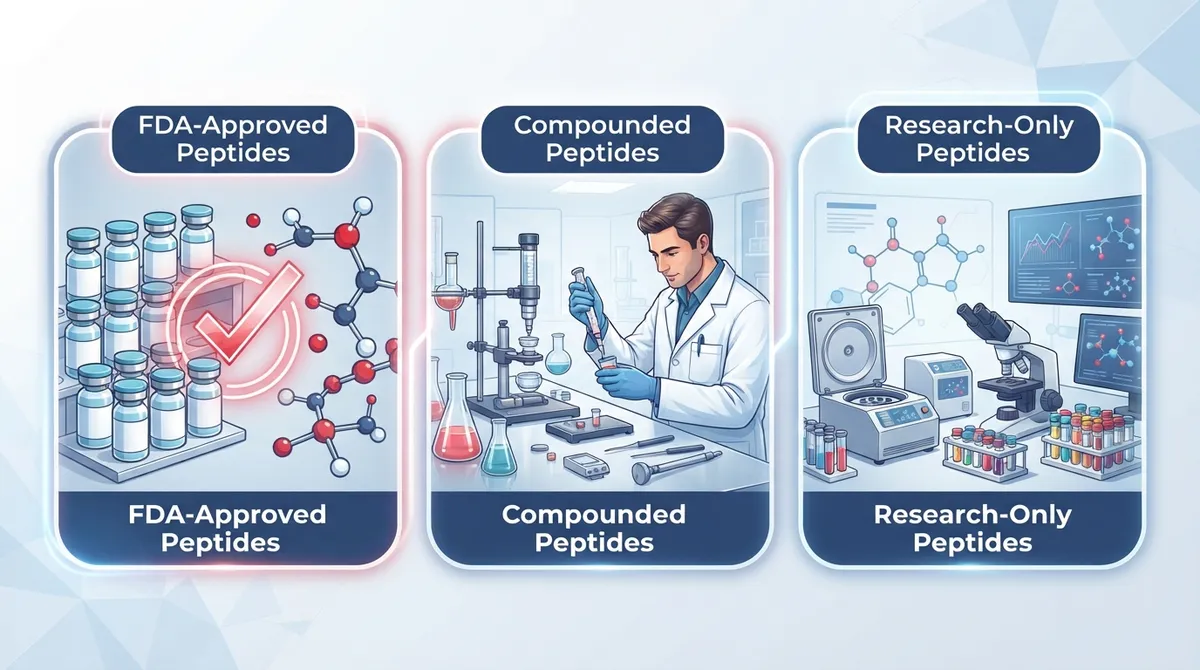
FDA-Approved vs. Compounded vs. Research-Only Peptides
The regulatory status of a peptide shapes how much you can trust its safety and quality. This is the single most important concept for anyone considering peptide therapy in Tampa.
|
Category |
What It Means |
What to Consider |
|---|---|---|
|
FDA-approved peptide medicines |
Reviewed by the FDA for specific conditions, such as certain GLP-1 medicines |
Strongest evidence base for the approved use; label guidance applies |
|
Compounded peptide preparations |
Prepared by a pharmacy for an individual patient; not FDA-approved |
FDA does not generally review each product for safety, effectiveness, or quality |
|
Research-use-only products |
Labeled for laboratory use, not human treatment |
Avoid; quality and purity are not assured for human use |
Compounding may address a documented individual medical need. It is not a blanket substitute for an FDA-approved medicine when an approved option is appropriate. To compare the two paths in more depth, read FDA-Approved vs. Compounded Peptides: Which Is Safer?
What the Evidence Says About Popular Wellness Peptides
Evidence varies enormously by peptide and by intended use. For many peptides promoted for tissue repair, longevity, or performance, the research is largely preclinical or based on limited human data. Marketing claims should never be treated as established clinical benefits without strong human trials.
The FDA has flagged potential concerns for several compounded peptide ingredients, including BPC-157, CJC-1295, ipamorelin acetate, MOTS-c, and TB-500. Cited concerns include limited human safety information, peptide-related impurities or aggregation, and the possibility of immune reactions. Regulatory status can change, so always verify current FDA guidance before starting any treatment.
There are also no reliable Tampa-specific statistics on how common personalized peptide therapy is or how well it works. Be cautious of any clinic that quotes precise success percentages without a peptide-specific, indication-specific clinical source.
If you want to look at individual peptides, these resources break down the science:
- 5 Facts About MOTS-c Function Every Patient Should Know
- 4 Facts on BPC-157 FDA Approval Status in 2026
- 9 Facts on Ipamorelin FDA Approval Status in 2026
- What Do CJC-1295 Human Studies Actually Show?
What a Responsible Peptide Consultation in Tampa Looks Like
A trustworthy evaluation feels like good primary care. It is thorough, unhurried, and honest about uncertainty. Here is what to expect.
A Full Review of Your Health
Your clinician should review your medical history, current medications, supplements, and goals. Relevant physical exams and lab work should be considered before any treatment is proposed. Peptides can interact with other medications and may not be suitable for people with certain conditions.
A Candid Discussion of Evidence and Alternatives
You should hear what is known and what is not. A good clinician explains whether the proposed use is FDA-approved or compounded, what the human evidence shows, and whether proven alternatives exist. For some goals, such as weight management, approved options with stronger evidence may be a better starting point. See How to Evaluate Peptide Therapy for Wellness Safely for a deeper framework.
A Monitoring and Follow-Up Plan
Any treatment plan should include scheduled follow-up, clear stopping criteria, and guidance on symptoms that need prompt medical attention. For example, growth-hormone-related peptides call for careful oversight, as covered in What Monitoring Is Needed With Growth Hormone Peptides?
Questions to Ask Any Tampa Peptide Provider
Use this checklist to protect yourself. A reputable provider will welcome these questions and answer them clearly.
- What exact peptide and formulation are you proposing?
- Is the intended use FDA-approved, or is this a compounded preparation?
- Which licensed pharmacy supplies the product?
- How are product quality, purity, and storage addressed?
- What human clinical evidence supports this use for someone like me?
- What monitoring is planned, and when would we stop treatment?
- What side effects or symptoms should prompt me to call right away?
Avoid any product labeled for research use only, and never accept peptides obtained without a valid clinical prescription. For a longer list, review 15 Questions to Ask a Peptide Therapy Clinic in Tampa and 9 Things to Know Before Choosing a Peptide Specialist in Tampa.
Possible Risks and Side Effects
Every treatment carries risk, and peptides are no exception. Because many compounded peptides have limited human safety data, the full risk picture may be unclear. Potential concerns include:
- Injection-site reactions such as redness, swelling, or pain
- Allergic or immune reactions to the peptide or its impurities
- Effects from contaminated or poorly stored products
- Interactions with prescription medicines
- Unknown long-term effects when human data are lacking
These risks are one reason medical supervision matters. If you are weighing a specific product, the guide Are Peptide Injections in Tampa Safe or Risky? offers helpful context.
How Peptide Therapy Fits Into Whole-Person Primary Care
Peptides, if used at all, work best as one piece of a bigger plan. Sleep, nutrition, exercise, stress, chronic conditions, and hormone balance often explain symptoms that people hope a peptide will fix. A primary care approach looks at these foundations first.
That is how InCare approaches wellness in Tampa and Riverview. Our clinic combines primary care, preventive screening, weight management, DNA gene testing, metabolic breath analysis, body composition analysis, and IV hydration so that decisions rest on measurable data rather than trends. When a patient asks about peptides, we start with a conversation about goals, evidence, and safety.
If cost is part of your decision, our guide on What Does Monthly Peptide Therapy Cost in Tampa? can help you plan. For related approved options, see What Is GLP-1? How It Works and Who It Helps in 2026.
Who May Want to Explore Peptide Therapy Conversations
Different people come to this topic for different reasons. Understanding your own motivation helps you ask better questions.
- Tech-savvy and wellness-focused adults often want data-driven optimization and should insist on evidence, not hype.
- Busy families and professionals may want efficient care and should prioritize a clinic that coordinates follow-up.
- Younger adults exploring prevention are often better served by foundational screening and lifestyle care before considering peptides.
- Women focused on preventive health may benefit most from a comprehensive wellness visit that addresses hormones, screening, and overall risk.
In every case, a licensed clinician should guide the decision. Self-directed purchasing from unverified sources is the riskiest path.
Warning Signs of an Unreliable Provider
Not every clinic meets the standard you deserve. Be cautious if you notice any of these red flags:
- Guaranteed results or precise success percentages without clinical sources
- No review of your medical history, medications, or labs
- Reluctance to name the exact peptide or pharmacy
- Products labeled for research use or sold without a prescription
- Pressure to buy multi-month packages before an evaluation
- No plan for monitoring or follow-up
Spotting these early can save you money and protect your health. For more, read 8 Peptide Clinic Tampa Mistakes That Put Your Health at Risk.
Take the Next Step With Confidence
Personalized peptide therapy in Tampa can be a legitimate topic of conversation with a qualified clinician, but it is not a magic fix. The most important steps are understanding what each peptide is, knowing its regulatory status, and working with a provider who explains risks as openly as potential benefits.
You can follow our health updates on Instagram, Facebook, and TikTok. When you are ready for a thoughtful, evidence-first conversation, InCare is here to help. Book your visit with InCare today, or contact our team with questions about care in Tampa or Riverview.
FAQs
Q: What is personalized peptide therapy, and how does it work?
A: Personalized peptide therapy describes a clinician reviewing your goals and health history, then discussing whether a specific peptide medicine or compounded preparation fits your situation. It is not a single standardized treatment, so the exact peptide, indication, and evidence matter.
Q: Are compounded peptides FDA-approved or proven safe and effective?
A: No. Compounded drugs are not FDA-approved, and the FDA generally does not review each compounded product for safety, effectiveness, or quality before it is marketed. Compounding may address a documented individual need, but it does not replace an appropriate FDA-approved medicine.
Q: What evidence supports BPC-157, CJC-1295, ipamorelin, or TB-500?
A: For many wellness peptides, evidence is largely preclinical or based on limited human data. The FDA has identified potential concerns for these ingredients, including limited human safety information and possible immune reactions, so discuss the current evidence with a licensed clinician.
Q: What should I expect during a peptide therapy consultation in Tampa?
A: A responsible consultation includes a review of your medical history, medications, and goals, plus relevant exams or labs. You should also receive a clear explanation of evidence, alternatives, risks, pharmacy sourcing, and a follow-up monitoring plan.
Q: What questions should I ask a Tampa peptide provider about product quality?
A: Ask which exact peptide and formulation is proposed, whether the use is FDA-approved or compounded, and which licensed pharmacy supplies it. Also ask how quality and storage are handled, and avoid any product labeled for research use or sold without a valid prescription.