Key Takeaways
- Safety depends on the specific peptide, its indication, route, source, and monitoring, not on the word 'peptide,' which is a marketing term rather than a single treatment.
- FDA-approved peptide drugs have been reviewed for safety and effectiveness for defined uses, while compounded peptides have not been FDA-reviewed for safety, effectiveness, or quality before marketing.
- A prescription and a licensed pharmacy do not make a compounded peptide FDA-approved, and an HHS enforcement-discretion policy does not establish safety or effectiveness.
- Avoid 'research use only' peptide products entirely; they often lack prescriptions, traceable sourcing, and pharmacy oversight, so vial contents, sterility, and dose cannot be confirmed.
- Before starting, ask the clinic for the exact drug and dose, the medical reason, FDA status, the dispensing pharmacy, and the follow-up plan, and verify the clinician's license via the Florida Department of Health.
- Vague blends, guaranteed results, treatment started at the first visit without labs, and no discussion of risks are warning signs of an unsafe clinic.
Search for safe peptide therapy in Tampa and you will find a wide range of claims. Some clinics promise faster recovery, better sleep, and younger skin. Others sell injectable products with little medical oversight. For patients, the key question is not whether peptides are safe as a group. The real question is which peptide, for which condition, prescribed by whom, and made by which pharmacy.
"Peptide therapy" is a marketing term, not a single treatment. Peptides are short chains of amino acids, and different peptide medicines have very different evidence, risks, and legal status. Some are FDA-approved for defined uses. Many others promoted for "optimization" are unapproved or compounded.
This guide compares the two main categories side by side so you can judge safe peptide therapy in Tampa with confidence. It covers what the FDA says, which warning signs matter, and what a responsible clinic should explain before you start. It is educational and does not replace advice from your own clinician.
What Does Safe Peptide Therapy in Tampa Actually Mean?
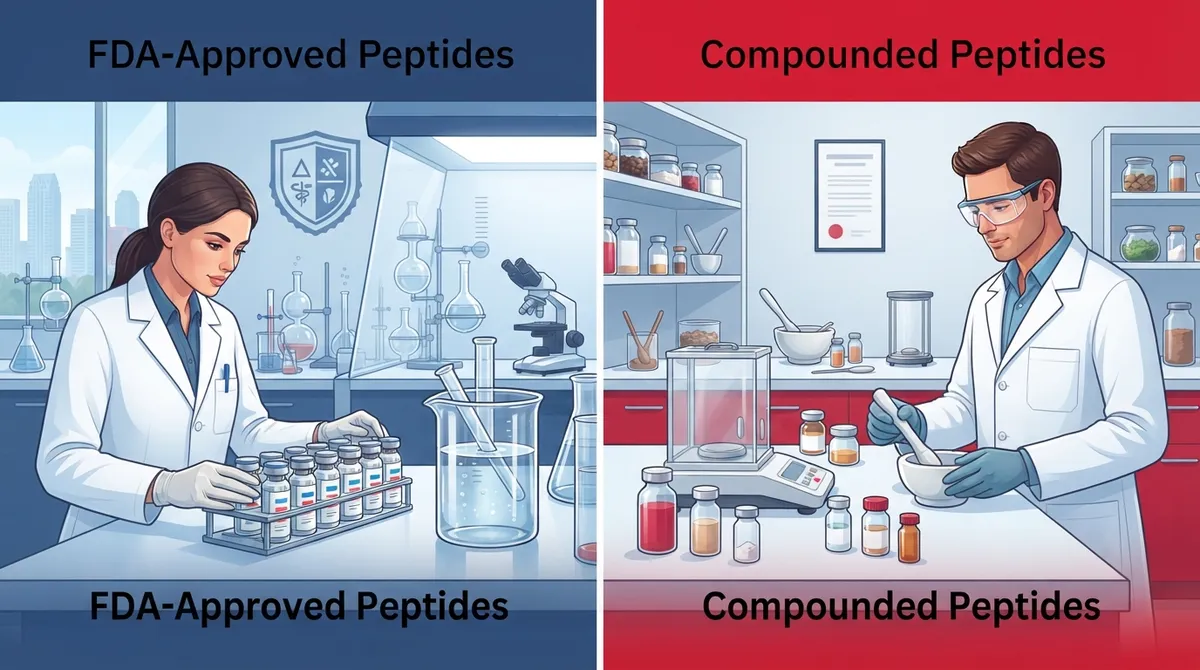
Safe peptide therapy in Tampa starts with transparency. A safe program names the exact drug, states the medical reason for using it, and explains what is known and unknown about its risks. It also uses a licensed clinician, a licensed pharmacy, and a plan for follow-up.
Safety is not a feature of the word "peptide." It depends on five things:
- The substance: Each peptide has its own evidence and side effect profile.
- The indication: A peptide may be reasonable for one condition and unproven for another.
- The route: Injection, nasal, and intravenous use carry different risks.
- The source: Pharmacy oversight, sourcing, and testing affect product quality.
- The monitoring: Labs, symptom checks, and follow-up visits catch problems early.
If a clinic cannot answer questions about all five, treat that as a warning sign. You can also review our guide on how to evaluate peptide therapy for wellness safely for more detail.
FDA-Approved vs. Compounded Peptides at a Glance
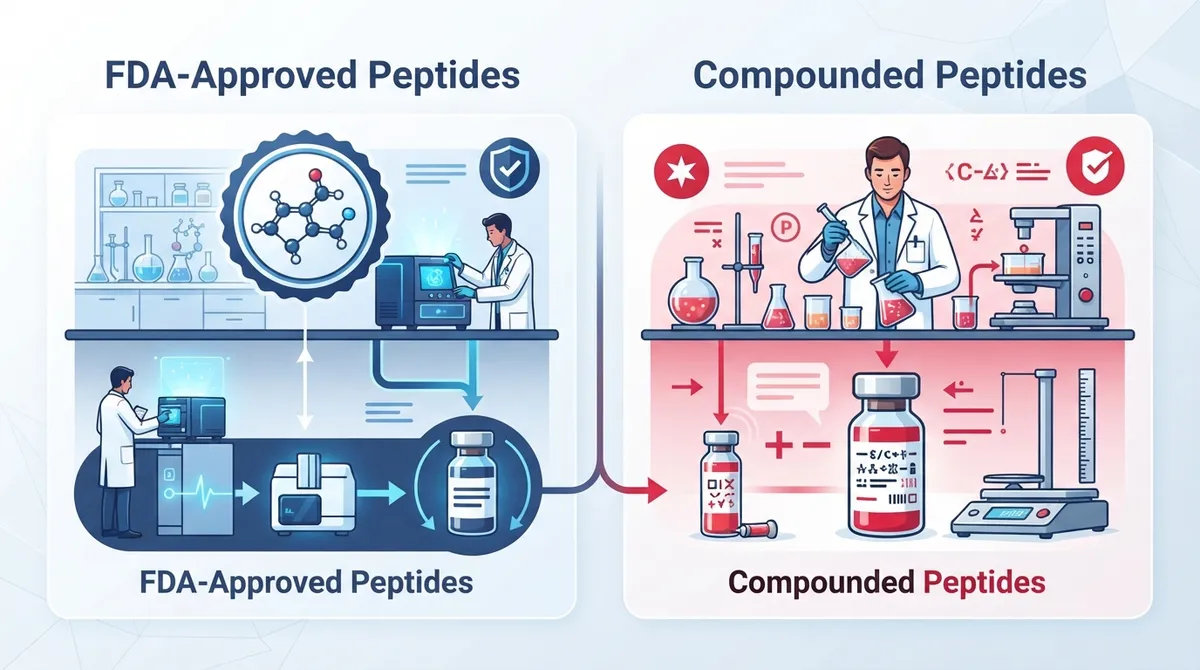
The biggest safety divide is regulatory. Some peptide-based medicines went through FDA review for specific uses. Compounded peptides did not. The table below shows the practical difference.
|
Factor |
FDA-Approved Peptide Drugs |
Compounded Peptides |
|---|---|---|
|
FDA review before marketing |
Yes, for safety and effectiveness in a defined use |
No, not reviewed for safety, effectiveness, or quality before marketing |
|
Evidence base |
Clinical trials for the labeled indication |
Varies widely; often limited human data |
|
Manufacturing oversight |
FDA-regulated manufacturing standards |
Depends on the pharmacy; quality can vary |
|
Labeled uses |
Specific, defined conditions |
No FDA-labeled uses |
|
Typical monitoring |
Established in prescribing information |
Set by the clinician; needs extra care |
|
Best fit |
Conditions the drug is approved to treat |
Patient-specific needs when no approved option fits |
The FDA states that compounded drugs are not FDA-approved. Compounding can be appropriate for certain patient-specific medical needs. But it is not a substitute for evidence of benefit. A prescription and a licensed pharmacy do not make a compounded product FDA-approved.
Why FDA-Approved Peptide Drugs Offer a Clearer Safety Picture
When a peptide medicine is FDA-approved, the agency has reviewed data for a specific use. Doctors know the studied doses, common side effects, and who should avoid it. That gives patients a clearer map of risks and benefits.
Approval has limits, though. Approval of one peptide drug does not show that other peptides are safe or effective. It also does not validate a clinic's broader "optimization" program. A patient should still ask why a drug is being recommended and whether it fits their health history.
Many peptide-related medicines are used in primary care. Some support weight management and blood sugar control. If you are exploring that area, our comparison of tirzepatide and semaglutide explains how approved options differ.
Why Compounded Peptides Need Extra Scrutiny
Compounded products are made by a pharmacy for a specific patient. This can be valuable when a patient cannot use a commercial product, for example because of an allergy to an inactive ingredient. But many peptides promoted for recovery, anti-aging, or performance are not approved for those goals. Their safety data in humans is often thin.
The FDA has raised concerns about certain peptides in compounding. These concerns are specific to each substance and route, so they should not be applied to every peptide:
- BPC-157: The FDA has noted limited human safety data and potential impurity or immune reaction risks. A 2026 FDA briefing document said the available evidence and safety information weighed against adding BPC-157 free base and BPC-157 acetate to the 503A bulk drug substances list.
- CJC-1295: Serious adverse event concerns have been reported.
- Ipamorelin: Serious adverse event concerns have been reported with intravenous use.
To dig deeper into each, see our articles on BPC-157 FDA approval status, CJC-1295 safety, and ipamorelin FDA approval status.
A 2026 Federal Register notice described an HHS enforcement-discretion policy for certain peptide compounding. It explicitly did not confer FDA approval or establish safety and effectiveness. In plain terms, a product being allowed to exist is not the same as being proven safe.
The Biggest Red Flag: Research-Use-Only Products
Some websites sell peptides labeled "research use only" or "not for human consumption." Buyers inject them anyway. This is not a safe alternative to clinician-directed care.
These products often come without a valid prescription, traceable sourcing, or pharmacy oversight. You cannot confirm what is in the vial, how it was stored, or whether it is sterile. Self-injection raises the risk of infection, wrong dosing, and unknown contaminants.
Common mistakes are covered in our guide to BPC-157 buying mistakes. The safest rule is simple: if a product does not come through a licensed clinician and a licensed pharmacy, do not inject it.
How to Vet a Tampa Peptide Provider: A Step-by-Step Checklist
Use these steps before you agree to any peptide treatment in the Tampa Bay area.
- Ask for the exact drug name. A vague answer like "our healing blend" is not enough. You should know the specific substance and dose.
- Ask about the indication. Why this peptide, for your condition, and what is the evidence?
- Confirm FDA status. Ask whether the product is FDA-approved, compounded, or investigational for your use.
- Verify the clinician's license. Florida patients can check a provider's license through the Florida Department of Health.
- Ask which pharmacy dispenses the product. Confirm it is state-licensed and ask how products are sourced and tested.
- Review your history and alternatives. A good clinician reviews medications, conditions, and other treatment paths first.
- Discuss risks and unknowns openly. You should hear about adverse effects and what remains uncertain.
- Plan follow-up and monitoring. Know whom to contact about side effects and when you will be rechecked.
For a longer list of questions, read 15 questions to ask a peptide therapy clinic in Tampa. You can also compare common mistakes in 8 peptide clinic mistakes that put your health at risk.
Signs of a Safer Clinic vs. Signs to Walk Away
|
Safer Clinic Behavior |
Warning Sign |
|---|---|
|
Names the exact drug and dose |
Uses vague blends or secret formulas |
|
Explains FDA-approved vs. compounded status |
Implies all peptides are "FDA-cleared" or proven |
|
Reviews labs, history, and medications first |
Starts treatment at the first visit with no workup |
|
Uses a licensed, state-regulated pharmacy |
Cannot say where the product comes from |
|
Discusses risks and unknowns plainly |
Promises guaranteed results or dramatic claims |
|
Schedules follow-up and monitoring |
Sells products to self-inject without oversight |
What the Evidence Can and Cannot Tell You
No reliable Tampa-specific statistic on peptide therapy safety or effectiveness was identified in current sources. That matters. Local marketing often implies local proof when none exists. Be cautious when a clinic cites vague success rates without published data.
For athletes and recovery seekers, the gap between hype and evidence is especially wide. Our article on peptides for recovery: what the evidence really shows and peptides for athletes: hype vs. medical reality explain why many claims outpace the research.
Alternatives to Consider Before Starting Peptide Therapy
Many goals people bring to peptide clinics can be met with proven, lower-risk care. Consider these first:
- Poor sleep or low energy: A workup for sleep apnea, thyroid issues, anemia, or vitamin deficiencies often finds treatable causes.
- Weight concerns: Physician-supervised programs using approved medications and lifestyle support have stronger evidence.
- Slow recovery or joint pain: Physical therapy, imaging, and a review of medications may help more than an unproven injection.
- Hormone symptoms: Lab testing can show whether a true deficiency exists before any treatment is chosen.
- Prevention goals: Cancer screenings, DNA gene testing, and metabolic assessments give measurable data to guide care.
A primary care physician can help you sort through these options. Starting with a full evaluation is also the safest way to see whether peptides belong in your plan at all.
Why Start With a Primary Care Clinic Like InCare
Peptide questions are best answered inside a broader care relationship. At InCare, our Tampa and Riverview team combines primary care, urgent care, and advanced wellness services with state-of-the-art technology. We focus on prevention and whole-body optimization, which means we look at your labs, history, medications, and goals before recommending anything.
That approach fits the safety standard in this guide. You get a clinician who can explain evidence, separate approved options from unproven ones, and arrange follow-up. If you want help understanding your choices, you can read about peptide therapy in Riverview or learn how to find safe peptide therapy in Tampa Bay in 2026. Our patients also share their experiences, and you can visit us on Google — InCare to read recent reviews of our Tampa Bay team.
For general background on how federal regulators view compounded drugs, the FDA's human drug compounding resources are a helpful reference. You can verify any Florida clinician's license through the Florida Department of Health. For ongoing wellness updates from our team, follow us on Instagram.
Conclusion: Safety Comes From Questions, Not Labels
The safest path to peptide therapy in Tampa is a careful, clinician-led one. FDA-approved peptide drugs offer the clearest evidence for their labeled uses. Compounded peptides can have a place for patient-specific needs, but they are not FDA-reviewed for safety, effectiveness, or quality. Research-use-only products should be avoided entirely.
Ask for the exact drug, the evidence, the pharmacy, and the follow-up plan. Do not accept vague answers. If you want a trusted team to review your goals and walk you through options, book an appointment with InCare or contact our team with your questions.
FAQs
Q: Is peptide therapy safe in Tampa?
A: Safety depends on the specific peptide, the reason it is used, the route of administration, and the prescribing clinician and pharmacy. Some peptide medicines are FDA-approved for defined uses, while many promoted for optimization are unapproved or compounded. A responsible Tampa clinic will name the exact drug, explain the evidence and risks, and arrange follow-up monitoring.
Q: What is the difference between an FDA-approved peptide drug and a compounded peptide?
A: An FDA-approved peptide drug has been reviewed for safety and effectiveness for a specific use. A compounded peptide is made by a pharmacy for an individual patient and is not reviewed by the FDA for safety, effectiveness, or quality before it is marketed. A prescription and licensed pharmacy do not make a compounded drug FDA-approved.
Q: Are BPC-157, CJC-1295, or ipamorelin safe and effective?
A: The FDA has raised concerns about each, including limited human safety data and possible impurity or immune reaction risks for BPC-157, and serious adverse event concerns for CJC-1295 and intravenous ipamorelin. These concerns are specific to each substance and route. Discuss any of these only with a licensed clinician who can review your history.
Q: How can I check whether a Tampa provider or pharmacy is licensed?
A: Florida patients can verify a clinician's license through the Florida Department of Health. Also ask which pharmacy dispenses your medication, whether it is state-licensed, how products are sourced and tested, and whom to contact about side effects.
Q: What are the risks of buying peptides online?
A: Products sold online as research use only are not intended for human use and often lack a valid prescription, traceable sourcing, and pharmacy oversight. You cannot confirm purity, sterility, or dose, which raises the risk of infection and harmful reactions. Avoid self-injection and use only clinician-directed care.