
Key Takeaways
- Peptide therapy is a broad, non-standardized label, not one treatment, so a product's safety, effectiveness, and FDA status must be verified individually rather than assumed from the term.
- Approved peptide drugs like insulin, semaglutide, and tirzepatide have strong evidence for specific conditions, while popular peptides like BPC-157, TB-500, CJC-1295, and ipamorelin are not FDA-approved.
- Compounded peptide products are not reviewed by the FDA for safety, effectiveness, or quality before sale, and the FDA has reported dosing errors and hospitalizations linked to compounded GLP-1 injections.
- Avoid any peptide sold as 'research use only' for human use, since that label signals the product was never meant for patients.
- Start with your health goal and ask whether an FDA-approved option exists first; treat non-approved peptides as a conversation with a clinician, not a purchase.
- Before starting, ask your doctor for the exact peptide, its regulatory status, human evidence, approved alternatives, risks, drug interactions, and the labs and follow-up that will monitor you.
Peptide therapy is one of the most talked-about topics in wellness today. Clinics, social media, and online stores all promote it. But what is peptide therapy, really? And does it work better than the proven care your primary care doctor already offers?
The honest answer is more complicated than most ads suggest. "Peptide therapy" is not one treatment. It is a broad label for many different products. Some are FDA-approved medicines with strong evidence. Others are unapproved substances with little human research behind them.
This article compares peptide therapy with standard primary care approaches. You will learn what peptides are, which ones are approved, where the risks lie, and how to decide with your doctor. At InCare, we believe informed patients make the best health choices, and that begins with clear facts.
What Is Peptide Therapy?
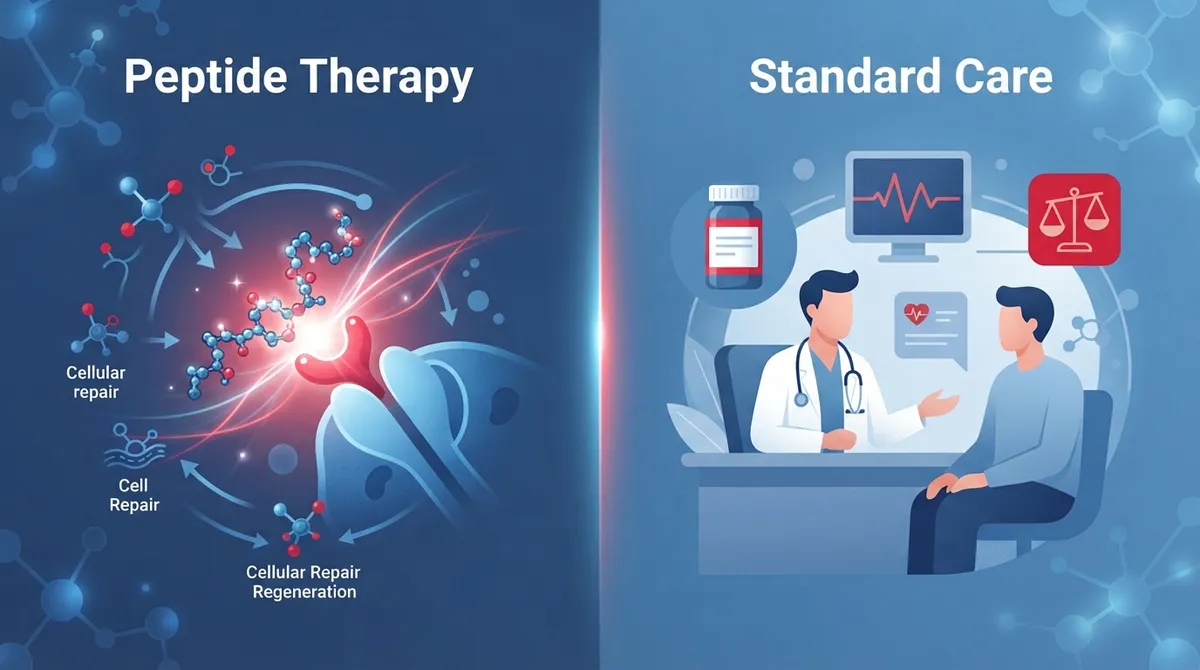
Peptides are short chains of amino acids. Your body makes thousands of them, and they act as signals that guide processes like blood sugar control, appetite, and tissue repair. Peptide therapy is a general term for treatments that use peptide substances to influence those signals.
The term is not standardized. It does not mean one product, one dose, or one level of proof. Because of this, the words "peptide therapy" alone do not tell you whether a product is safe, effective, or approved by the FDA.
A Simple Way to Think About It
Think of peptides as messages. Some messages have been tested for decades and are sold as approved medicines. Others are new, untested, or sold without regulatory review. Your job, with your doctor, is to sort which is which.
Which Peptide Medicines Are FDA-Approved?
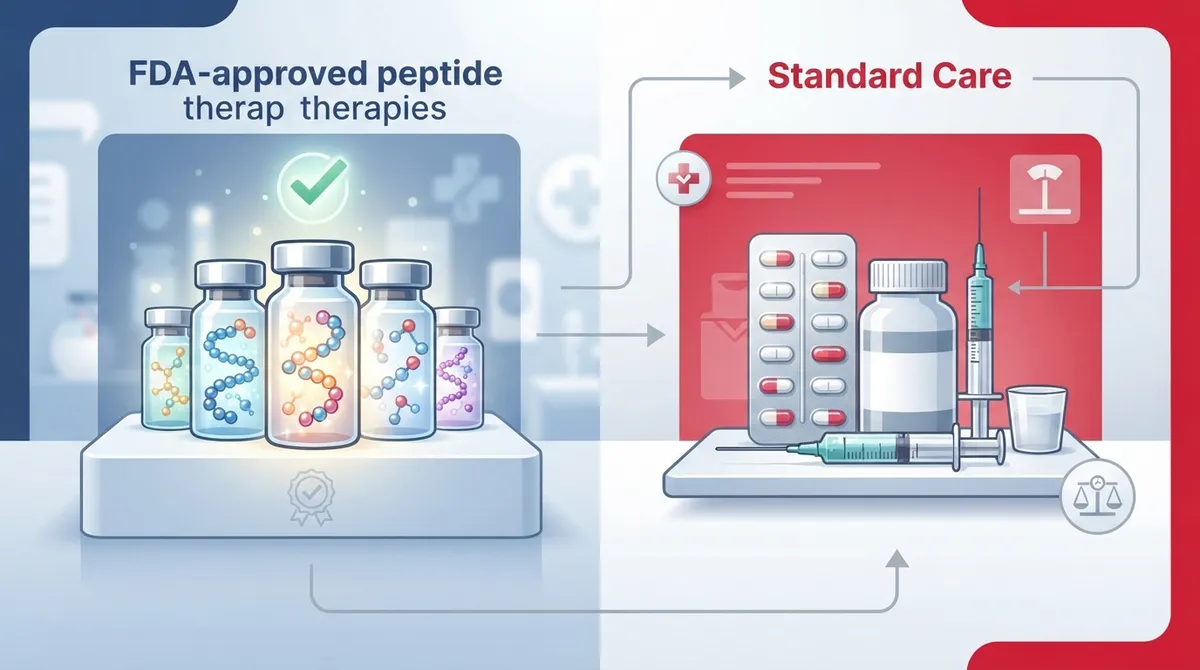
Some peptide-based drugs are approved for specific conditions. Their approval applies to each product and its listed use. It does not cover peptide therapy as a whole category.
- Insulin: An approved peptide hormone used to treat diabetes.
- Semaglutide: An approved GLP-1 medicine for type 2 diabetes and, in certain products, weight management.
- Tirzepatide: An approved medicine for type 2 diabetes and, in certain products, chronic weight management.
If you want to learn how these drugs work, see our guides on semaglutide's mechanism of action and how tirzepatide works inside your body. For a side-by-side look, read Semaglutide vs Tirzepatide: Which Works Better in 2026?
Which Peptides Are Not FDA-Approved?
Many peptides sold by wellness and anti-aging clinics are not FDA-approved medicines. Examples include BPC-157, TB-500, CJC-1295, and ipamorelin. Claims about faster recovery, muscle gain, or anti-aging should not be treated as proven benefits without reliable human evidence.
Regulatory status can shift. In 2026, advisory discussions and policy changes have touched certain peptides. But an advisory recommendation or enforcement-discretion policy is not FDA approval. Always verify current federal and Florida rules before assuming a product is legal or appropriate.
For deeper detail on individual products, review facts on BPC-157 FDA approval status and facts on ipamorelin FDA approval status.
Peptide Therapy vs. Standard Primary Care: A Side-by-Side Look
The table below compares the two approaches on the points that matter most to patients.
|
Factor |
Peptide Therapy (Wellness Setting) |
Standard Primary Care |
|---|---|---|
|
Definition |
Broad, non-standard term covering many products |
Established, guideline-based care |
|
Regulatory status |
Varies; many peptides are not FDA-approved |
Uses FDA-approved drugs and screenings |
|
Evidence base |
Strong for a few approved drugs; limited for many others |
Large clinical trials and national guidelines |
|
Product quality |
Compounded products are not reviewed by the FDA before sale |
Approved products meet FDA manufacturing standards |
|
Monitoring |
Depends on the clinic; can be inconsistent |
Routine labs, vitals, and follow-up |
|
Best for |
Specific approved uses under close supervision |
Prevention, chronic disease, and whole-body health |
The Evidence: What We Know and Do Not Know
There is no reliable single statistic on how well "peptide therapy" works overall. The term covers too many products and uses. Evidence has to be judged one peptide and one condition at a time.
Consider a useful warning from 2026. A systematic review screened 113 studies on IV or intramuscular NAD+ and found no eligible clinical outcome trials showing improved anti-aging, energy, or wellness in humans. NAD+ is not a peptide. Still, it shows why you should separate the ingredient from the marketing. A popular wellness product can still lack human proof.
For a closer look at specific claims, see Peptides for Recovery: What the Evidence Really Shows and What Do CJC-1295 Human Studies Actually Show?
Understanding the Risks
Every treatment has risks. With non-approved peptides, some risks are harder to measure. Patients should ask about each of these points before starting.
- Uncertain dose and purity: Products may not contain what the label says.
- Contamination: Manufacturing problems can affect injectable products.
- Injection-site reactions: Redness, swelling, and pain can occur.
- Unknown adverse effects: Long-term safety data are limited for many peptides.
The FDA has reported dosing errors and hospitalizations linked to compounded GLP-1 injections. It has also noted that salt forms of semaglutide are not the same active ingredient as in approved products. Our article on compounded semaglutide mistakes explains these concerns in more detail.
Compounded vs. FDA-Approved Products
A compounded drug is custom-prepared for a specific patient. It is not FDA-approved. The FDA does not review compounded products for safety, effectiveness, or quality before they are marketed. Compounding does not turn an unapproved drug into an approved one.
Also avoid any peptide sold as "research use only" for human use. Those labels signal that the product was never meant for patients. Read more in FDA-Approved vs. Compounded Peptides: Which Is Safer?
Where Standard Care Wins
For most people, the biggest health gains come from basics done well. These include preventive screenings, blood pressure and blood sugar control, sleep, nutrition, and movement. A strong primary care relationship supports all of them.
Standard care is also built around safety. Your doctor reviews your history, your medicines, and your lab results. That helps catch problems early. If you are starting out, how to get the most from preventive care visits is a useful guide.
Medical Weight Loss as an Example
Weight management shows how the two worlds can meet. Approved GLP-1 medicines can be a real option for the right patient. They work best with nutrition, activity, and follow-up. Learn more in How Does Medically Supervised Weight Loss Work?
Where Peptide Therapy May Fit
Peptide therapy can have a place when the product is approved or well understood, the goal is clear, and a qualified clinician is supervising. It is not a shortcut around diagnosis or basic care.
A responsible clinic will start with a visit, a diagnosis, and labs. It will then discuss approved alternatives before suggesting anything experimental. Our guide on how to evaluate peptide therapy for wellness safely walks through this process.
10 Questions to Ask Before Starting Peptide Therapy
Use this numbered list at your next appointment.
- What is the exact peptide, and what is my diagnosis or goal?
- Is this product FDA-approved for my condition?
- What human evidence supports it, and how strong is it?
- Is there an approved alternative I should try first?
- Where does the product come from, and is it made for human use?
- Is it compounded, and what does that mean for quality checks?
- What are the risks, side effects, and drug interactions?
- Who has a medical reason to avoid it?
- What labs and follow-up visits will monitor me?
- What is the full cost, and when will we decide if it is working?
For a longer checklist, see 15 Questions to Ask a Peptide Therapy Clinic in Tampa and 8 Signs of a Reputable Peptide Clinic in 2026.
How to Decide: A Simple Framework
Start with your goal. Are you managing diabetes, losing weight, recovering from an injury, or looking for general energy? Each goal has proven first steps. Then ask whether an approved option exists. If it does, begin there.
If you are curious about a non-approved peptide, treat it as a conversation, not a purchase. Talk with a doctor who will explain the evidence and the unknowns. Avoid sellers who promise fast results or skip the medical review.
Health decisions are also easier with a trusted team. If you are looking for one, see how to choose the best primary care near you in Tampa. You can also follow practice updates on Instagram, Facebook, and TikTok.
To see what patients say about us, read InCare reviews on Google, where InCare holds a 4.8 rating. Strong care needs a comfortable setting too, and local partners like Marks Air help keep Tampa Bay buildings cool and comfortable. For authoritative background on how the FDA treats compounded drugs, visit the FDA human drug compounding page.
Why InCare Is a Strong Choice in Tampa and Riverview
InCare combines primary care, urgent care, and advanced wellness under one roof. We serve Tampa and Riverview, with virtual visits also available. Our approach is prevention first, built on labs, screenings, DNA testing, metabolic analysis, and weight loss programs.
That foundation matters. Before any peptide discussion, we want to understand your whole health picture. We explain the evidence in plain language, review approved options first, and plan monitoring and follow-up. Learn more in our guide to peptides explained by your doctor.
Conclusion: Evidence First, Then Choices
So, what is peptide therapy? It is a broad label, not a single treatment. Some peptide drugs are approved and well studied. Many others are not. Standard primary care remains the best base for lasting health, and any peptide plan should sit on top of it, not replace it.
Ask hard questions, verify the product, and insist on monitoring. If you want a clear, honest conversation about your options, book your appointment with InCare today. You can also contact our team with questions before your visit.
FAQs
Q: What is peptide therapy in simple terms?
A: Peptide therapy is a broad term for treatments that use peptides, which are short chains of amino acids that act as signals in the body. It is not one standardized treatment. Safety, evidence, and FDA status depend on the specific peptide product and its use.
Q: Are BPC-157, TB-500, CJC-1295, and ipamorelin FDA-approved?
A: No. These peptides are not FDA-approved medicines. Claims about recovery, muscle gain, or anti-aging should not be treated as proven without reliable human evidence, and you should discuss them with a qualified clinician first.
Q: Is compounded peptide therapy safe?
A: Compounded drugs are custom-made and are not reviewed by the FDA for safety, effectiveness, or quality before marketing. Risks include uncertain dosing, purity problems, and contamination. Choose a licensed clinician, confirm the product source, and avoid items labeled research use only.
Q: Which peptide medicines are FDA-approved?
A: Insulin and certain GLP-1 medicines, such as semaglutide and tirzepatide, are FDA-approved peptide-based drugs for specific conditions. Approval applies to each product and indication, not to peptide therapy as a whole category.
Q: What should I ask my doctor before considering peptide therapy?
A: Ask for the exact peptide, your diagnosis and goal, its regulatory status, the evidence in humans, and any approved alternatives. Also ask about the product source, risks, drug interactions, and the monitoring and follow-up plan.