
Key Takeaways
- "Medical grade" is a marketing term, not an FDA-defined category, so the label alone does not show a supplement is safer, more effective, or held to stricter standards.
- Dietary supplements are not FDA-approved before sale; manufacturers are responsible for safety and labeling, so look for voluntary third-party verification such as USP Verified or NSF certification and check the certifier's directory.
- Share every supplement you take with your care team, since supplements can cause side effects and interact with prescription medicines, including blood thinners, diabetes drugs, and blood pressure medications.
- Ask your clinician why a supplement suits you, what evidence supports it, whether lab testing is needed first, and how you will judge whether it works; supplements should never replace prescribed care.
Many Tampa residents hear the phrase "medical grade supplements" and assume it means a safer, stronger, or more tightly regulated product. That assumption deserves a closer look. In the United States, the term is a marketing label, not a category defined by the FDA. A shelf in a physician's office and a shelf in a grocery store both hold dietary supplements, and both fall under the same federal framework.
That does not mean every product is equal. Quality varies widely, and a supplement chosen with clinical guidance can make more sense than one picked from a viral post. This guide explains what medical grade supplements in Tampa really means, how to verify quality, and how a primary care team can help you decide what belongs in your routine. It is written for busy adults, parents, and wellness seekers who want clear, accurate answers in 2026.

What "Medical Grade" Actually Means
The terms "medical-grade," "professional-grade," and "practitioner-grade" are not defined by the FDA. They do not, on their own, show that a product is safer, more effective, or held to stricter federal standards. A clinic may use these words to describe products it selects or sells, but the label alone proves nothing.
The more useful question is simple: what evidence supports this product, and who has verified its quality? When a Tampa practice offers medical grade supplements, you should be able to ask how products are chosen, what testing exists, and why a given ingredient suits your health needs.
For a deeper comparison, see 11 Facts: Are Medical Grade Supplements Better? (2026) and 15 Things to Know About Professional Grade Supplements in Tampa.
How Supplements Are Regulated in the United States
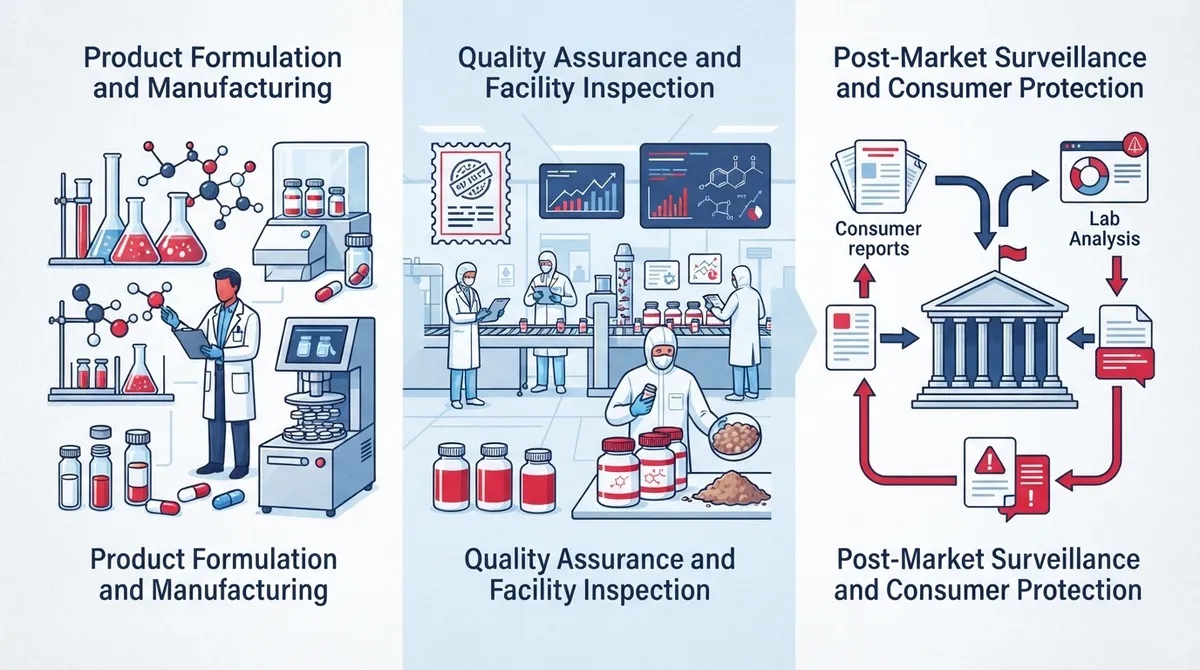
Dietary supplements are regulated as food, not as drugs. The Dietary Supplement Health and Education Act (DSHEA), enacted in 1994, created the current federal framework. Under it, the FDA does not approve supplements for safety or effectiveness before they reach the market.
Manufacturers carry the responsibility for product safety and truthful labeling. The FDA can act against products that are adulterated or misbranded, but it generally does so after a product is already for sale.
Manufacturers must also follow current Good Manufacturing Practice rules in 21 CFR Part 111. These rules cover manufacturing, packaging, labeling, and holding of supplements. They are important, but they do not mean the FDA has tested or approved each individual product.
What This Means for You
- An FDA-registered facility does not equal an FDA-approved product.
- A clinic recommendation does not replace independent quality checks.
- Claims about treating or preventing disease should be supported by real evidence.
How to Choose Medical Grade Supplements in Tampa: Step by Step
Use this process to evaluate any supplement, whether it comes from a clinic, a pharmacy, or an online store.
- Start with a goal and a reason. Know why you want a supplement. A documented deficiency, a dietary gap, or a clinician's recommendation is a stronger starting point than a trend.
- Review your health history. Diet, medications, pregnancy status, planned procedures, and existing conditions all affect what is appropriate.
- Ask whether testing makes sense. Lab work may be useful in some cases to check levels before supplementing. It should guide decisions, not replace them.
- Look for independent verification. Check for programs such as USP Verified or NSF certification, and confirm what the mark actually covers.
- Read the label closely. Look at the ingredient list, amounts per serving, and any added fillers or proprietary blends that hide dose details.
- Check for interactions. Share every supplement you take with your care team, including vitamins, herbs, and over-the-counter products.
- Plan a follow-up. Revisit the plan after a set period to decide whether to continue, adjust, or stop.
Understanding Third-Party Verification
Voluntary third-party programs can help you judge product quality. Depending on the program, they may assess product identity, label accuracy, specified contaminants, manufacturing practices, or whether a tablet dissolves properly.
Certification is voluntary, and its scope varies. A mark on the bottle does not tell the whole story. The best habit is to look up the product in the certifier's own directory and confirm exactly what was tested.
|
Quality Signal |
What It May Show |
What It Does Not Show |
|---|---|---|
|
"Medical grade" label |
Marketing positioning |
FDA approval or stricter standards |
|
cGMP compliance (21 CFR Part 111) |
Manufacturing and labeling practices |
FDA testing of each product |
|
USP Verified or NSF certification |
Identity, label accuracy, and other tested points, depending on program |
That the product works for your condition |
|
Clinician recommendation |
Individualized judgment |
That the ingredient is proven for your goal |
Why Clinical Guidance Matters
Evidence for benefit differs greatly by ingredient and by condition. Some nutrients have strong support when a true deficiency exists. Others have limited or mixed research. A clinic carrying a product does not prove it treats or prevents disease.
This is where a primary care relationship adds value. A clinician can weigh your history, labs, and goals, then tell you when a supplement makes sense and when it does not. A supplement plan should never replace indicated medical care, such as prescribed treatment, screenings, or follow-up for a chronic condition.
If you are weighing specific nutrients, our guides on vitamin D3 and K2 and choosing an integrative supplement doctor in Tampa offer practical next steps.
Safety, Side Effects, and Medication Interactions
Supplements are not automatically harmless. They can cause side effects and can interact with prescription and over-the-counter medicines. The National Center for Complementary and Integrative Health (NCCIH) notes that some supplements may pose risks for people with certain medical conditions or who are preparing for surgery.
Always disclose every supplement to your healthcare team. This matters most if you take blood thinners, diabetes medicines, blood pressure drugs, or hormone therapy, or if you are pregnant or planning a procedure. You can review current federal guidance at NCCIH's guide to using dietary supplements wisely.
Red Flags to Watch For
- Promises to cure or reverse a disease.
- Proprietary blends that hide the amount of each ingredient.
- Pressure to buy large bundles or long subscriptions.
- No way to verify testing or look up a certification.
- Advice to stop prescribed medication in favor of supplements.
What to Ask a Clinician Before You Start
A short list of questions can protect your health and your budget. Bring these to your next visit:
- Why do you recommend this supplement for me specifically?
- What evidence supports it for my goal?
- Has this product been verified by an independent program, and can I check it?
- Could it interact with my medications or conditions?
- Do I need lab testing first, and when should I recheck?
- How long should I take it, and how will we judge whether it works?
Clear answers are a good sign. Vague answers, or reluctance to discuss evidence, are a reason to pause.
Finding the Right Care in Tampa
The right setting makes supplement decisions easier. Look for a practice that treats supplements as one part of whole-person care, alongside preventive screenings, lab work, and chronic condition management. If you are still searching for a clinician, Best Primary Care Doctor in Tampa: How to Choose in 2026 walks through what to look for.
InCare is a personalized primary care and wellness clinic with locations in Tampa and Riverview, Florida. The team combines state-of-the-art technology with medical expertise, offering services that range from primary care and urgent care to cancer screenings, weight loss programs, DNA gene testing, and IV hydration therapy. That mix lets a clinician look at your full health picture before recommending any product, rather than guessing from a label.
Patients can see what others say about their experience by reading InCare reviews on Google, and you can follow wellness updates on Instagram.
Supplements and the Bigger Health Picture
Supplements work best as an addition to the basics, not a shortcut around them. Sleep, nutrition, movement, stress management, and regular preventive care carry far more weight for most people. A well-chosen supplement may help fill a specific gap, but it cannot offset poor sleep or skipped screenings.
For busy families and professionals, a coordinated plan saves time. Reviewing medications, labs, and goals in one visit reduces guesswork and keeps everyone on your care team informed. If sleep is the concern, our article on when to see a doctor for poor sleep is a helpful starting point.
Conclusion
Medical grade supplements in Tampa are not a regulated category, so the label alone should never settle your decision. Focus on what you can verify: a clear reason for taking the product, independent testing where available, a review of your medications, and a plan to reassess. Pair those habits with guidance from a clinician who knows your health history, and you will make smarter, safer choices.
If you want help building a plan around your goals, book an appointment with InCare or contact our team to talk through your questions in Tampa or Riverview.
FAQs
Q: What does medical grade mean for supplements in Tampa?
A: "Medical grade" is a marketing term, not an FDA-defined category. It does not by itself show that a product is safer, more effective, or held to stricter federal standards. Ask a clinic how its products are selected and what independent testing supports them.
Q: Are medical grade or practitioner grade supplements FDA approved?
A: No. The FDA does not approve dietary supplements for safety or effectiveness before they are sold. Manufacturers are responsible for safe products and accurate labeling, and the FDA can act against adulterated or misbranded products.
Q: How can I check whether a supplement is third-party tested?
A: Look for voluntary programs such as USP Verified or NSF certification, then confirm the product in the certifier's online directory. Certification scope varies, so check exactly what the mark covers, such as label accuracy, contaminants, or manufacturing practices.
Q: Can supplements interact with my prescriptions or medical conditions?
A: Yes. Supplements can cause side effects and interact with prescription and over-the-counter medicines, and some may pose risks with certain conditions or surgery. Tell your healthcare team about every supplement you take, and never replace prescribed treatment with a supplement.