
Key Takeaways
- "Peptide specialist" is a marketing phrase, not a formal Florida credential, so verify the underlying license (MD, DO, NP, or PA) through the Florida Department of Health online lookup before booking.
- Ask the provider which exact peptide is proposed, what condition it treats, whether it is FDA-approved or compounded, which licensed pharmacy supplies it, and what evidence supports it.
- FDA-approved peptide drugs are approved only for specific uses; compounded peptides are not reviewed by the FDA for each formulation, and 'research use only' products cannot be verified for human use.
- Red flags include no clinician evaluation before prescribing, guaranteed results, inability to name the pharmacy, and pressure to buy packages upfront.
Search for a peptide specialist in Riverview, and you will find many clinics promising faster recovery, better energy, and easier weight loss. Some claims are reasonable. Others go far beyond the evidence. Before you book, you need clear facts and a plan for checking any provider.
Here is the first fact to know. In Florida, "peptide specialist" is a marketing phrase. It is not a formal medical specialty or a state credential. The title tells you little about training, safety, or the quality of what a clinic sells. What matters is the license behind the name and how carefully the clinician evaluates you.
This guide gives you 15 practical points for 2026. You will learn what peptides are, how approved medicines differ from compounded products, and which questions to ask. You will also learn how to spot red flags. Whether you are a busy parent, a health-focused professional, or new to wellness care, these steps help you decide with confidence.

Understanding the Basics of Peptide Care
1. Peptides Are Short Chains of Amino Acids
Peptides are small molecules made of amino acids, the building blocks of proteins. Your body makes many of them naturally. Some act as hormones or signals that help regulate appetite, blood sugar, and growth.
Because peptides are such a broad category, the word alone says nothing about safety. Some peptide-based drugs have strong evidence behind them. Others have almost none. Always ask which specific peptide is being discussed.
2. "Peptide Specialist" Is Not an Official Title
No Florida board certifies someone as a peptide specialist. A clinic can use the phrase freely. The real credential is the underlying license, such as an MD, DO, nurse practitioner, or physician assistant.
You can verify any license through the Florida Department of Health's online lookup before you book. This takes a few minutes and is the single most useful check you can do.
3. Advertising Does Not Prove Approval or Effectiveness
Several Riverview-area clinics advertise peptide consultations. An advertisement does not show that a treatment is FDA-approved. It also does not show that the treatment works for your goal or fits your health history.
Treat marketing as a starting point for questions, not as evidence.
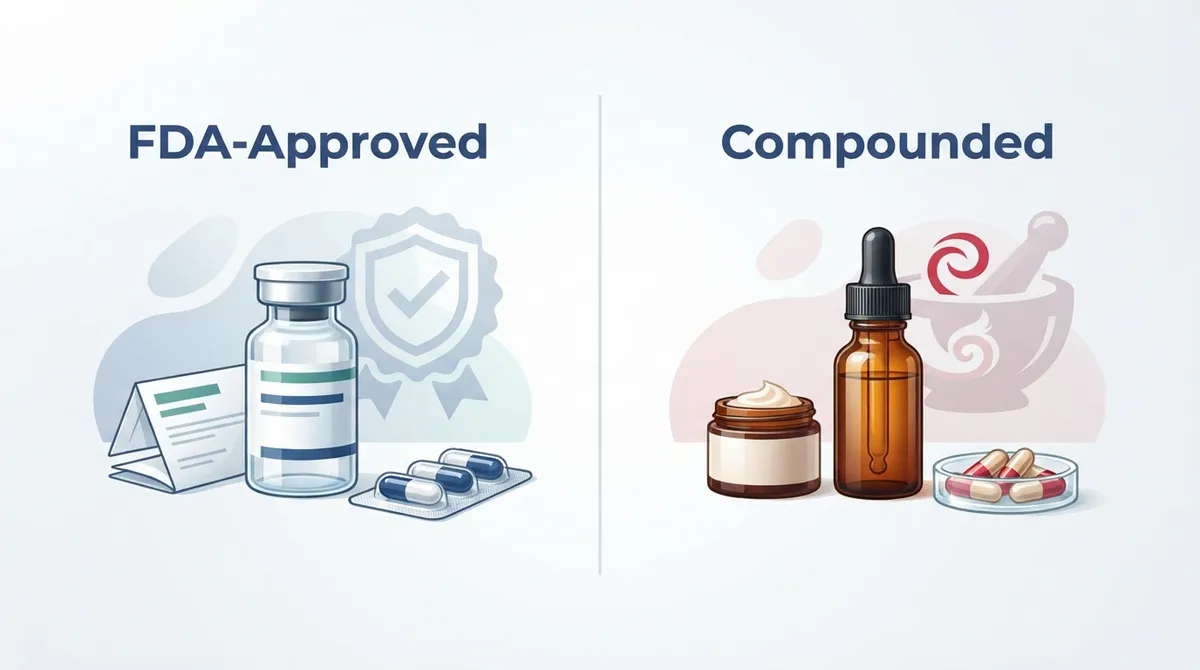
FDA-Approved Versus Compounded Products
4. Some Peptide Medicines Are FDA-Approved
A number of peptide-based drugs have FDA approval for specific conditions. Approval means regulators reviewed safety and effectiveness data for a defined use. That approval applies only to that drug and that purpose.
It does not carry over to other peptides sold for recovery, anti-aging, or general wellness. For a closer look, read our guide on FDA-approved vs. compounded peptides.
5. Compounded Drugs Are Not FDA-Approved Products
Compounded medications are custom-prepared by pharmacies. The FDA does not review each compounded formulation for safety, effectiveness, or manufacturing quality before it is marketed. Compounding is not the same as making an approved drug.
Compounding can be appropriate in some situations. But it means you rely more on the prescriber's judgment and the pharmacy's quality standards.
6. The FDA Has Raised Concerns About Certain Peptides
The FDA has flagged concerns about some compounded peptides. These include limited human safety data, possible immune reactions, impurities, and uncertain product quality.
Products sold online as "research use only" are even harder to verify. They are not intended for human use, and you cannot confirm what is in the vial. Our article on BPC-157 buying mistakes explains these risks in detail.
|
Feature |
FDA-Approved Peptide Medicine |
Compounded or Unapproved Peptide |
|---|---|---|
|
FDA review of safety and effectiveness |
Yes, for a specific use |
No, not for each formulation |
|
Manufacturing oversight |
Standardized and inspected |
Varies by pharmacy |
|
Human trial evidence |
Required for approval |
Often limited or absent |
|
Labeling for intended use |
Defined indications |
Often off-label or unspecified |
|
Verification by patient |
Easier |
Harder |
How to Vet a Provider
7. Verify the License First
Follow these steps before your first visit:
- Get the clinician's full name and listed credentials.
- Search the Florida Department of Health license lookup.
- Confirm the license is active and has no serious disciplinary action.
- Check that the clinician's scope of practice covers the treatment offered.
8. Ask Who Evaluates and Who Prescribes
Some clinics have a sales staff member explain treatments while a clinician only signs off remotely. You deserve a real evaluation. Ask who examines you, who writes the prescription, and who you can call with questions.
A primary care setting often handles this well because your history is already on file. See our guide on questions to ask a peptide therapy clinic for a full checklist.
9. Ask Which Peptide, Which Indication, and Which Pharmacy
A responsible provider can answer these questions plainly:
- Which exact peptide are you recommending?
- What condition or goal is it for?
- Is it FDA-approved for that use, or compounded?
- Which licensed pharmacy supplies it?
- What evidence supports it?
Vague answers are a warning sign. Clear, honest answers, including "the evidence is limited," are a good sign.
10. Expect a Real Medical Evaluation
A good visit reviews your goals, medical history, current medications, and possible contraindications. It should also explain uncertainties and alternatives. If a clinic offers a peptide before asking about your health, be cautious.
Many wellness goals have proven first steps, such as sleep care, nutrition, and strength training. Our post on how to evaluate peptide therapy for wellness safely covers this in more depth.
Matching Peptides to Your Goals
11. Weight Loss Has the Strongest Approved Options
For weight management, certain peptide-based medicines are FDA-approved and have large clinical trials behind them. These are very different from unregulated products sold for fat loss. A medical weight loss program can prescribe approved options when they are appropriate and monitor your progress.
Compare options in tirzepatide vs. semaglutide weight loss, and see how medical weight loss clinics support results.
12. Recovery and Anti-Aging Claims Often Outrun the Evidence
Peptides promoted for tissue repair, joint pain, or longevity often rely on animal studies or small human reports. That does not make them useless, but it does mean you should expect uncertainty. Read about what the evidence really shows on peptides for recovery before you spend money.
13. Costs Vary and Hidden Fees Are Common
Pricing depends on the product, pharmacy, and follow-up schedule. Ask for a full written estimate, including visits and lab work. Our peptide cost guide helps you set a realistic budget.
Safety and Follow-Up
14. Know the Risks and Side Effects
Peptide injections can cause injection-site reactions, nausea, headaches, or allergic responses. Impure or mislabeled products add further risk. Tell your clinician about every medication and supplement you take, since interactions are possible.
Seek care right away for swelling of the face or throat, trouble breathing, or severe pain. Our review of peptide injection safety explains what to watch for.
15. Insist on Monitoring and a Follow-Up Plan
Good care does not end with a prescription. Ask how outcomes will be measured, which labs will be repeated, and when you will be reassessed. Some peptides require specific checks. For example, see what monitoring is needed with growth hormone peptides.
A plan for stopping treatment if it is not working is just as important as a plan for starting it.
|
Red Flag |
Why It Matters |
|---|---|
|
No clinician visit before prescribing |
Skips safety screening |
|
"Research use only" products offered for people |
Not intended or verified for human use |
|
Guaranteed results |
No honest provider can promise outcomes |
|
Cannot name the pharmacy |
Quality cannot be checked |
|
Pressure to buy packages upfront |
Prioritizes sales over care |
Why a Primary Care Approach Helps
A peptide specialist in Riverview works best when peptides are part of a broader care plan, not the whole plan. At InCare, our clinicians look at your full health picture first. That includes preventive screenings, lab work, weight management, and chronic condition care. We discuss peptide options only when the evidence and your history support them, and we are open about what is proven and what is not.
This approach suits busy families, professionals, and anyone who wants proactive care without hype. Our Riverview team can also coordinate with your other health needs, from choosing a peptide health clinic in Riverview to everyday primary care. You can also see what patients say on Google by visiting our InCare location on Google, and follow updates on Instagram.
Conclusion
Choosing a peptide specialist in Riverview comes down to verification, transparency, and follow-up. Check the license. Ask which peptide, for what purpose, and from which pharmacy. Separate FDA-approved medicines from compounded or unapproved products. Expect a real evaluation and a monitoring plan.
If you want a clear, evidence-based conversation, our team is ready to help. Book your appointment with InCare today, or contact us with questions before your visit.
FAQs
Q: What does a peptide specialist do in Riverview?
A: The term usually describes a licensed clinician or clinic that offers consultations about peptide-based treatments. It is not a formal medical specialty or Florida credential. Always verify the clinician's underlying license and scope of practice.
Q: Is peptide therapy FDA-approved?
A: Some peptide-based medicines are FDA-approved for specific conditions, but that approval does not extend to every peptide. Many peptides marketed for wellness, recovery, or anti-aging are compounded or unapproved. Ask your clinician whether the exact product is approved for your intended use.
Q: How do I verify a peptide provider's license in Florida?
A: Use the Florida Department of Health's online license lookup to search the clinician's name. Confirm the license is active, check for disciplinary history, and make sure the treatment fits their scope of practice.
Q: What should I ask before starting peptide therapy?
A: Ask which specific peptide is proposed, what it is for, and whether it is FDA-approved or compounded. Also ask which licensed pharmacy supplies it, what evidence supports it, and how side effects and results will be monitored.
Q: Are compounded peptides safe?
A: Safety varies. The FDA does not review each compounded formulation for effectiveness or manufacturing quality, and it has raised concerns about impurities and limited human data for some peptides. Working with a licensed clinician and a reputable pharmacy lowers risk but does not remove it.