Key Takeaways
- Semax is a synthetic seven-amino-acid peptide derived from ACTH. It is approved as a prescription neurological medicine in Russia but is not FDA-approved in the United States.
- FDA reviewers found evidence insufficient to support Semax's effectiveness for cerebral ischemia, migraine, or trigeminal neuralgia, citing small samples and missing clinical endpoints.
- A July 2026 FDA advisory committee vote to add Semax to the 503A Bulks List is only a recommendation, not an approval, and does not prove effectiveness or product quality.
- Online 'research use only' Semax products may vary in dose, purity, and sterility, and the FDA has flagged immune reactions linked to peptide aggregation or impurities as a safety concern.
- Before considering any unapproved peptide, verify its regulatory status, look for independently replicated human studies, confirm the source is a licensed pharmacy with third-party testing, and review your medications with a clinician.
- Brain fog, poor sleep, and stress often have treatable causes such as thyroid problems, vitamin deficiencies, sleep apnea, or medication side effects, so a primary care evaluation is the safest first step.
You may have seen Semax promoted online as a "brain booster" or a recovery aid. Social media, wellness forums, and online sellers often describe it with bold claims. For anyone trying to separate fact from marketing in 2026, a simple question comes first: what is Semax, and does the evidence support the hype?
This guide gives a clear, careful answer. It explains what Semax is, where it is approved, what the research shows, and what safety questions remain. It also gives you a step-by-step way to evaluate any unapproved peptide before you try it. The goal is not to sell you a product. The goal is to help you make a safe, informed choice with a qualified clinician by your side.

What Is Semax?
Semax, also written as ACTH(4–7)PGP, is a synthetic peptide made of seven amino acids. It is built from a small fragment of adrenocorticotropic hormone (ACTH), a hormone the body makes. Researchers designed it so that it keeps some brain-related activity of that fragment without the hormone effects of full ACTH.
Semax has been studied mainly as an intranasal medicine, meaning it is delivered through the nose. In research settings, it has been described as a neuroactive or neuroprotective agent. That label simply reflects what scientists have studied. It does not prove that Semax works as a treatment for the average person.
Quick Answer for Featured Snippets
Semax is a synthetic seven-amino-acid peptide derived from a fragment of ACTH. It is used as a prescription neurological medicine in Russia, mostly as a nasal spray. It is not approved by the U.S. Food and Drug Administration (FDA), and human evidence outside Russia is limited.
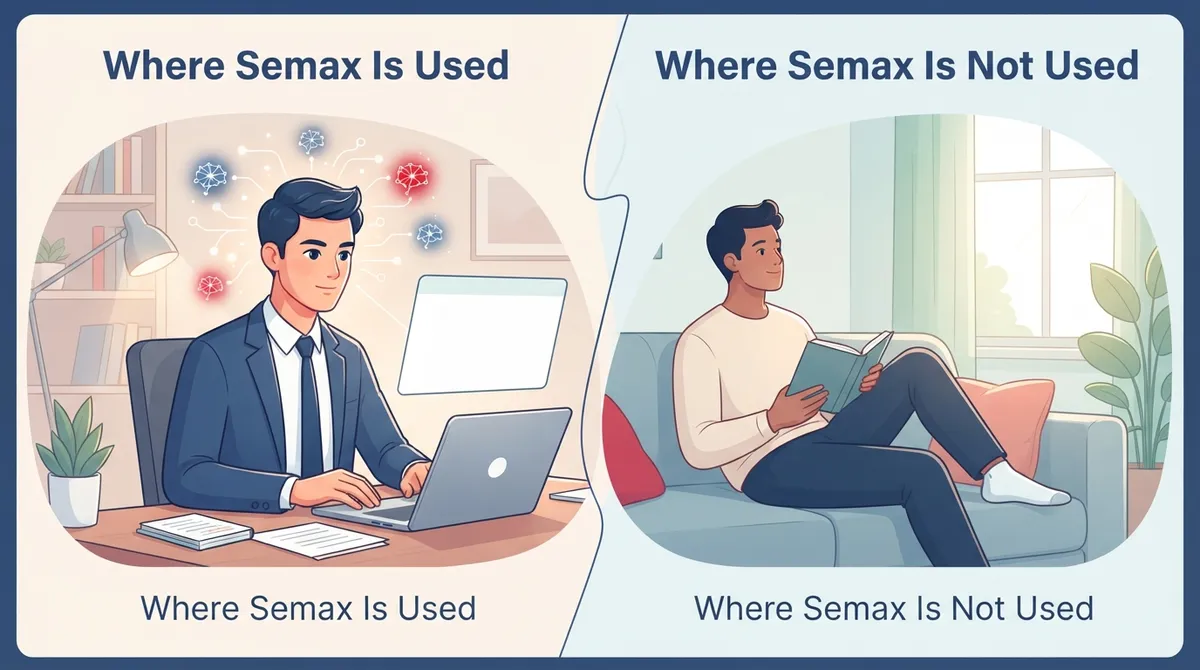
Where Semax Is Used and Where It Is Not
Semax is used as a prescription medicine in Russia for certain neurological and cerebrovascular conditions. Most of the human studies come from Russia as well. That history is real, and it explains why the peptide gets so much attention.
However, approval in one country does not carry over to another. A medicine approved in Russia is not automatically safe or effective for patients in the United States. Different regulators use different standards, and those standards matter.
- Russia: prescription use for certain neurological and cerebrovascular conditions.
- United States: not FDA-approved and not part of any FDA-approved drug.
- Online market: products sold as "research chemicals" with no guarantee of quality, dose, or purity.
What the FDA Has Said About Semax
FDA briefing materials say Semax is not a component of an FDA-approved drug. Reviewers examined eight references on human use and concluded that the evidence was not enough to support effectiveness for cerebral ischemia, migraine, or trigeminal neuralgia. They described the available data as limited, with small samples and missing clinical endpoints.
In July 2026, a Pharmacy Compounding Advisory Committee voted 8–5, with one abstention, to recommend adding Semax forms to the 503A Bulks List. That headline can sound like approval, but it is not. An advisory vote is only a recommendation. It does not change the FDA approval status, and it does not prove the peptide works or that a given product is well made.
Later reporting described narrow conditions under which compounding of Semax may occur under enforcement discretion. This too is a regulatory posture, not an endorsement. It does not establish effectiveness or product quality.
|
Item |
What It Means |
What It Does Not Mean |
|---|---|---|
|
Russian prescription use |
Approved locally for certain neurological uses |
Approved or proven in the U.S. |
|
Advisory committee vote (July 2026) |
A recommendation about the 503A Bulks List |
FDA approval or a final listing |
|
Enforcement discretion |
Narrow conditions for compounding |
Proof of safety, effectiveness, or quality |
|
Online "research use" product |
A labeled chemical for lab research |
A tested, human-grade medicine |
What Does the Research Show?
Human studies of Semax have focused on stroke and cerebrovascular conditions, and most were done in Russia. FDA reviewers pointed out small sample sizes and gaps in clinical outcomes. Independent replication, meaning other research teams repeating the work and getting the same results, is lacking.
Scientists have also proposed how Semax might act. One idea involves neurotrophic signaling, including brain-derived neurotrophic factor (BDNF), a protein linked to nerve cell health. These are research hypotheses. They are not proof that Semax improves memory, focus, recovery, or general wellness in real patients.
It is also worth noting that no reliable, independently verified estimate exists for how often Semax works or how often it causes side effects. Be cautious of any website that quotes exact success or safety percentages.
Known Safety Concerns
The FDA has raised potential safety concerns about compounded Semax. One concern is immunogenicity, which means the immune system could react to the peptide. This can happen when peptide molecules clump together (aggregation) or when impurities are present. Safety information for some proposed routes of use is also limited.
Product quality is a second major issue. Peptides sold online or labeled "for research use only" may vary in strength, purity, and sterility. You cannot assume the label matches what is in the vial. For related reading on this theme, see FDA-Approved vs. Compounded Peptides: Which Is Safer? and 10 Signs You're Getting 3rd-Party Tested Peptides.
How to Evaluate Semax: A Step-by-Step Approach
If you are curious about Semax, a structured approach protects you. Follow these steps before you consider any unapproved peptide.
- Identify the claim. Write down exactly what the seller or article says Semax will do. Vague claims like "optimize the brain" are a warning sign.
- Check the regulatory status. Confirm whether the product is FDA-approved. For Semax, it is not, so treat every benefit claim as unproven.
- Look for human evidence. Ask for published human studies, not animal or cell studies. Note the sample size and whether results were independently repeated.
- Verify the source. Avoid products labeled "research use only." Ask whether a licensed pharmacy prepared it and whether third-party testing exists.
- Review your health history. Share your medicines, supplements, and conditions with a clinician. Interactions and immune reactions are real possibilities.
- Ask about alternatives. Many goals people hope Semax will meet, such as better sleep, focus, or stress control, have proven options.
- Decide with a clinician. Make the final choice together, with a plan to monitor and stop if problems appear.
Red Flags to Watch For
- Claims that Semax "cures" or "reverses" a condition.
- No named manufacturer, pharmacy, or testing report.
- Pressure to buy quickly or buy in bulk.
- Instructions to self-inject or self-dose without medical review.
- Use of approval in Russia as proof of safety in the United States.
Questions to Ask a Clinician About Any Unapproved Peptide
A good appointment turns confusing online claims into a clear plan. Consider asking these questions:
- Is this product FDA-approved, and if not, what is its legal status?
- What human evidence exists, and how strong is it?
- How was this specific product made and tested?
- What side effects and immune reactions are possible?
- What proven options could meet my goal instead?
- How will we monitor me, and when would we stop?
To go deeper, you may find these guides helpful: What Should Tampa Patients Know Before Trying Semax Peptide?, Semax vs. Selank: Which Cognitive Peptide Has More Evidence?, and What Is a Neuroprotection Peptide and Does It Work?
Why Primary Care Is the Right Starting Point
Interest in peptides often grows from real concerns: brain fog, poor sleep, stress, slow recovery, or worries about aging. These concerns deserve attention. But the safest first step is rarely a vial from an online seller. It is a full evaluation that looks for treatable causes.
A primary care clinician can check sleep quality, thyroid function, vitamin levels, blood sugar, blood pressure, mood, and medicine side effects. These factors often explain the symptoms people hope a peptide will fix. If you are tired or foggy, for example, it may help to read How to Know When to See a Doctor for Poor Sleep. For a wider view of safe options, see How to Evaluate Peptide Therapy for Wellness Safely.
At InCare, our care model combines primary care, urgent care, and advanced wellness services in Tampa and Riverview, Florida. We focus on prevention and whole-body health, using tools such as lab testing, body composition analysis, metabolic breath analysis, and DNA gene testing to guide personalized plans. We will always be honest with you about what is proven, what is still experimental, and what is not appropriate. You can also read what patients say about their visits when you visit us on Google — InCare.
Proven Ways to Support Focus, Sleep, and Recovery
Before turning to an unapproved peptide, consider options with a stronger track record. A clinician can help you build a plan around them.
- Sleep care: screening for sleep apnea and insomnia, since poor sleep strongly affects focus and mood.
- Lab testing: checking for thyroid problems, low vitamin D or B12, anemia, and blood sugar issues.
- Stress and mood support: evidence-based counseling and, when needed, approved medicines.
- Movement and nutrition: regular activity and balanced meals support brain and body health.
- Medication review: some prescriptions and supplements can cause fog or fatigue.
How This Fits Different Readers
If you are a busy professional or a tech-savvy wellness seeker, you may be drawn to the idea of optimizing performance. The best optimization starts with data from your own body, not an untested product. If you are a young adult exploring wellness trends online, remember that a strong social media post is not a clinical trial. And if you are a parent or caregiver weighing options for family health, a trusted primary care relationship is the safest home base for every question like this one. You can follow InCare updates on Instagram, Facebook, and Tik Tok for plain-language health education.
The Bottom Line on Semax
So, what is Semax? It is a synthetic ACTH-fragment peptide with a history of use as a neurological medicine in Russia and a body of limited, mostly Russian research. In the United States it is not FDA-approved, and the FDA has said the evidence is insufficient to support its effectiveness for the conditions reviewed. Proposed mechanisms remain hypotheses, and safety questions about quality and immune reactions remain open.
None of this means curiosity is wrong. It means the right response is careful questions, not quick purchases. Treat Semax as an unproven option, and treat any seller's promises with healthy doubt.
Take the Next Step With InCare
If you have questions about Semax, peptides, brain fog, sleep, or overall wellness, the most useful move is a conversation with a qualified clinician. Our team in Tampa and Riverview can review your history, order the right tests, and help you choose safe, evidence-based steps. Book your appointment with InCare today, or contact our team to ask a question first.
FAQs
Q: What is Semax and what is it used for?
A: Semax is a synthetic seven-amino-acid peptide derived from a fragment of ACTH, studied mainly as a nasal neuroactive agent. In Russia it is used as a prescription medicine for certain neurological and cerebrovascular conditions. It is not FDA-approved in the United States.
Q: Is Semax FDA-approved in the United States?
A: No. Semax is not part of any FDA-approved drug, and FDA briefing materials say the evidence is insufficient to support its effectiveness for cerebral ischemia, migraine, or trigeminal neuralgia. A July 2026 advisory committee vote recommending its addition to the 503A Bulks List is not an approval.
Q: What are the safety concerns with Semax?
A: The FDA has noted potential concerns for compounded Semax, including immune reactions linked to peptide clumping or impurities, and limited safety data for some routes of use. Products sold online or labeled for research use may also vary in dose, purity, and quality.
Q: What should I ask a clinician before considering an unapproved peptide?
A: Ask about its legal status, the strength of the human evidence, how the specific product was made and tested, and what side effects are possible. Also ask what proven options could meet your goal and how you would be monitored.