
Key Takeaways
- Advanced health testing has no standard definition, so ask each Tampa clinic for a written list of included tests and the clinical reason for each one.
- Separate evidence-based screenings, such as USPSTF-guided colorectal cancer and diabetes screening, from optional wellness tests like body-composition scans and expanded biomarker panels.
- More testing is not always better: low-risk people can get false positives and incidental findings that cause follow-up cost and worry without health benefit.
- Choose tests that could change a medical decision, based on your age, symptoms, family history, medications, and goals, after a clinician explains the purpose.
- Never start supplements or medications based on a single abnormal result; review it with your doctor, who may repeat the test or order related tests.
- Verify cost and insurance coverage before testing, since preventive screenings are often covered while expanded wellness panels and gene testing are often self-pay.
Advanced health testing in Tampa can mean many things. For some people, it means a broader blood panel. For others, it means body-composition scans, metabolic breath analysis, or DNA gene testing. The phrase is not a standard medical package, so what you get depends on the clinic and the clinician.
That gap creates confusion. A longer list of tests is not always a better list. The right tests depend on your age, symptoms, family history, medications, and goals. A clinician should explain why each test is recommended and what you will do with the results.
This guide explains what advanced health testing includes, how it differs from routine screening, and which questions to ask before you book. It is written for busy adults, young families, and wellness-minded readers across Tampa and Riverview who want clear, practical answers. At InCare, testing is paired with primary care so that numbers turn into a plan.

What Advanced Health Testing Means in Primary Care
In primary care and wellness, advanced health testing usually refers to lab work or diagnostic assessments that go beyond a basic annual checkup. These tests look at health risks, symptoms, or performance goals in more detail.
There is no single national definition. One clinic may offer an expanded biomarker panel. Another may focus on fitness and body-composition testing. Local providers describe their offerings differently, so it helps to ask for a written list of included tests.
Common Types of Advanced Testing
- Expanded blood work: cholesterol and related cardiovascular markers, glucose or A1C, thyroid tests, and selected hormone or metabolic markers.
- Biomarker panels: broader measures tied to inflammation, nutrient status, and metabolism.
- Body-composition analysis: 3D imaging that tracks fat, muscle, and changes over time.
- Metabolic breath analysis: an assessment of how your body uses energy at rest.
- DNA gene testing: insight into inherited predispositions that may guide prevention.
- Cancer screenings: early detection tests chosen by age and risk.
Some of these tests have strong evidence behind them. Others are optional wellness tools. A trusted clinician will tell you which is which.
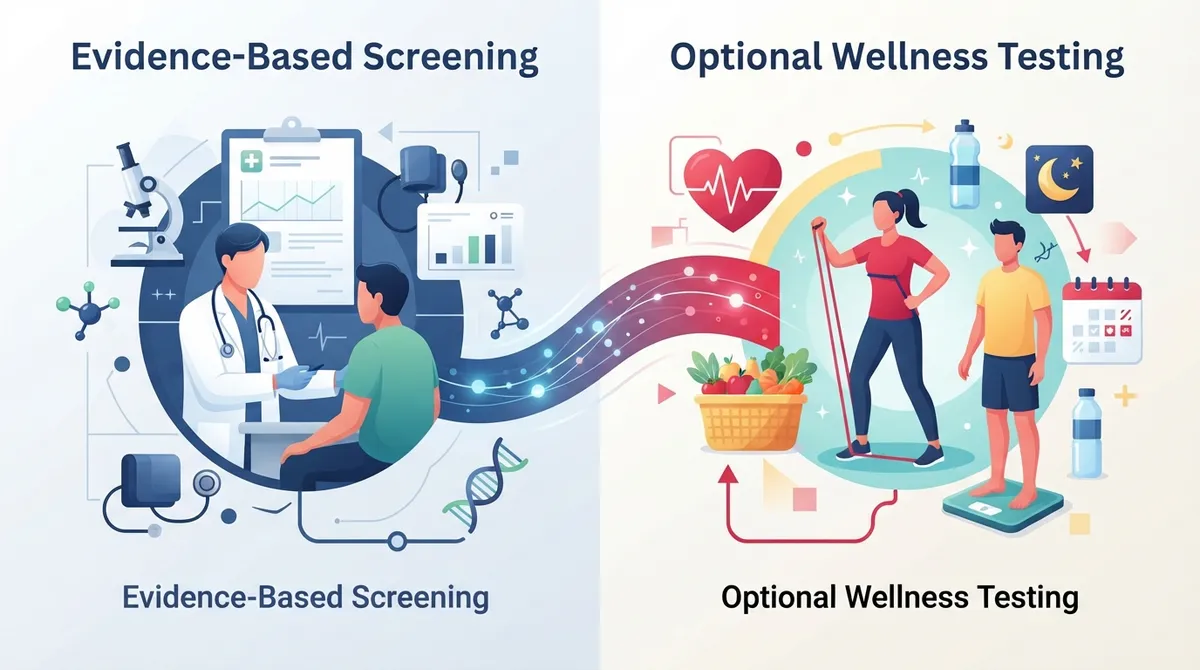
Evidence-Based Screening vs. Optional Wellness Testing
This distinction matters most. Preventive screening is based on research. Optional wellness testing may be useful, but the evidence for each test varies.
The U.S. Preventive Services Task Force (USPSTF) publishes screening recommendations built on evidence. Two examples show how specific these guidelines are:
- The USPSTF recommends colorectal cancer screening for adults ages 45 to 75. For adults older than 75, the decision is individualized.
- The USPSTF recommends screening for prediabetes and type 2 diabetes in adults ages 35 to 70 who have overweight or obesity.
Recommendations depend on personal circumstances and can change. You can review current guidance on the U.S. Preventive Services Task Force website and discuss it with your doctor.
How the Two Categories Compare
|
Feature |
Evidence-Based Screening |
Optional Wellness Testing |
|---|---|---|
|
Basis |
Published clinical guidelines |
Clinician judgment and patient goals |
|
Examples |
Colorectal cancer screening, diabetes screening, cholesterol checks |
Expanded biomarker panels, body-composition scans, fitness testing |
|
Who it suits |
Adults who meet age and risk criteria |
People with symptoms, risk factors, or performance goals |
|
Insurance coverage |
Often covered when guidelines are met |
Often self-pay; verify before testing |
Both categories can belong in a good care plan. The key is knowing which test serves which purpose.
Why More Testing Is Not Always Better
It is tempting to think a large panel catches everything. In practice, testing people at low risk can produce incidental findings and false-positive results. Those findings can lead to extra follow-up, cost, and worry without improving health.
Good testing is selective. It starts with a conversation about your history and your goals. Then the clinician chooses tests that can change a decision. If a result will not change your care, it may not be worth ordering.
The Role of Your Primary Care Doctor
Advanced testing works best when it sits inside an ongoing relationship with a primary care physician. A doctor who knows your history can place a result in context. A single number rarely tells the whole story.
Primary care teams can also coordinate routine laboratory work, preventive care, and cancer screenings in one place. This is especially helpful for busy parents and professionals who want fewer appointments and clear next steps. If you are still choosing a provider, this guide on how to choose the best primary care doctor in Tampa can help.
What a Good Visit Should Include
- A review of your symptoms, medications, and family history
- A clear reason for each recommended test
- Instructions on fasting or medication changes
- A plan for reviewing results with a clinician
- Defined follow-up steps, whether lifestyle changes, retesting, or referral
Tests Tampa Adults Commonly Ask About
Cholesterol and Cardiovascular Markers
Cholesterol testing helps estimate heart disease risk. Your doctor may also look at blood pressure, glucose, and family history. How often you repeat the test depends on your results and risk factors.
Glucose and A1C
These tests help identify prediabetes and diabetes. Early detection allows you to act before complications develop. Weight, age, and family history all influence when screening should start.
Thyroid and Hormone Testing
Thyroid tests can explain fatigue, weight changes, and temperature sensitivity. Hormone testing may be appropriate when symptoms point to an imbalance. Results should always be read alongside how you feel. For men exploring this topic, see who provides medically supervised TRT in Tampa Bay.
Body Composition and Metabolic Testing
Body weight alone does not show what is happening inside the body. Body-composition scans separate fat from lean mass. Metabolic breath analysis can show how your body uses fuel. Together, they give useful data for weight management and fitness planning. You can learn more in this overview of what a metabolic breath test shows.
DNA Gene Testing
Genetic testing may reveal inherited risks that shape your prevention plan. It does not predict the future on its own. Genes are one piece of the picture, alongside lifestyle and environment. Interpretation by a clinician is essential.
How to Prepare for Advanced Testing
Preparation helps you get accurate results and avoid repeat visits. Follow these steps:
- Ask which tests are included and why each is recommended.
- Confirm whether fasting is required and for how long.
- Ask whether you should pause any medications or supplements.
- Find out where samples are collected and how long results take.
- Confirm who will review results with you and how follow-up works.
- Check cost and insurance coverage before the visit.
Bring a list of current medications, supplements, and any family history of heart disease, cancer, or diabetes. If you are new to a practice, this checklist on what to bring to your first primary care visit is a helpful starting point.
Understanding Cost and Insurance
Coverage varies widely. Many preventive screenings are covered when you meet age and risk criteria. Expanded wellness panels, body-composition scans, and gene testing are often self-pay.
Provider marketing pages do not establish prices, coverage, or clinical benefit. Always verify these details directly with the clinic and your insurer before you test. Ask for an itemized estimate so there are no surprises.
Questions to Ask Any Tampa Testing Provider
- Which tests are included, and what is the clinical reason for each?
- Are these tests recommended by guidelines or offered as optional wellness tools?
- Who interprets my results, and will I get a one-on-one review?
- What happens if a result is abnormal?
- Is follow-up care included, or billed separately?
- What will this cost, and what will insurance cover?
Clear answers to these questions are a good sign. Vague answers or pressure to buy a large package are warning signs.
How to Interpret Abnormal Results
An abnormal result is not a diagnosis. It is a signal to look closer. Your clinician may repeat the test, add a related test, or review lifestyle factors that influence the number.
Avoid acting on results alone. Do not start supplements or medications based only on a lab value. Review the finding with your doctor first. This protects you from unnecessary treatment and keeps your plan grounded in evidence.
Why Tampa Patients Choose InCare for Advanced Testing
InCare is a personalized healthcare clinic that combines state-of-the-art technology with medical expertise. With locations in Tampa and Riverview, the practice offers primary care, urgent care, cancer screenings, metabolic breath analysis, body-composition analysis, DNA gene testing, weight loss programs, and IV hydration therapy under one roof.
That integration is the main advantage. Your testing, results, and follow-up care stay connected. Instead of collecting numbers in different places, you work with one team that focuses on prevention and whole-body optimization. Patients recognize the difference: InCare holds a 4.8 out of 5 rating on Google across 359 reviews, with many praising the friendly staff and attentive physicians. You can read InCare reviews on Google to see what patients say.
You can also follow the clinic's updates on Instagram, Facebook, and TikTok for health tips and clinic news.
Who Benefits Most
- Busy professionals: one coordinated visit instead of several.
- Young families: preventive screenings and weight management in one practice.
- Wellness seekers: advanced tools like gene testing and body-composition tracking, interpreted by a physician.
- Women and young adults without a primary care doctor: a full wellness baseline beyond reproductive care.
Virtual appointments are also available, which helps when your schedule is tight. For related reading, see how to get the most from preventive care visits in 2026.
Take the Next Step
Advanced health testing is most valuable when it is selective, explained clearly, and followed by a plan. Start with evidence-based screening, then add optional tests that match your symptoms and goals. Keep a clinician involved at every step.
Ready to build a testing plan that fits you? Book Now to schedule a visit at InCare in Tampa or Riverview, or contact our team with questions about which tests are right for you.
FAQs
Q: What does advanced health testing include in Tampa?
A: It is not a standard package, so it varies by provider. It often includes expanded blood work, biomarker panels, body-composition scans, metabolic testing, and sometimes DNA gene testing. Ask for a written list of included tests and the reason for each.
Q: Are advanced wellness blood tests covered by insurance?
A: Coverage depends on your plan and the test. Guideline-based preventive screenings are often covered when you meet age and risk criteria, while optional wellness panels are frequently self-pay. Confirm cost and coverage with the clinic and your insurer before testing.
Q: Do I need to fast before advanced blood tests?
A: Some tests, such as certain cholesterol and glucose measurements, may require fasting, while others do not. Your provider should give specific instructions on fasting duration and any medication changes before your appointment.
Q: What is the difference between routine lab work and advanced biomarker testing?
A: Routine lab work covers common markers like cholesterol, glucose, and thyroid function. Advanced biomarker testing adds broader measures related to inflammation, hormones, metabolism, and nutrient status. A larger panel is not automatically more useful, so a clinician should guide which tests make sense for you.
Q: How should I interpret abnormal results from a wellness test?
A: An abnormal result is a signal to investigate, not a diagnosis. Review it with your doctor, who may repeat the test or add related testing. Avoid starting supplements or treatments based on a single number.