
Key Takeaways
- No peptide has been shown to extend human lifespan, and "longevity peptides" is a marketing label rather than a recognized medical treatment category.
- Most peptide research for aging comes from cell and animal studies, not large human trials, so claimed benefits remain unproven for healthy adults.
- FDA approval for a peptide is tied to a specific condition; using it for anti-aging is off-label and its evidence is often thin.
- The FDA flagged BPC-157, CJC-1295, and ipamorelin in 2023 for compounding safety concerns, including immune reactions, impurities, and limited safety data.
- "Research use only" peptides sold online are not established as safe, and quality, dosing, and contamination vary widely.
- The strongest evidence for healthy aging comes from exercise, nutrition, quality sleep, vaccinations, cancer screening, and controlling blood pressure, blood sugar, and cholesterol.
Search for ways to slow aging, and peptides appear almost everywhere. Social media, wellness websites, and online vendors promote them as shortcuts to better recovery, more energy, and a longer life. So what peptides are used for longevity, and do they actually work? The honest answer is more complicated than the marketing suggests.
"Longevity peptides" is a marketing label, not a recognized medical treatment category. No peptide has been shown to extend human lifespan, and the evidence for improving healthspan in healthy people is limited. Still, many people are curious, and they deserve clear, balanced information from a clinician they trust.
This guide explains which peptides are commonly promoted for longevity, what the research really says, and what regulators have flagged. It also covers the proven habits that do support healthy aging. At InCare, we believe the best longevity plan starts with evidence, prevention, and a physician who knows your full health picture.
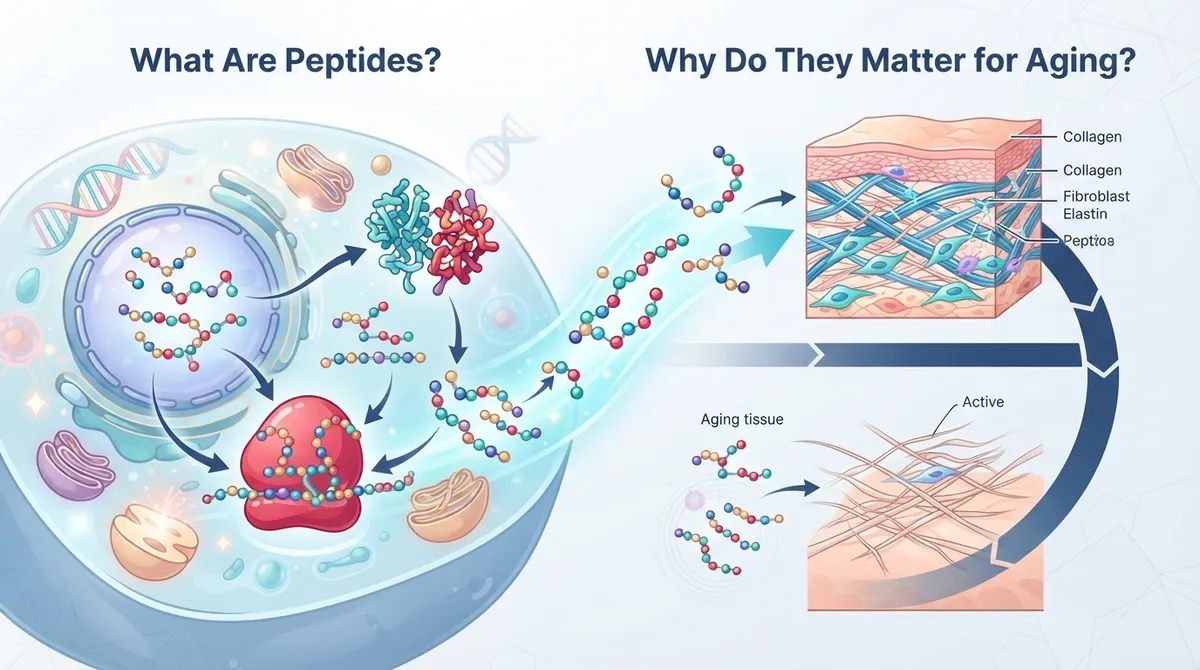
What Are Peptides, and Why Do They Matter for Aging?
Peptides are short chains of amino acids, the building blocks of proteins. Your body makes thousands of them naturally. They act as chemical messengers that help regulate hormones, immune function, tissue repair, and metabolism.
As we age, some of these signaling systems slow down. Growth hormone output declines, tissue repair becomes less efficient, and inflammation tends to rise. This is why researchers study peptides in aging. The theory is simple: if signaling declines with age, restoring it might help the body function better for longer.
That theory is reasonable. But a reasonable theory is not the same as a proven treatment. Most peptide research for aging has been done in cells or animals, not in large human trials. That gap is the most important thing to understand before trying any of these products.

What Peptides Are Used for Longevity?
Several peptides are regularly promoted for anti-aging and longevity goals. Here is a plain look at each one and its status.
Growth Hormone Axis Peptides
These peptides, including CJC-1295, ipamorelin, and sermorelin, aim to prompt the body to release more growth hormone. Proponents claim better body composition, sleep, and recovery. Human evidence for healthy adults is limited, and none carries an approved longevity indication. If you want to learn more about these agents, see our guides on what CJC-1295 actually does and whether ipamorelin is right for you.
BPC-157
BPC-157 is promoted for tissue repair, gut health, and recovery. Much of the supporting data comes from animal studies. A small uncontrolled pilot study of 58 people with knee pain reported sustained relief in 58% of participants. Without a control group, however, that result cannot prove the peptide works, and it says nothing about longevity.
TB-500 and Thymosin Beta-4
These are marketed for healing and recovery. They are often discussed alongside BPC-157. Human data on safety and effectiveness remains sparse. You can read more in our overview of TB-4 and healing support.
GHK-Cu
This copper-binding peptide is popular in skincare and is studied for collagen and wound repair. Topical use is the most researched form. Claims about systemic anti-aging effects are not established. Learn more in our guide to using GHK-Cu safely for skin and wellness.
Epitalon
Epitalon is often called a "telomere" peptide because of early laboratory interest in cellular aging. Strong human evidence that it extends life or slows aging is lacking.
Evidence Snapshot: What Is Proven and What Is Not
The table below summarizes how these peptides are marketed versus what is actually established.
|
Peptide |
Common Claim |
Evidence Status |
FDA Approval for Longevity |
|---|---|---|---|
|
CJC-1295 |
Raises growth hormone, improves body composition |
Limited human data; safety concerns raised for compounding |
No |
|
Ipamorelin |
Supports recovery and sleep |
Sparse human evidence |
No |
|
Sermorelin |
Stimulates growth hormone release |
Limited data in healthy adults |
No |
|
BPC-157 |
Tissue repair, gut healing |
Mostly animal studies; small uncontrolled human reports |
No |
|
TB-500 |
Healing and recovery |
Minimal human research |
No |
|
GHK-Cu |
Collagen and skin repair |
Best studied topically; systemic claims unproven |
No |
|
Epitalon |
Cellular aging effects |
Largely laboratory-based |
No |
The key takeaway is consistent. None of these peptides has shown a lifespan benefit in humans, and none is approved for longevity.
FDA Approval Does Not Equal a Longevity Benefit
Some peptide drugs are FDA-approved, but only for specific diseases. For example, tesamorelin is approved to reduce excess abdominal fat in adults with HIV-associated lipodystrophy. That approval does not mean it works or is safe for anti-aging in healthy people.
This distinction matters. When a provider or website says a peptide is "FDA-approved," ask a follow-up question: approved for what? Approval is tied to a specific condition, dose, and patient group. Using a drug outside that purpose is considered off-label, and the evidence for that use may be thin.
Safety and Regulatory Concerns You Should Know
Safety is where the conversation gets serious. In 2023, the FDA identified 19 bulk drug substances, including several peptides, as presenting potential significant safety risks for compounding. The agency specifically raised concerns about substances such as BPC-157, CJC-1295, and ipamorelin. These concerns relate to immune reactions, impurities, and limited safety data.
Not every peptide carries the same risk, and regulatory status can vary by substance and context. But the broader picture is clear:
- Compounded products are not FDA-approved. The FDA does not review them for safety, effectiveness, or quality before they reach patients.
- "Research use only" does not mean safe. Products sold online under this label are not established as safe for human use.
- Quality varies. Impurities, wrong doses, and contamination are real risks with unregulated sources.
- Long-term effects are unknown. Dosing, interactions, and multi-year safety are generally not well studied.
Possible Side Effects
Risks depend on the peptide, the dose, the route, and the product quality. Reported or FDA-noted concerns for some peptides include:
- Injection-site reactions
- Allergic or immune responses
- Increased heart rate
- Nausea
- Other systemic effects that are not yet well understood
If you take prescription medications or have a chronic condition, interactions are another reason to involve a physician before starting anything.
How to Think About Peptides for Healthy Aging
A responsible approach does not require dismissing peptides entirely. It requires honesty about uncertainty. Here is a practical way to evaluate them.
- Define your goal. Are you trying to recover from an injury, improve body composition, or support general aging? Different goals call for different tools.
- Review your health history. Heart disease, cancer risk, hormone status, and current medications all affect whether a therapy makes sense.
- Ask about the evidence. Request human studies, not just testimonials or animal data.
- Confirm the source. Know where the product comes from and how it is made and tested.
- Plan follow-up. Any therapy should include monitoring, lab work, and a clear stopping point if it is not helping.
If you are in the Tampa Bay area and want a physician-guided conversation, our team offers information on peptide therapy in 2026 and can help you weigh benefits and risks honestly. You can also explore our broader overview of peptides and wellness.
What Actually Supports Longevity
Here is the part that rarely goes viral. The strongest evidence for healthy aging comes from foundational habits and preventive medicine, not from any single injectable.
|
Longevity Pillar |
Why It Matters |
How Primary Care Helps |
|---|---|---|
|
Regular exercise |
Protects heart, muscle, bone, and brain |
Safe activity planning; VO2 max testing |
|
Nutrition and weight management |
Lowers risk of diabetes and heart disease |
Medical weight loss support and body composition tracking |
|
Quality sleep |
Supports hormones, mood, and immunity |
Screening for sleep apnea and sleep problems |
|
Cancer and disease screening |
Catches problems early when they are treatable |
Cancer screening and routine labs |
|
Vaccinations |
Prevents serious infections as immunity changes |
Age-appropriate immunization schedules |
|
Chronic disease control |
Keeps blood pressure, blood sugar, and cholesterol in range |
Ongoing chronic illness management |
These pillars are not glamorous, but they are measurable and proven. Longevity medicine works best when it is built on a strong primary care foundation. We explore this idea further in our article on why longevity medicine starts with primary care.
Personalized Tools That Go Beyond Guesswork
Rather than guessing, modern wellness care can measure where you stand. Personalized data helps you and your physician decide what is worth doing.
- DNA gene testing can offer insight into inherited health risks and predispositions. Learn more about DNA gene testing.
- Body composition analysis tracks muscle and fat over time, which is more useful than a scale alone. See our page on body composition.
- Metabolic breath analysis shows how efficiently your body uses energy. Explore metabolic breath analysis.
- Laboratory testing reveals hormone levels, inflammation markers, and metabolic health.
Data like this turns vague wellness goals into a clear, trackable plan. It also helps you avoid spending money on products that do not match your actual needs.
Who Should Be Extra Cautious?
Some people have more reason to slow down and talk with a physician first. Be especially careful if you:
- Have a history of cancer or are being monitored for it
- Are pregnant, planning pregnancy, or breastfeeding
- Take multiple prescription medications
- Have heart, kidney, or liver disease
- Are considering products bought online without medical oversight
For these groups, unknowns about long-term effects carry more weight. A clinician can help you decide whether to wait, choose a better-studied option, or focus on proven care.
The InCare Approach to Longevity
At InCare, we combine state-of-the-art technology with medical expertise to support prevention and whole-body optimization. Our approach is simple: start with your goals, measure what matters, treat what is proven, and be transparent about what is still uncertain.
Patients in Tampa and Riverview trust us for primary care, urgent care, cancer screening, weight loss, DNA gene testing, and IV hydration. We hold a 4.8 out of 5 rating on Google, and you can see what our InCare patients say on Google. We also share health tips and updates on Instagram, Facebook, and TikTok.
We will never present an unapproved peptide as a proven way to live longer. What we will do is give you honest guidance, thorough testing, and a plan built around your biology and your life.
Conclusion
So, what peptides are used for longevity? Commonly promoted options include CJC-1295, ipamorelin, sermorelin, BPC-157, TB-500, GHK-Cu, and epitalon. But "longevity peptide" remains a marketing term. No peptide has been proven to extend human lifespan, and most lack strong human evidence, FDA approval for anti-aging, and long-term safety data.
The smartest path to a longer, healthier life runs through proven habits, early screening, and a physician who looks at the whole picture. If you are curious about peptides, bring your questions to a clinician who will give you straight answers.
Ready to build a longevity plan grounded in evidence? Book your appointment with InCare today, or contact our team with any questions.
FAQs
Q: What peptides are marketed for longevity or anti-aging?
A: Commonly promoted peptides include CJC-1295, ipamorelin, sermorelin, BPC-157, TB-500, GHK-Cu, and epitalon. These are marketed for tissue repair, recovery, and cellular aging. However, "longevity peptides" is a marketing term rather than a recognized medical category, and none is approved for longevity.
Q: Do longevity peptides actually extend lifespan in humans?
A: No peptide has been shown to extend human lifespan, and evidence for improving healthspan in otherwise healthy people is insufficient. Much of the supporting research comes from laboratory or animal studies, or from small uncontrolled human reports that cannot establish effectiveness.
Q: Are BPC-157, CJC-1295, or ipamorelin FDA-approved?
A: None of these peptides is FDA-approved for longevity or general wellness. The FDA has also raised safety concerns about these substances for compounding, citing risks such as immune reactions, impurities, and limited safety data.
Q: What is the difference between an FDA-approved peptide and a compounded peptide?
A: FDA-approved peptide drugs are reviewed for safety, effectiveness, and quality for a specific condition. Compounded products are not FDA-approved and are not reviewed by the agency before they are marketed, so their quality and safety are not independently verified.
Q: What evidence-based steps support healthy aging instead?
A: Regular exercise, balanced nutrition, quality sleep, vaccinations, cancer screening, and good control of blood pressure, blood sugar, and cholesterol have the strongest evidence. A primary care physician can build and monitor a personalized prevention plan around these pillars.