
Key Takeaways
- No peptide regimen has been established as a treatment to slow aging or extend lifespan, so 'longevity peptides' is a marketing label rather than a proven therapy.
- The FDA does not review compounded drugs for safety, effectiveness, or quality before marketing, so always ask whether the exact product is FDA-approved for your intended use.
- The FDA has flagged safety concerns for BPC-157, CJC-1295, and ipamorelin, including impurities, immune reactions, and serious adverse events like increased heart rate.
- Proven steps like managing blood pressure, cholesterol, and blood sugar, treating sleep apnea, and keeping up with cancer screenings deliver more benefit than peptides right now.
- Before any injection, get a physician evaluation, baseline labs, and a clear risk discussion, and verify the clinician's credentials and the pharmacy's product sourcing.
Searching for the best longevity peptides in Tampa can feel exciting. Social media, wellness websites, and local clinics all promise younger bodies and longer lives. But the phrase "longevity peptides" is a marketing label, not a medical diagnosis or a proven treatment. Making the wrong choice can waste money and, in some cases, put your health at risk.
The goal of this guide is simple. It shows you the six most common mistakes Tampa patients make when they look for the best longevity peptides in Tampa, and it explains how a careful, primary-care-first approach can protect you. You will learn what the evidence says, what the FDA warns about, and which questions to ask before you ever consider an injection. At InCare, we believe the best path to healthy aging starts with a thorough medical evaluation, honest conversations about risk, and treatments that have real evidence behind them.

What "Longevity Peptides" Really Means
Peptides are short chains of amino acids. Your body makes thousands of them naturally. Some peptide medicines are FDA-approved for specific conditions. Insulin is a well-known example.
"Longevity peptides" is different. It is a broad marketing term. It may refer to compounds such as BPC-157, CJC-1295, ipamorelin, sermorelin, or others. Each one has its own evidence level, legal status, and risk profile. No peptide regimen has been established as a general-purpose treatment to slow aging or extend human lifespan.
That means the "best longevity peptides in Tampa" cannot be ranked like restaurants or gyms. A better question is this: Is any peptide medically appropriate for me, and who can safely guide that decision?
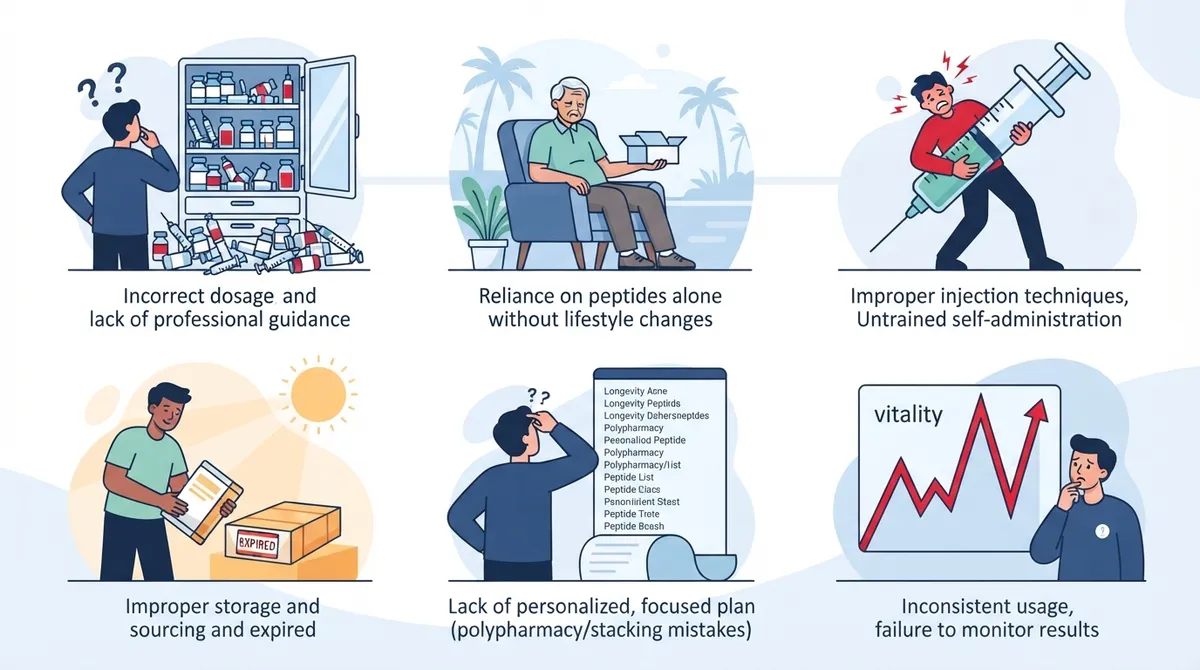
The 6 Mistakes to Avoid
Mistake 1: Assuming "Longevity Peptide" Means Proven or Approved
This is the most common error. A clinic may advertise anti-aging peptides with confident language. That does not make the treatment proven.
According to the FDA, compounded drugs are not FDA-approved. The agency does not review them for safety, effectiveness, or quality before they are marketed. FDA-approved peptide medicines do exist, but they are approved for particular conditions. That approval does not extend to other peptides or to compounded versions.
Before you commit, ask one direct question: "Is this exact product FDA-approved for my intended use?" If the answer is no, you are in experimental territory.
Mistake 2: Ignoring the FDA's Safety Concerns
The FDA has flagged specific safety questions about several popular wellness peptides. These concerns are worth knowing before you search for the best longevity peptides in Tampa.
- BPC-157: Limited human safety information, possible immune reactions, and concerns about impurities.
- CJC-1295: Serious adverse events have been reported, including increased heart rate and systemic vasodilatory reactions. Clinical data are limited.
- Ipamorelin: Limited human safety data and peptide impurity or characterization concerns.
These are not minor footnotes. They are reasons to slow down and involve a qualified physician. If you want more background, our guides on BPC-157 safety and what CJC-1295 actually does explain the details in plain language.
Mistake 3: Believing Marketing Claims Over Clinical Evidence
Many peptide ads promise faster healing, fat loss, muscle gain, better sleep, or reversed aging. Ask yourself where the proof is.
The research picture is thin. Reports reviewing the published literature find no randomized trial evidence establishing BPC-157 for injury healing in people. They also find no clinical trials testing ipamorelin, alone or combined with CJC-1295, for fat loss or muscle gain. Animal studies and small early studies do not equal proven results in real patients.
A clinic's before-and-after photos and testimonials are not clinical outcome data. Treat them as marketing, not evidence.
Mistake 4: Skipping the Basics That Actually Extend Healthy Life
Peptide hype often distracts from the interventions with the strongest track record. Most major drivers of early death and disability are well understood and modifiable.
A primary care evaluation can identify and address:
- Cardiovascular risk, including blood pressure and cholesterol
- Blood sugar problems and diabetes risk
- Sleep disorders such as sleep apnea
- Tobacco and alcohol use
- Age-appropriate cancer screenings
- Body composition, fitness, and metabolic health
These steps are less glamorous than an injection, but they deliver far more proven benefit. A thorough annual wellness visit is often the best first move. Our article on why longevity medicine starts with primary care explains this approach in more depth.
Mistake 5: Not Checking the Clinician, the Pharmacy, and the Product
Not all providers are equal. When you compare options for peptide care in Tampa, look past the website design. Evaluate the substance.
|
What to Check |
Why It Matters |
Warning Sign |
|---|---|---|
|
Clinician credentials |
A licensed physician should evaluate and prescribe |
No named, licensed medical provider |
|
Medical assessment |
Treatment needs a clear diagnosis and rationale |
Peptides offered before any exam or labs |
|
Risk discussion |
You deserve a full explanation of benefits and risks |
Only benefits are mentioned |
|
Product and pharmacy source |
Quality, contamination, and dosing risks are real |
Vague sourcing or "research use only" labels |
|
Follow-up plan |
Monitoring catches problems early |
No adverse-event or follow-up plan |
|
Regulatory honesty |
FDA status should be stated plainly |
Claims of approval for anti-aging use |
One more caution. Compounding can be appropriate in specific cases, such as when a clinician determines a patient's needs cannot be met by an FDA-approved drug. But compounding does not make a drug FDA-approved. Quality, labeling, and dosing risks still apply. If you are weighing your options, our guide on FDA-approved vs. compounded peptides in Tampa breaks down the differences.
Mistake 6: Going Straight to Treatment Without a Medical Baseline
Some people buy peptides online or visit a clinic that starts injections on day one. This skips the most important step: knowing where your health stands today.
A responsible plan begins with data. That can include a physical exam, lab work, a review of medications, and screening for conditions that could make a treatment unsafe. Advanced tools can add useful detail. For example, metabolic breath analysis, body composition testing, and DNA gene testing can help personalize a prevention plan.
Without a baseline, you cannot tell whether any treatment is helping, harming, or doing nothing at all.
A Safer Way to Approach Longevity in Tampa
If you are curious about longevity care, here is a practical, step-by-step path that keeps safety first.
- Start with a full primary care evaluation. Review your history, medications, family risks, and current symptoms.
- Get baseline testing. Labs, blood pressure, metabolic markers, and age-appropriate cancer screenings set the foundation.
- Fix the proven risks first. Sleep, nutrition, exercise, weight, blood sugar, and blood pressure come before any experimental therapy.
- Discuss peptides openly with a physician. Ask about evidence, FDA status, side effects, and alternatives for your specific goal.
- Insist on monitoring. Any treatment should have a follow-up schedule and a plan for reporting side effects.
This approach is not about saying no to innovation. It is about saying yes to safety and to treatments that match the evidence. You can learn more about how we approach this in our overview of longevity in primary care.
Questions to Ask Any Tampa Peptide Provider
Bring this list to your first consultation. A trustworthy clinic will welcome these questions.
- What is my diagnosis, and why is this peptide the right treatment?
- Is this specific product FDA-approved? If not, why is it being used?
- What human clinical evidence supports this use?
- What are the known risks, and what are the alternatives?
- Which pharmacy makes the product, and how is quality verified?
- How will you monitor me, and what happens if I have a reaction?
- What does the full cost include?
If answers feel vague, rushed, or defensive, treat that as a red flag. You can also review our broader checklist in what to look for in a peptide therapy clinic in Tampa.
Why a Primary-Care-First Clinic Makes Sense
When you work with a clinic that treats the whole person, peptides become one small part of a bigger picture rather than the whole plan. A primary care team can order labs, manage chronic conditions, coordinate screenings, and spot warning signs that a stand-alone wellness shop might miss.
InCare serves patients in Tampa and Riverview with personalized primary care, preventive screenings, advanced wellness testing, and weight management. Our physicians, including Dr. Pramjeet Ahluwalia, focus on prevention and whole-body optimization. Patients also tell us they value the friendly staff and clear communication. You can see what they say by reading InCare reviews on Google. You can also follow our updates on Instagram, Facebook, and TikTok.
If you want a deeper look at how peptide conversations fit into a medical setting, read our article on peptides in primary care: what works and what is risky in 2026.
What About Busy, Health-Conscious Adults?
Many Tampa patients are busy professionals, parents, and young adults who want to invest in their health without wasting time. That is a smart goal. The best use of your time and money is a plan built on measurable data, not on trends.
For example, a high-income wellness seeker may be drawn to advanced testing. A young family may need efficient preventive care for every household member. A young adult exploring gene testing may want to understand risk early. In each case, the first step is the same: a conversation with a physician who can interpret your results and recommend what is truly worth doing. Same-day and virtual options can make that first step easier to fit into a packed schedule.
Conclusion
The search for the best longevity peptides in Tampa is understandable, but the smartest answer is not a product. It is a process. Avoid the six mistakes above: assuming peptides are proven, ignoring FDA safety warnings, trusting marketing over evidence, skipping proven basics, failing to vet the provider and product, and starting treatment without a medical baseline.
Healthy aging is built on prevention, accurate testing, and honest medical guidance. If you want a trusted partner in Tampa or Riverview, book your visit with InCare today, or contact our team with questions. Let us help you build a longevity plan that is safe, personal, and grounded in real science.
FAQs
Q: What are longevity peptides, and which ones are commonly marketed in Tampa?
A: "Longevity peptides" is a marketing term, not a single approved treatment. It may refer to compounds such as BPC-157, CJC-1295, ipamorelin, or sermorelin, each with different evidence and risks. A physician should evaluate whether any of them is appropriate for you.
Q: Are longevity peptides FDA-approved for anti-aging or lifespan extension?
A: No. No peptide regimen has been established as a treatment to slow aging or extend lifespan. FDA-approved peptide medicines exist for specific conditions, and compounded drugs are not reviewed by the FDA for safety, effectiveness, or quality before marketing.
Q: What are the risks of CJC-1295 or ipamorelin injections?
A: The FDA has noted limited human safety data and concerns about impurities and immune reactions for these compounds. Serious adverse events, including increased heart rate and systemic vasodilatory reactions, have been associated with CJC-1295.
Q: How can I evaluate a peptide therapy clinic in Tampa?
A: Check the clinician's credentials, ask for a clear diagnosis and evidence-based rationale, and request details about the product and pharmacy. A reputable clinic also explains risks and alternatives and provides a follow-up and adverse-event plan.
Q: What evidence-based steps support healthy aging and longevity?
A: Strong options include managing blood pressure, cholesterol, and blood sugar, improving sleep, staying active, avoiding tobacco, and keeping up with cancer screenings. A primary care evaluation can identify which of these matter most for you.