
Key Takeaways
- Peptide therapy is not one standardized treatment; evaluate each specific product, its intended use, dose, and route, since these determine risk and evidence.
- FDA approval applies to a specific product for a specific condition, not to peptide therapy as a wellness category, so approved peptides do not prove benefit for unrelated goals.
- Compounded peptides are not reviewed by the FDA for safety, effectiveness, or quality before sale, and compounding does not create an FDA-approved equivalent.
- The FDA has flagged concerns about certain bulk peptides proposed for compounding, including GHRP-2 and GHRP-6, citing impurities and limited safety data.
- Ask any prescriber whether the product is FDA-approved or compounded, what human evidence supports your goal, how the pharmacy verifies quality, and what alternatives exist.
- Symptoms like fatigue, weight gain, or slow recovery can stem from thyroid issues, sleep apnea, deficiencies, or hormone imbalances, so a primary care evaluation should come before any peptide.
Clinical peptide therapy in Tampa has become a popular topic among adults who want to optimize their health. Many people search for it after hearing about recovery, weight management, or anti-aging claims online. But the term is confusing. "Peptide therapy" is not one standardized treatment. It covers a wide range of products with very different levels of evidence and oversight.
The most important distinction is simple. Some peptide medicines are FDA-approved for specific conditions. Others are compounded or marketed for wellness goals without FDA approval for those uses. Knowing the difference helps you make safer choices.
This guide compares the two paths side by side. It explains what each one means, what the research says, and what to ask before starting. Whether you are a busy professional, a wellness-focused millennial, or a parent managing family health, a clear framework will help. You will also learn how a primary care approach, like the one at InCare, can add safety and structure to the process.

What Clinical Peptide Therapy Really Means
Peptides are short chains of amino acids. Your body makes many of them naturally. Some act as hormones, such as insulin. Others help signal growth, appetite, or tissue repair.
"Peptide therapy" simply means treatment with peptide-based medicines. It is a broad label, not a single protocol. A clinician in Tampa might use it to describe an FDA-approved diabetes medicine. Another provider might use it to describe a compounded product aimed at recovery or energy.
Because the label is so broad, you should never evaluate "peptide therapy" as one thing. Instead, evaluate the specific product, the intended use, the dose, and the route of delivery. Each of those details changes the risk and the evidence.
Why a Clinical Approach Matters
A truly clinical approach starts with you, not the product. A qualified clinician reviews your symptoms, medical history, medications, goals, and relevant lab or exam findings first. Only then do they discuss whether a peptide makes sense.
This is where primary care adds real value. A primary care team sees the full picture. They can screen for conditions that cause fatigue, weight gain, or slow recovery before anyone recommends an injection. You can learn more about this whole-person model in our guide to comprehensive primary care.
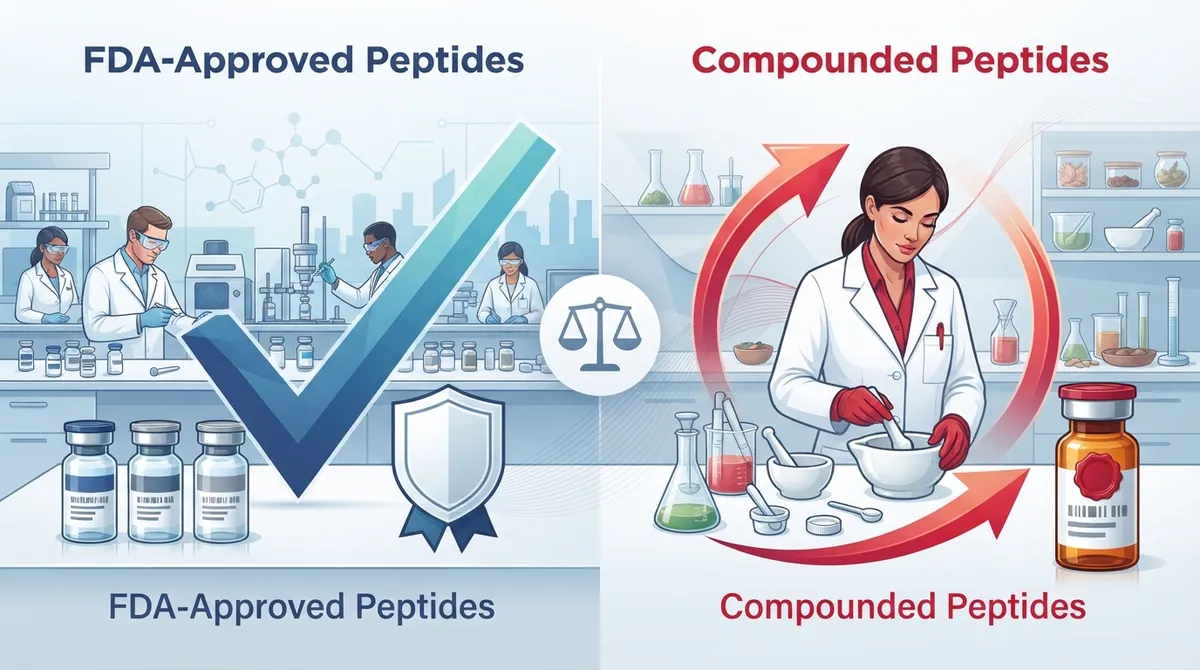
FDA-Approved Peptides vs. Compounded Peptides
This is the core comparison. The two categories are regulated very differently, and the gap affects safety, quality, and evidence.
FDA-Approved Peptide Medicines
FDA approval applies to a specific product, for a specific condition, at a specific dose and route. The agency reviews safety, effectiveness, and manufacturing quality before the product reaches patients.
Approval does not extend to peptide therapy as a general wellness category. An approved medicine for one condition does not prove benefit for unrelated goals. A clinician may sometimes prescribe an approved drug for another use, which is called off-label prescribing. That choice requires careful clinical judgment and a clear conversation with the patient.
Compounded and Unapproved Peptides
Compounded drugs are made by a pharmacy for an individual patient. They are not reviewed by the FDA for safety, effectiveness, or quality before they are sold. Compounding can be appropriate when legal requirements are met. However, it is not a way to create an FDA-approved equivalent or to bypass limits on unapproved drugs.
The FDA's compounding framework includes two main sections. Section 503A covers traditional pharmacy compounding. Section 503B covers outsourcing facilities. Neither makes a compounded product an FDA-approved drug.
Side-by-Side Comparison
|
Factor |
FDA-Approved Peptides |
Compounded or Wellness-Marketed Peptides |
|---|---|---|
|
Pre-market FDA review |
Yes, for safety, effectiveness, and quality |
No FDA review of the finished product |
|
Evidence base |
Clinical trials for a defined use |
Varies widely; often limited human data |
|
Labeling and dosing |
Standardized and approved |
Set by prescriber and pharmacy |
|
Quality control |
Regulated manufacturing standards |
Depends on the pharmacy or facility |
|
Typical use |
Specific diagnosed conditions |
Recovery, anti-aging, body composition goals |
|
Best next step |
Discuss with a licensed prescriber |
Ask about sourcing, evidence, and alternatives |
Which Peptides Are Commonly Discussed in Tampa?
Several peptides come up often in local wellness conversations. It helps to know where they stand.
- BPC-157 and TB-500: Often promoted for recovery and healing. They are not FDA-approved drugs for those wellness claims. Human safety data is limited.
- CJC-1295 and ipamorelin: Often promoted for growth hormone support, energy, and body composition. They are also not FDA-approved for those claims.
- GLP-1 medicines: Some GLP-1 products are FDA-approved for diabetes or weight management. These are a different category from the wellness peptides above.
Marketing claims should not be treated as proven clinical benefits. If you want a deeper look at one of these, our article on BPC-157 facts for wellness patients explains what is known and unknown. For a broader review of approval status, see our guide to FDA-approved peptides and our overview of non-FDA approved peptides.
Safety Considerations You Should Know
Safety depends on the substance, the dose, the route, and the patient. There is no single risk profile for all peptides.
Quality and Sourcing Concerns
The FDA has flagged potential safety concerns for certain bulk substances proposed for compounding. These include risks related to peptide impurities, aggregation, immunogenicity, and limited safety information. Its risk notices include GHRP-2 and GHRP-6. The agency has also received serious adverse-event reports tied to GHRP-2, though it states that causality has not been established.
These points do not mean every peptide is unsafe. They mean product quality and evidence matter a great deal. Unknown sourcing adds real risk.
Possible Side Effects
Reported effects vary by product. Some providers report injection-site reactions, headache, nausea, fatigue, flushing, and appetite or digestive changes. Limited evidence can make it harder to predict how you will respond.
Always tell your clinician about every medicine and supplement you take. Seek care promptly for concerning symptoms. If you need same-day help, urgent care is available when something does not feel right.
Evaluating a Peptide Provider in Tampa
The provider matters as much as the product. A responsible, primary-care-oriented consultation should include several clear elements.
- A licensed prescriber. Verify the clinician's Florida license before you begin.
- A plain explanation of regulatory status. Ask whether the proposed product is FDA-approved or compounded, and why it fits you.
- A full review of your health. This includes contraindications, medication interactions, and relevant lab work.
- A discussion of alternatives. Lifestyle changes or approved treatments may serve your goal better.
- Transparent pharmacy sourcing. You should know where the product is made and by whom.
- A follow-up plan. Good care includes monitoring, not just a prescription.
If a clinic skips these steps or relies on promotional outcome claims, treat that as a warning sign. Directory listings and testimonials are not clinical evidence. For more guidance, read our breakdown of what to look for in a peptide therapy clinic in Tampa.
Why Start With Primary Care
Many people jump straight to a peptide because of a symptom. Low energy, stubborn weight, or slow recovery can feel like a peptide problem. Often, they are signs of something else.
Thyroid issues, sleep apnea, vitamin deficiencies, blood sugar problems, and hormone imbalances can all cause these symptoms. A primary care visit can rule them in or out. That step protects you from spending money on a treatment that does not address the root cause.
At InCare, the approach combines medical expertise with advanced tools. Services such as metabolic breath analysis, body composition analysis, and DNA gene testing give your care team objective data. This helps guide decisions based on your biology rather than trends.
Who May Benefit From a Closer Look
- Tech-savvy professionals who want data-driven wellness and clear answers about what is proven.
- Affluent wellness seekers who expect advanced testing before any treatment decision.
- Busy parents who need efficient, coordinated care and honest guidance on safety.
- Young adults and women new to primary care who want a trusted clinician instead of relying on social media advice.
How InCare Approaches Peptide Conversations
InCare is a personalized healthcare clinic with locations in Tampa and Riverview, Florida. The care team focuses on prevention and whole-body optimization, with physicians such as Dr. Pramjeet Ahluwalia leading patient care. You can meet the full provider team to see who may guide your visit.
Patients who want to explore options can read our overview of peptide therapy at InCare and our guide on how to get started with peptide therapy in Tampa. The goal is always the same: match the right option to the right patient, with evidence and follow-up.
Patients also share their experiences publicly. You can read InCare reviews on Google to see what neighbors in the Tampa Bay area say about their care. To stay current on clinic updates and wellness tips, you can follow InCare on Instagram, Facebook, and TikTok.
Questions to Ask Before You Begin
Bring a short list to your appointment. These questions keep the conversation focused and honest.
- Is this specific product FDA-approved, and for what condition?
- If it is compounded, why is it appropriate for me?
- What does the human evidence show for my goal?
- What are the risks, side effects, and interactions with my medicines?
- Which pharmacy supplies it, and how is quality verified?
- What labs or monitoring will you order, and when is my follow-up?
- What are my alternatives if I choose not to start?
A confident, qualified clinician will welcome these questions. Clear answers are a good sign that you are in the right hands.
Conclusion: Choose Evidence and Oversight First
In Tampa, clinical peptide therapy is not one thing. FDA-approved peptide medicines have defined uses and regulatory review. Compounded and wellness-marketed peptides vary widely in evidence, quality, and oversight. The safest path is to start with a thorough evaluation, ask direct questions, and work with a licensed prescriber who explains the trade-offs.
If you want a primary care team that puts your whole health first, InCare is ready to help. Book your visit with InCare today to talk through your goals, or contact our team with questions before you schedule.
FAQs
Q: What is clinical peptide therapy in Tampa?
A: Clinical peptide therapy refers to treatment with peptide-based medicines, which are short chains of amino acids. It is a broad term rather than one standardized treatment. Products range from FDA-approved medicines for specific conditions to compounded products marketed for wellness goals.
Q: Is peptide therapy FDA-approved for anti-aging or recovery?
A: No. FDA approval applies to specific products for specific conditions, not to peptide therapy as a wellness category. Peptides such as BPC-157, TB-500, CJC-1295, and ipamorelin are not FDA-approved drugs for recovery or anti-aging claims.
Q: What are the risks of compounded peptide therapy?
A: Compounded drugs are not reviewed by the FDA for safety, effectiveness, or quality before marketing. Risks depend on the substance, dose, and product quality, and may include injection-site reactions, headache, nausea, and fatigue. Limited evidence and unknown sourcing can add further uncertainty.
Q: How do I choose a safe peptide therapy provider in Tampa?
A: Verify that the prescriber holds a current Florida license and ask whether the product is FDA-approved or compounded. A responsible provider reviews your health history, explains alternatives, discloses pharmacy sourcing, and schedules follow-up care.
Q: Do I need a prescription or lab testing for peptide therapy?
A: Prescription peptide medicines require evaluation by a licensed prescriber. A thorough consultation typically includes a medical history review and relevant lab work. Ongoing follow-up helps monitor safety and whether the treatment is appropriate for you.