
Key Takeaways
- KPV lacks any human clinical trials for IBS; all evidence comes from cell and animal studies of colitis (an IBD model), not IBS, making its effectiveness in people completely unproven.
- IBS is a functional gut-brain disorder without tissue damage, fundamentally different from IBD like Crohn's disease; animal colitis studies cannot predict KPV's effect on IBS.
- Evidence-based IBS management includes low-FODMAP diet trials, symptom-targeted medications, stress management, sleep improvement, and psychological therapy—all supported by clinical guidelines and primary care.
- KPV products sold online lack FDA approval, established safe doses, long-term safety data, and quality control; unregulated peptides carry real risks of contamination, incorrect dosing, and unknown side effects.
If you have searched for "kpv ibs management," you have likely found forums and wellness sites claiming this peptide can calm your gut. It sounds promising, especially if you have tried diets, medications, and stress tricks without much relief. But before you spend money on an unproven peptide, it helps to understand what the science actually shows and what real IBS treatment looks like in a primary care setting.
This article breaks down the difference between KPV research and proven irritable bowel syndrome (IBS) management. We will look at what KPV is, why people are talking about it, and what actually works when it comes to easing symptoms like bloating, cramping, and unpredictable bowel habits. Whether you are a busy parent trying to manage symptoms between school pickups or a young professional tired of canceling plans due to stomach pain, this guide will help you make an informed decision.
What Is KPV and Why Is It Linked to IBS?
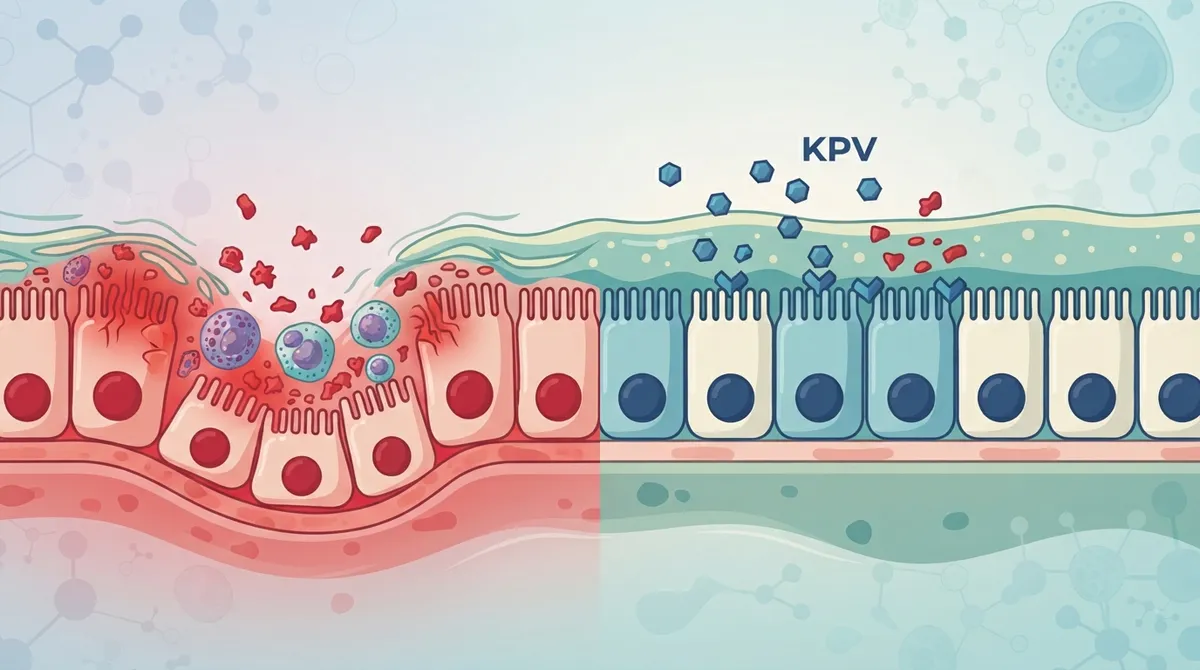
KPV stands for lysine-proline-valine. It is a small tripeptide, a tiny fragment made from a naturally occurring hormone called alpha-melanocyte-stimulating hormone (α-MSH). In wellness circles, KPV is often described as an anti-inflammatory peptide that might calm an irritated gut.
The idea comes from lab and animal research, not from studies on people with IBS. Scientists have looked at how KPV affects certain inflammation pathways in cells, including NF-κB and MAPK signaling. Researchers have also studied how KPV enters intestinal cells through a transporter called PepT1 (Merlin et al., 2008). These are interesting findings, but they come from petri dishes and mouse studies, not human trials.
What Does the Research Actually Show?
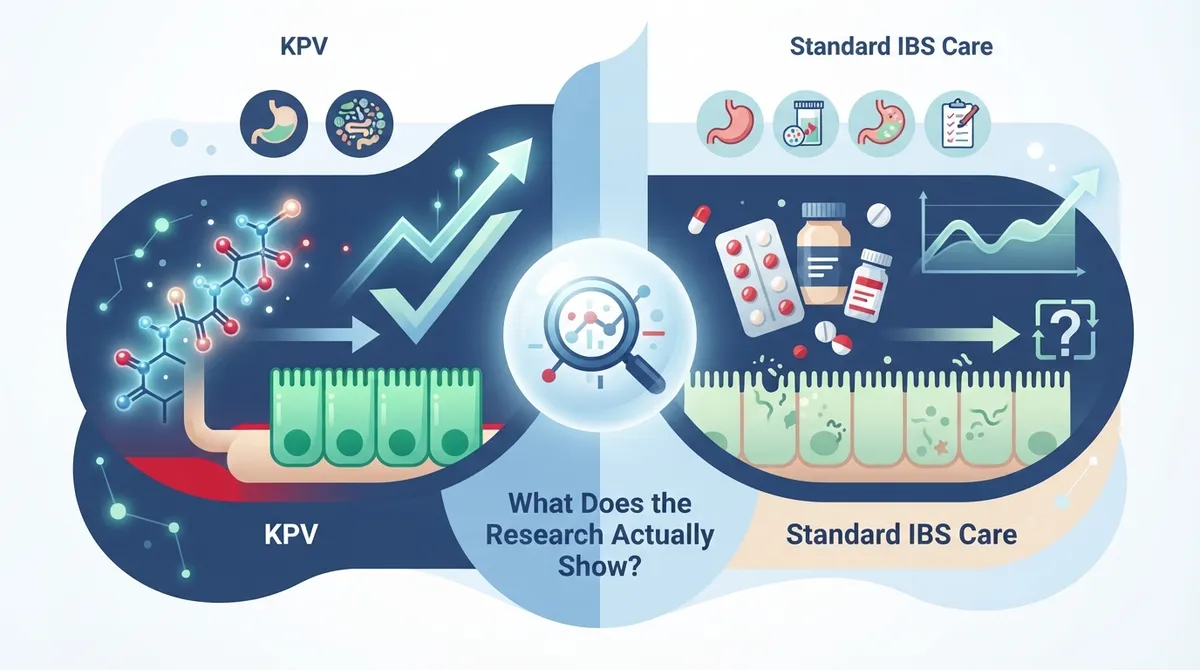
It is important to separate hype from hard evidence. Here is what the current research tells us about KPV:
- Lab studies suggest KPV may reduce inflammatory signaling in intestinal and immune cells at very low, nanomolar concentrations (Merlin et al., 2008).
- Animal studies from 2007 and 2008 found that KPV reduced signs of colitis in mice given chemicals like DSS or TNBS to trigger gut inflammation.
- These animal models mimic inflammatory bowel disease (IBD), such as ulcerative colitis, much more closely than they mimic IBS.
- No well-controlled human clinical trial has tested KPV for IBS. There is no proven human dose, safety profile, or treatment length.
In short, the strongest KPV evidence is preclinical. It has not been tested in people with IBS, and animal colitis studies cannot be used to predict how KPV would work in humans dealing with a gut-brain disorder like IBS.
Why IBS Is Different From IBD
This mix-up trips up a lot of people. IBS is a functional gut disorder. It affects how your gut and brain communicate, causing pain, bloating, and irregular bowel habits without visible damage to the intestinal lining.
IBD, on the other hand, includes conditions like Crohn's disease and ulcerative colitis. These involve real inflammation and tissue damage that can be seen on colonoscopy or biopsy. The animal studies used to support KPV's anti-inflammatory potential are IBD models, not IBS models. Treating one condition does not mean a substance treats the other. If you have ongoing digestive symptoms, a visit to a primary care provider can help clarify which condition you may actually be dealing with.
Is KPV Safe? What We Don't Know
Because there are no completed human trials, several important safety questions remain unanswered:
- There is no established safe or effective dose for humans.
- Long-term effects have not been studied in people.
- Safety during pregnancy or breastfeeding has not been evaluated.
- Interactions with other medications are unknown.
- Product quality varies widely since KPV is often sold as a research chemical, not a regulated drug.
Peptides sold online are frequently labeled "for research purposes only." This label exists because these products have not gone through FDA approval for human use. Buying and using them without medical guidance carries real risk, including contamination, incorrect dosing, and unknown side effects.
KPV vs. Evidence-Based IBS Management: A Side-by-Side Look
|
Approach |
Evidence Level |
Human Trials? |
Used in Primary Care? |
|---|---|---|---|
|
KPV Peptide |
Preclinical (cell and animal studies only) |
No |
No |
|
Low-FODMAP Diet Trial |
Supported by clinical guidelines |
Yes |
Yes |
|
Symptom-Directed Medication |
Supported by clinical guidelines |
Yes |
Yes |
|
Stress and Sleep Management |
Supported by clinical guidelines |
Yes |
Yes |
|
Psychological Therapy (CBT, gut-directed hypnotherapy) |
Supported by clinical guidelines |
Yes |
Yes |
This comparison makes it clear. KPV has not reached the same level of testing or clinical acceptance as standard IBS care. Guidelines from the UK's National Institute for Health and Care Excellence (NICE), reviewed as recently as April 2025, outline a structured approach built on diet, lifestyle, medication, and psychological support, not experimental peptides.
What Does Evidence-Based IBS Care Actually Look Like?
If you are dealing with ongoing digestive symptoms, a proper diagnosis is the first step. Primary care providers use a combination of history, symptom patterns, and sometimes lab work to rule out other conditions before confirming IBS. From there, treatment usually includes:
- Patient education and reassurance about what IBS is and is not
- Regular physical activity to support gut motility and reduce stress
- Sleep improvement, since poor sleep can worsen gut symptoms
- A structured, time-limited low-FODMAP diet trial under professional guidance
- Medications targeted to your specific symptoms, such as antispasmodics or fiber supplements
- Psychological support, including cognitive behavioral therapy, when stress plays a major role
This is a much more thorough approach than trying an unregulated peptide. It treats the whole person, not just one symptom. If you are new to primary care or unsure where to start, a comprehensive primary care visit is a good first move.
When Should You See a Doctor Instead of Self-Treating?
Some symptoms should never be managed with supplements or peptides alone. See a doctor promptly if you notice any of the following:
- Rectal bleeding that is new or persistent
- Unexplained weight loss
- Signs of anemia, such as fatigue or paleness
- Symptoms that wake you up at night
- Fever along with digestive symptoms
- A family history of colorectal cancer or inflammatory bowel disease
- New digestive symptoms appearing later in life
These red flags call for proper evaluation, not experimentation. A gastroenterologist referral may be needed to rule out IBD, celiac disease, or other conditions that mimic IBS.
Why Primary Care Should Be Your First Step
Trying an unproven peptide before getting a real diagnosis can delay proper treatment. It can also mask symptoms that need medical attention. This is why working with a trusted primary care team matters so much.
At InCare, providers take a whole-body approach to digestive health. Rather than jumping to a trendy but unproven fix, the focus stays on accurate diagnosis, lifestyle changes, and treatments backed by real clinical evidence. Our providers in Tampa and Riverview work with patients to build management plans that fit their daily lives, not just their lab results.
For those managing busy schedules, families, or demanding jobs, having a dependable primary care clinic near Tampa and Riverview means you do not have to guess your way through gut symptoms. You get a clear plan built around your health history and your goals.
Beyond IBS: A Whole-Body Approach to Gut Health
Gut symptoms rarely exist in isolation. Stress, sleep, diet, and even hormone balance can all play a role in how your digestive system behaves. That is why InCare also offers services like weight loss programs, metabolic breath analysis, and DNA gene testing to help identify what is really driving your symptoms.
If inflammation is a concern, our team can discuss options that are actually supported by clinical research, rather than experimental compounds with no human safety data. You can learn more about how our approach compares to unproven peptide trends in our related article on KPV vs. traditional anti-inflammatories.
Patients often share their experiences after finding real answers for long-standing digestive issues. You can visit us on Google — InCare to read reviews from people who found relief through evidence-based primary care rather than trial-and-error supplements. We also share patient education and wellness updates on Facebook, Instagram, and TikTok.
Making the Right Choice for Your Gut Health
KPV may be an interesting subject for future research. But right now, it is not a proven IBS treatment. There is no approved human dose, no long-term safety data, and no clinical trial showing it helps people with IBS feel better.
What does work is a structured, guided approach: proper diagnosis, dietary changes like a supervised low-FODMAP trial, symptom-specific medication, stress management, and psychological support when needed. This is the path supported by major clinical guidelines, including NICE guidance reviewed in 2025.
If digestive symptoms are affecting your daily life, do not wait for unproven trends to catch up with science. Our team is ready to help you build a real plan for relief. Reach out to our care team today or schedule your appointment now to start getting answers that are actually backed by evidence.
FAQs
Q: What is KPV and why is it discussed for IBS?
A: KPV is a small peptide made of three amino acids: lysine, proline, and valine. It is derived from a natural hormone and has shown anti-inflammatory effects in lab and animal studies, which is why some wellness sources link it to gut health, though not specifically proven for IBS.
Q: Does KPV actually treat irritable bowel syndrome?
A: No well-controlled human clinical trial has tested KPV for IBS. Current evidence comes only from cell studies and animal colitis models, which do not confirm any benefit for people with IBS.
Q: Is KPV FDA-approved for treating IBS?
A: No. KPV is not FDA-approved for IBS or any other condition. It is typically sold as a research compound, meaning it has not been evaluated for human safety or effectiveness by regulatory agencies.
Q: How is IBS different from ulcerative colitis or Crohn's disease?
A: IBS is a functional gut-brain disorder without visible tissue damage, while ulcerative colitis and Crohn's disease are forms of inflammatory bowel disease with measurable inflammation and tissue changes. Treatments studied for one condition should not be assumed to work for the other.
Q: When should someone with IBS symptoms see a doctor?
A: You should see a doctor promptly if you have rectal bleeding, unexplained weight loss, nighttime symptoms, fever, or a family history of colorectal cancer or IBD. These symptoms require proper evaluation rather than self-treatment with unproven supplements.