
Key Takeaways
- BPC-157 is not FDA-approved for any condition, and FDA materials state there is insufficient clinical safety information to describe its safety in humans.
- A 2025 HSS Journal review found 36 relevant studies, but only one was clinical; the human evidence rests on just three small studies with 30 participants total, rated very low certainty.
- Before any peptide therapy, ask the clinic for a diagnosis, a review of your medications and history, product sourcing and third-party purity testing, and a written list of risks.
- Red flags include promises that BPC-157 heals injuries, calling it FDA-approved, skipping an exam, and pushing peptides as the only option instead of proven care like physical therapy.
If you have searched for BPC-157 therapy in Tampa, you have probably seen bold promises. Some wellness providers market this peptide for joint pain, tendon healing, gut support, and faster recovery. Those claims sound appealing, especially if you are an active professional, a busy parent, or someone tired of nagging aches.
The facts deserve a closer look. BPC-157 is not an FDA-approved drug for any condition, and the human research is very limited. That does not mean you cannot ask questions about it. It means you should ask the right ones.
This guide explains what BPC-157 is, what the evidence shows in 2026, and how to judge any Tampa clinic that offers it. You will also learn which evidence-based options to discuss with a primary care clinician first. At InCare, our approach starts with diagnosis, safety, and proven care, so you can make decisions with confidence.
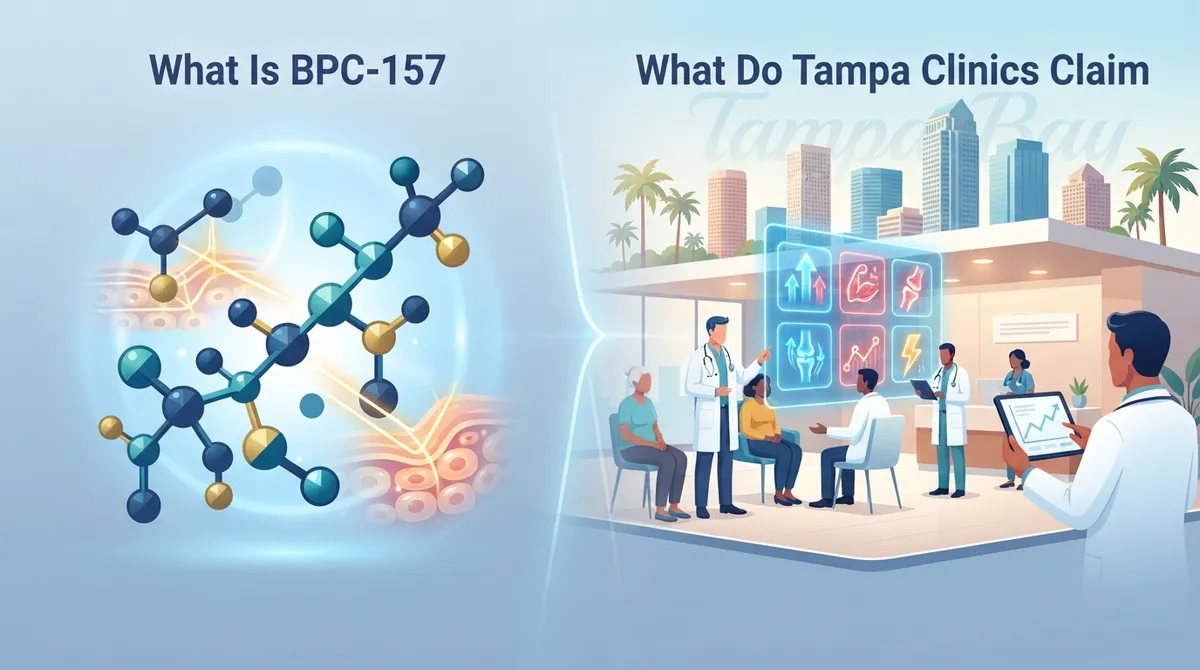
What Is BPC-157, and What Do Tampa Clinics Claim?
BPC-157 stands for Body Protection Compound-157. It is a synthetic peptide made of 15 amino acids. Some wellness and sports-recovery providers promote it for tissue repair, pain relief, and gut health.
These are marketing claims, not proven clinical benefits. Most of the excitement comes from animal and lab studies. Results in animals often do not carry over to people.
If you want a plain-language primer first, read What Is BPC-157 and Why Are Clinics Buzzing About It? It covers the basics before you dive into the details below.
Common Claims You May See
- Faster healing of tendons, ligaments, and muscles
- Relief from joint and back pain
- Support for gut health and digestive complaints
- General "regeneration" or whole-body repair
None of these uses are established by strong human evidence. Treat each claim as unproven until a regulated clinical trial shows otherwise.

What Does the Research Actually Show in 2026?
The honest answer is: not much in humans. A 2025 review in the HSS Journal found 36 relevant studies. Of those, 35 were preclinical (animal or lab work) and only one was clinical.
A later human-focused review found just three small studies with 30 participants in total. Those studies looked at knee pain, interstitial cystitis, and an intravenous safety pilot. Reviewers rated the certainty of the evidence as very low.
|
Human Study Area |
Participants |
Design |
Key Limitation |
|---|---|---|---|
|
Knee pain |
16 |
Retrospective |
No control group |
|
Interstitial cystitis |
12 |
Pilot study |
Very small sample |
|
Intravenous safety |
2 |
Safety pilot |
Short follow-up |
In the knee-pain study, 14 of 16 people reported significant relief after injections that contained BPC-157, alone or with TB4. That sounds impressive. But the study had no comparison group and a tiny sample. Improvement in an uncontrolled study does not prove the peptide caused it.
For a closer look at how outcomes get misread, see 8 BPC-157 Clinical Outcome Mistakes Patients Make.
Is BPC-157 FDA-Approved?
No. FDA materials state that neither BPC-157 nor its acetate form is a component of an FDA-approved drug. The agency has also noted there is insufficient clinical safety information to describe its safety.
You may hear that a compounding pharmacy can supply it. That is true in some cases, but it does not make the product proven. Compounded medications are not FDA-approved finished products. A prescription does not show that the therapy works or is right for you.
FDA briefing materials describe several concerns:
- Limited safety data in humans
- No applicable USP/NF drug-substance monograph
- Adverse-event reports that cannot establish cause and effect
The regulatory picture keeps changing, so verify the current status before you act. Our explainer 4 Facts on BPC-157 FDA Approval Status in 2026 keeps the key points in one place.
What Are the Known and Unknown Risks?
Because the human data is thin, the risks are largely unknown. That is the main safety issue. You cannot weigh a benefit against a risk when neither is well measured.
Potential risks of unapproved injectable products include:
- Contamination of the product
- Incorrect strength or concentration
- Infection at the injection site
- Unknown short-term and long-term effects on the body
The small human studies cannot tell us about uncommon side effects or long-term safety. For more detail, review 6 BPC-157 Risks Every Wellness Patient Must Know (2026) and 5 BPC-157 Buying Mistakes That Put Your Health at Risk.
How to Evaluate a Tampa Clinic Offering BPC-157: Step by Step
Use this checklist before you book anything. A responsible clinic will welcome every question.
- Ask about the diagnosis first. A good clinician finds out why you hurt before suggesting any therapy. If a clinic offers a peptide without examining you, that is a warning sign.
- Ask about regulatory status. The clinic should say plainly that BPC-157 is not FDA-approved. Be wary of anyone who calls it "proven" or "cleared."
- Ask where the product comes from. Find out who made it, how it was tested, and whether you can see third-party purity results.
- Review your medical history together. Your clinician should check your medications, allergies, and health conditions before any plan.
- Ask about evidence-based alternatives. A trustworthy provider will discuss proven options, not only peptides.
- Request written risks and follow-up plans. You should know who to call if something goes wrong.
- Walk away from pressure. Limited-time deals and big promises are not how safe medicine works.
You can find a deeper list of questions in 15 Questions to Ask a Peptide Therapy Clinic in Tampa. It also helps to know the 8 Signs of a Reputable Peptide Clinic in 2026.
Red Flags vs. Green Flags
|
Red Flag |
Green Flag |
|---|---|
|
Promises that BPC-157 "heals" injuries or organs |
Says the evidence is limited and explains why |
|
No exam or lab review before treatment |
Starts with diagnosis and medical history |
|
Calls the product FDA-approved |
States clearly that it is not FDA-approved |
|
Cannot explain where the product is sourced |
Shares sourcing and testing information |
|
Pushes peptides as the only option |
Offers proven alternatives first |
What Evidence-Based Options Should You Discuss First?
For most injuries and chronic pain, proven care comes first. A primary care clinician can guide you through safe steps and refer you when needed.
- Accurate diagnosis. Exams, imaging, or labs to find the true cause of pain.
- Physical therapy and progressive exercise. Strong evidence supports this for many tendon and joint problems.
- Medication review. Safe pain control and checks for interactions.
- Lifestyle support. Sleep, nutrition, and weight management all affect recovery.
- Specialist referral. Orthopedic or sports medicine care when the problem needs it.
If you want a broader look at the topic, read Peptides for Recovery: What the Evidence Really Shows and How to Use Healing Peptides Safely for Recovery. You may also want Does BPC-157 Really Speed Up Muscle Recovery? if sports recovery is your main goal.
What About Cost and Availability in Tampa?
Prices vary widely, and a higher price does not mean a safer or better product. Because BPC-157 is not an approved drug, insurance typically does not cover it. Ask for a written cost breakdown before you agree to anything. Our guide What Does Monthly Peptide Therapy Cost in Tampa? explains what to expect.
It also helps to understand the larger picture of which products Tampa clinics promote. See Which Named Peptides Are Available in Tampa Clinics? for context.
A Practical Approach for Busy Tampa Adults
You may be a tech-savvy professional, a parent juggling school and work, or someone focused on prevention. Whatever your situation, a smart path looks the same:
- Start with a visit to a primary care clinician who knows your history.
- Get a clear diagnosis and a plan built on proven care.
- If you still want to explore peptides, discuss the risks openly and consider a regulated clinical trial instead of routine use.
This approach protects your health and your budget. It also keeps you from chasing trends that may not help.
How InCare Can Help
InCare is a personalized primary care and wellness clinic with locations in Tampa and Riverview, Florida. We combine modern technology with medical expertise to focus on prevention and whole-body health. If you are dealing with pain, slow recovery, or low energy, we start by finding the cause and building a safe plan.
You can learn more about how patients rate their experience, and read InCare reviews on Google to see what our community says. For updates and wellness tips, you can also follow us on Instagram, Facebook, and TikTok.
Not sure where to begin with your care? These guides can help: Best Primary Care Doctor in Tampa: How to Choose in 2026 and How to Evaluate Peptide Therapy for Wellness Safely.
Final Thoughts: Choose Evidence Before Hype
BPC-157 therapy in Tampa is easy to find and hard to evaluate. The peptide is not FDA-approved, the human research is small and weak, and long-term safety is unknown. That does not mean your pain or recovery goals are unimportant. It means you deserve care built on a real diagnosis and proven options.
Ask hard questions, check sources, and put a trusted clinician at the center of your decisions. When you are ready for a personalized plan, book your visit with InCare or contact our team with any questions. We are here to help you recover safely and stay well.
FAQs
Q: Is BPC-157 FDA-approved in the United States?
A: No. BPC-157 is not an FDA-approved drug for any condition. FDA materials state that neither BPC-157 nor its acetate form is part of an approved drug, and that there is insufficient clinical safety information to describe its safety.
Q: What is BPC-157 therapy, and what do Tampa clinics claim it treats?
A: BPC-157 is a synthetic 15-amino-acid peptide. Some Tampa wellness providers promote it for tissue repair, joint and tendon pain, and gut health. These are marketing claims, not established clinical benefits.
Q: Does BPC-157 work for tendon, joint, or muscle injuries?
A: The evidence in humans is very limited. A human-focused review found only three small studies with 30 total participants and rated the certainty as very low. Early results from uncontrolled studies cannot prove that BPC-157 caused any improvement.
Q: What are the risks of BPC-157 injections?
A: Long-term and uncommon risks are unknown because human data is scarce. Unapproved injectable products can also carry risks such as contamination, incorrect concentration, and injection-site infection.
Q: How can I evaluate a Tampa clinic that offers peptide therapy?
A: Look for a clinic that starts with a diagnosis, reviews your medications and history, and states plainly that BPC-157 is not FDA-approved. Ask about product sourcing and testing, and discuss evidence-based alternatives with a primary care clinician first.