Key Takeaways
- Medical cannabis certification has two parts: the clinician evaluation, which can be quick, and the state registry review, which causes most of the variable wait.
- Same-day certification is not guaranteed; the clinician must confirm eligibility and may need medical records first, and a completed certification is not the same as state approval.
- State processing times vary widely: Colorado reports 1–3 business days for online applications, while Illinois can take up to 30 business days for review plus up to 15 days for a card.
- Most delays come from incomplete or incorrect applications, mismatched names, expired ID or residency documents, and payment problems, so double-check every field before submitting.
- Filing online instead of by mail, when your state allows it, typically speeds up processing considerably.
- Ask your clinic whether telehealth is accepted in your state and how long your certification stays valid before you submit, since rules differ by state.
If you are thinking about medical cannabis, one of your first questions is probably simple: how long does medical cannabis certification take? The honest answer is that it depends. The clinical visit can be fast. The state steps that follow can take days or weeks.
There is no single nationwide timeline. Each state sets its own rules for who can certify patients, which conditions qualify, and how applications are processed. Because of this, the total wait is really a mix of two parts: your evaluation with a clinician and your state's registry process.
This guide breaks down each stage in plain language. You will learn what "certification" means, how long each step usually takes, what slows people down, and how to prepare so your process moves smoothly. Whether you are a busy parent, a young professional, or someone who wants whole-body care, knowing the timeline helps you plan with confidence. At InCare, our team in Tampa and Riverview helps patients understand these steps before they begin.
What Medical Cannabis Certification Actually Means
People often use "certification," "approval," and "card" as if they mean the same thing. They do not. Each is a separate step, and each has its own timeline.
- Certification: A qualified clinician evaluates you and writes a recommendation or attestation confirming you meet the state's requirements.
- Registration or approval: The state reviews your information and the clinician's certification, then approves your status.
- Card issuance: The state or program issues a physical or digital card, if your state uses one.
When someone asks how long medical cannabis certification takes, they usually mean the whole path from first appointment to legal access. The clinician portion is often quick. The state portion is where timelines vary the most.

How Long Does Medical Cannabis Certification Take? The Short Answer
A clinician may complete your evaluation and submit your certification during or shortly after your appointment. However, same-day certification is never guaranteed. The clinician must confirm that you are eligible under your state's law, and they may need medical records or follow-up details first.
After that, the state review can take anywhere from a few days to several weeks. Delivery of a physical card can add more time. In short, plan for the full process to take from a few days to about two months, depending on your state and how complete your paperwork is.
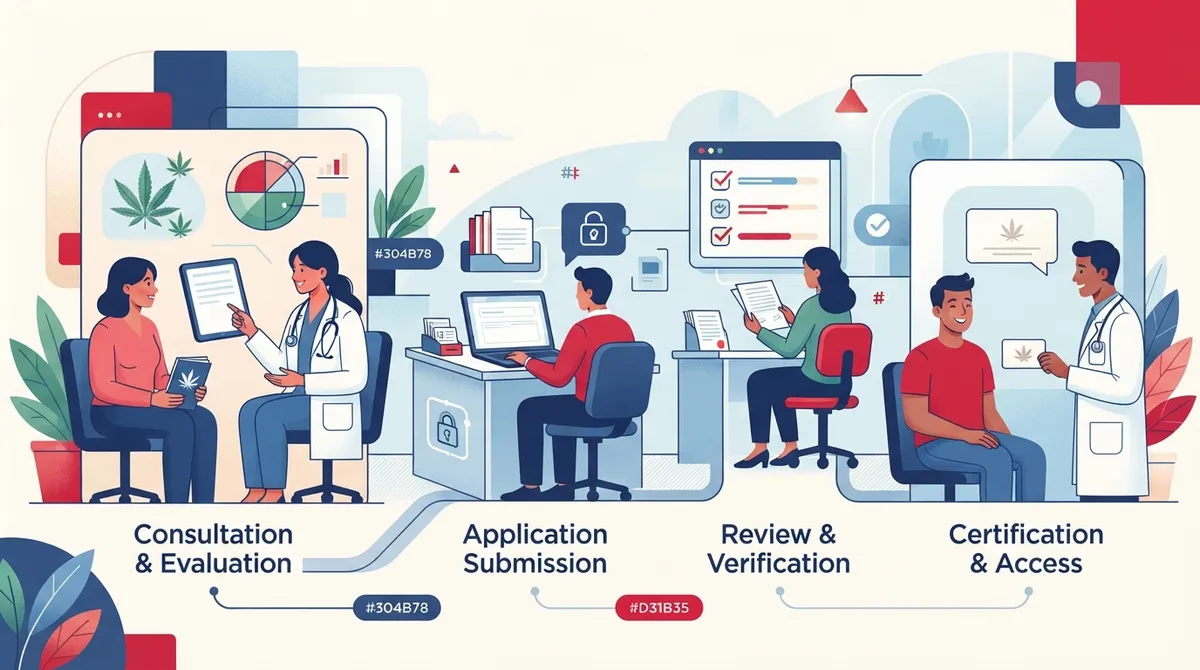
The Typical Timeline, Step by Step
- Book your evaluation. Availability varies by clinic. Some offer appointments within days.
- Attend your appointment. The visit itself is usually short, but it includes a review of your health history and qualifying condition.
- Receive your certification. The clinician submits it to the state or provides it to you, depending on local rules.
- Complete the state application. You enter your information, upload documents, and pay any state fee.
- Wait for state review. This is the most variable step.
- Receive approval and your card. Some programs issue a temporary approval while the physical card is on the way.
Each step can move quickly if you are organized. Delays usually come from missing information, not from the medical evaluation itself.
State Processing Times: Real Examples
State agencies publish their own estimates. These numbers show how different the process can be from one program to the next. They describe registry processing only, not the time it takes to get a clinician appointment.
|
State |
Reported Processing Time |
Notes |
|---|---|---|
|
Colorado |
1–3 business days (complete online applications); about 6–8 weeks for mailed applications |
Online filing is much faster than mail |
|
Arkansas |
Up to 14 days after the application and payment are received |
Incomplete or incorrect applications take longer |
|
Illinois |
Up to 30 business days to review a complete application, plus up to 15 days to issue a card after approval |
One of the longer official windows |
|
South Dakota |
Typically 2–4 days for review; 4–10 days for card delivery |
Review is fast, but mail adds time |
|
Nevada |
Cards should arrive within 7–10 business days after approval |
An approval letter may be used for up to 60 days |
|
Oregon |
A receipt after initial review can have the same legal effect as a card for 30 days |
Applicants are advised not to check status before 30 days |
These figures come from state health agencies and may change. Always confirm the current process with your clinician and your state program before you plan around any number.
Can You Get Certified the Same Day?
Sometimes the evaluation and certification happen in a single visit. That can feel like same-day progress. But a completed certification is not the same as a finished state approval. Most states still need to process your registration before you can legally use a card.
If you are in Florida and want to understand local options, our guide on same day cannabis certification in Tampa explains what is realistic. You can also read how MMJ certification in Tampa works in 2026 for a closer look at the local process.
Factors That Speed Up or Slow Down Your Timeline
Several things shape how long your certification takes. Knowing them lets you control what you can.
What Can Slow You Down
- Incomplete applications or missing fields
- Incorrect personal information or mismatched names
- Expired identification or residency documents
- Missing provider certification or attestation
- Payment problems or declined fees
- Mail delivery delays for paper applications or physical cards
- Limited clinician availability in your area
What Can Speed You Up
- Filing online instead of by mail when the state allows it
- Gathering records and ID before your appointment
- Checking every field for accuracy before you submit
- Choosing a clinic that helps you understand the state steps
A little preparation goes a long way. Our resource on what to bring to a medical cannabis visit lists the documents that keep things moving. It also helps to avoid common errors, which we cover in 9 cannabis card appointment mistakes to avoid.
Does Telehealth Change the Timeline?
Telehealth can shorten the wait for an appointment, because you do not need to travel or take extra time off. But whether a virtual evaluation is allowed depends entirely on your state. Some programs permit it. Others require an in-person visit or an existing patient-provider relationship.
Before you book, ask the clinic whether telehealth is accepted for certification in your state. This one question can save you from repeating an appointment later. For tech-savvy patients and busy families, a clear answer upfront is worth a lot.
Why Your Primary Care Relationship Matters
Medical cannabis is a health decision, and it works best when it fits into your overall care. A clinician who knows your history can spot possible medication interactions, review your qualifying condition, and monitor how you respond over time.
That is where a primary care and wellness clinic stands out. At InCare, patients can address cannabis eligibility alongside preventive screenings, chronic condition management, and whole-body wellness. Our team in Tampa and Riverview takes time to explain each step, so you are never guessing about what comes next. If you are still comparing options, our article on signs of a reputable medical marijuana clinic in Tampa shows what quality care looks like.
You can also see what patients say about their experience. Read feedback and visit us on Google for InCare to learn how we support people through the process.
Do Certifications Expire Before You Apply?
Yes, timing matters. A clinician's certification may have a limited window during which you must submit your state application. If you wait too long, you may need a new evaluation. Rules differ by state, so ask your clinician how long your certification stays valid.
The same is true for renewals. Cards and certifications typically expire after a set period. Planning ahead prevents gaps in access. If you already hold a card, learn how to renew a medical marijuana card in Tampa before yours lapses.
Can You Use a Temporary Approval While You Wait?
Some programs issue a temporary receipt or approval letter while your physical card is being produced. For example, Oregon's receipt carries the same legal effect as a card for 30 days, and Nevada allows an approval letter to be used for up to 60 days under its stated rules.
These provisions are state-specific, and many states do not offer them. Never assume a temporary document gives you the same rights as a card. Confirm what your state allows and keep a copy of every document you receive.
How to Make Your Certification Faster: A Quick Checklist
- Confirm your state's current rules and who may certify patients.
- Ask the clinic whether telehealth is allowed.
- Gather photo ID, proof of residency, and medical records.
- Choose a clinic that explains the state registry steps.
- Review your application for errors before submitting.
- Use online filing when available.
- Pay all fees promptly and keep receipts.
- Track your application and note any state response deadlines.
Following this list can remove many of the common delays. It also reduces stress, because you know what to expect at each stage.
Plan Your Path With a Trusted Care Team
The question of how long medical cannabis certification takes does not have one fixed answer. The clinical evaluation may be quick, but state review, document accuracy, and card delivery shape the real timeline. Understanding each part lets you plan, prepare, and avoid preventable delays.
InCare combines personalized primary care with advanced wellness services, so you get clear guidance and a team that treats the whole person. If you are ready to take the next step, book your appointment with InCare today, or contact our team with questions about the process. You can also follow our updates on Instagram, Facebook, and TikTok.
FAQs
Q: How long does it take to get a medical cannabis certification after an appointment?
A: A clinician may submit your certification during or shortly after your appointment, though same-day completion is not guaranteed. The state registry review that follows can take anywhere from a few days to several weeks, depending on where you live.
Q: How long does it take to receive a medical cannabis card after certification?
A: It varies by state. Colorado reports 1–3 business days for complete online applications, while South Dakota typically reviews applications in 2–4 days and delivers cards in another 4–10 days. Mailed applications and card delivery can add weeks.
Q: Can I get certified for medical cannabis through telehealth?
A: It depends on your state's rules. Some programs allow virtual evaluations, while others require an in-person visit or an existing patient-provider relationship. Ask your clinic before booking so you do not repeat an appointment.
Q: Why is my medical cannabis application taking longer than expected?
A: Common causes include incomplete applications, incorrect information, expired documents, missing provider certification, payment issues, and mail delays. Reviewing every field before you submit helps prevent most of these problems.
Q: Can I use a temporary approval while waiting for my card?
A: Only in some states. Oregon's receipt has the same legal effect as a card for 30 days, and Nevada allows an approval letter for up to 60 days. Because this is state-specific, confirm your program's rules before relying on any temporary document.