Key Takeaways
- Verify the physician's active Florida MD or DO license and cannabis course completion yourself through the Florida Department of Health's public lookup before booking.
- A legitimate clinic requires an in-person physical exam for your first certification; walk away from any clinic promising approval by phone or text.
- Avoid clinics that guarantee approval; honest providers explain whether your condition qualifies and admit when it does not.
- Get clinic fees in writing and remember the state ID card fee is paid separately to Florida's OMMU, not the clinic; confirm current amounts with OMMU.
Choosing a medical marijuana clinic is a health decision, not a shopping trip. In Florida, you cannot buy medical cannabis until a qualified physician evaluates you, certifies you in the state registry, and you receive a state ID card. That makes the clinic you pick the gatekeeper of the whole process. Some clinics are thorough and transparent. Others are rushed, vague about fees, or promise approval before they ever meet you.
If you are searching for a reputable medical marijuana clinic in Tampa, you need a clear way to judge quality. This guide gives you eight practical signs to look for, plus what Florida law requires, what the process costs, and how to avoid common mistakes. Whether you are a busy parent, a health-conscious professional, or someone managing a chronic condition, these steps help you choose with confidence.
Costs and rules can change, so always confirm current details with the clinic and the Florida Office of Medical Marijuana Use (OMMU) before you pay or book.
What Florida Law Requires Before You Start
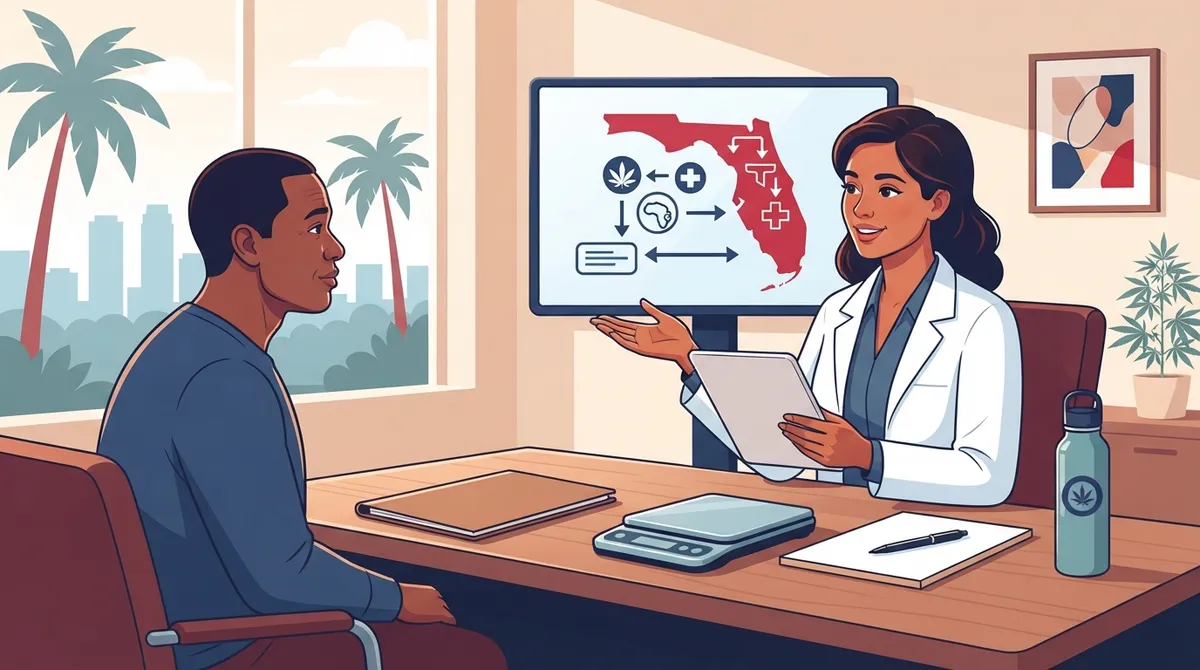
Before you compare clinics, know the basic rules. A reputable clinic will explain these clearly, without pressure.
To buy medical marijuana in Florida, a patient must:
- Be a permanent or seasonal Florida resident.
- Have a qualifying medical condition.
- Receive a physician certification entered into the Medical Marijuana Use Registry.
- Obtain a state registry identification card.
- Purchase products from a licensed Medical Marijuana Treatment Center (MMTC).
Florida lists 11 named qualifying conditions or categories, plus comparable conditions recognized under state law (Florida Statutes §381.986). These include cancer, epilepsy, glaucoma, HIV/AIDS, PTSD, ALS, Crohn's disease, Parkinson's disease, multiple sclerosis, a qualifying terminal condition, and chronic nonmalignant pain tied to a qualifying condition.
Sign 1: The Physician Holds an Active Florida License and the Required Training
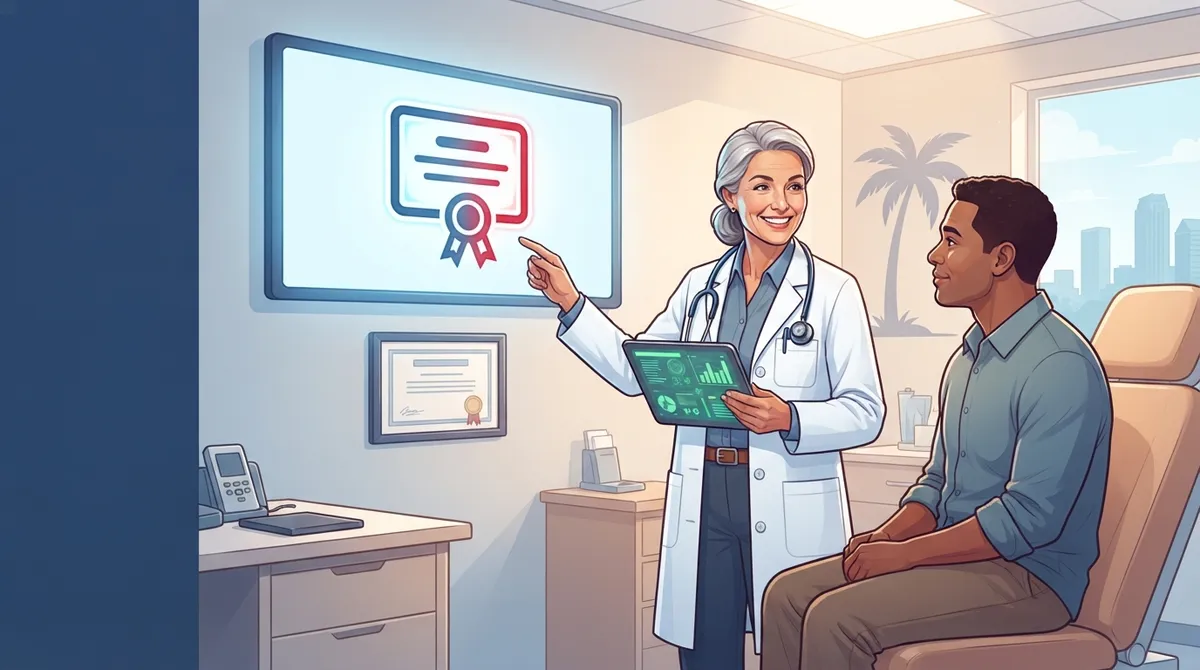
A certifying physician must be a licensed Florida MD or DO who has completed the required course and exam. This is the first thing to verify.
Do not rely on a website banner. Ask the clinic for the physician's name, then confirm the license through the Florida Department of Health's public lookup. A reputable clinic will gladly share this information. If a clinic avoids the question, treat that as a warning.
What to Verify
- An active, unrestricted Florida medical license.
- Completion of the state-required cannabis certification course.
- No unresolved disciplinary actions on the public record.
Sign 2: You Get a Real, In-Person Evaluation
Florida requires an in-person physical examination for an initial certification. This is not optional. A trustworthy clinic builds the visit around a genuine medical assessment.
During the physician visit, expect them to:
- Review your medical history and current medications.
- Check the prescription drug monitoring database.
- Document that the expected benefits outweigh the risks.
- Obtain your informed consent.
If a clinic promises approval over the phone, or says the exam is just a formality, walk away. A clinic that treats this as a rubber stamp puts both your health and your eligibility at risk.
Sign 3: The Clinic Explains Eligibility Without Guaranteeing Approval
Reputable providers never guarantee a card. They cannot, because approval depends on your diagnosis and the physician's clinical judgment.
A good clinic will tell you honestly whether your condition appears to qualify. If it does not, they will say so and may point you toward other options. That honesty is a strong signal of quality care.
Be cautious of ads that say "guaranteed approval" or "same-day card, no questions asked." Those claims often come from clinics focused on volume rather than patient care.
Sign 4: Fees Are Clear, Written, and Separated
Cost confusion is one of the most common patient complaints. Two separate costs exist, and a reputable clinic keeps them distinct:
- The clinic visit fee paid to the practice for your evaluation.
- The state ID card fee paid to Florida's OMMU, not to the clinic.
Clinic fees vary by provider. For example, one Tampa clinic lists a $149 new-patient evaluation and $129 recertification, while another lists $199 for a new-patient evaluation. These are provider-specific examples, not statewide rates. State card fees have also been reported with different figures, so confirm the current amount directly with OMMU.
|
Cost Item |
Who You Pay |
What to Ask |
|---|---|---|
|
New-patient evaluation |
The clinic |
Is this fee refundable if I do not qualify? |
|
Recertification visit |
The clinic |
What is the renewal price and timing? |
|
State ID card application |
Florida OMMU |
What is the current fee and processing time? |
|
Medical cannabis products |
Licensed MMTC dispensary |
Does the clinic sell products? (It should not.) |
Request the fee schedule in writing before your visit. Hidden add-ons are a red flag.
Sign 5: Certification, ID Card, and Products Are Kept Separate
Many first-time patients mix up three different things. A reputable clinic explains them plainly:
- Certification: The physician enters your approval into the registry, including authorized routes, forms, and amounts.
- State ID card: A separate application to the state after certification.
- Product purchase: Made at a licensed MMTC, not at the clinic.
A certification is not a prescription for a specific retail product. Your physician sets the authorized routes and amounts in the registry, and you obtain products through licensed treatment centers. If a clinic pushes particular brands or sells cannabis on site, question its priorities.
Sign 6: The Clinic Treats Cannabis as Part of Whole-Person Care
The best experiences happen when cannabis is one tool inside a bigger health plan. A purely transactional "card mill" rarely looks at your overall wellbeing.
This is where a primary care and wellness practice stands apart. At InCare, medical cannabis guidance sits alongside comprehensive primary care, chronic condition management, and preventive screening. That means your physician can consider your medications, your pain or anxiety history, and your long-term health goals together. You can learn more in our guide to a medical cannabis doctor in Tampa and how medical cannabis for chronic pain fits into care.
A reputable clinic will also discuss risks, side effects, and drug interactions. Cannabis is not right for everyone, and good physicians say so.
Sign 7: Renewals and Follow-Up Are Handled Properly
Your certification does not last forever. Renewal certifications require periodic physician evaluation. A 2026 legislative analysis states a physician must evaluate an existing patient at least once every 30 weeks before issuing a renewal certification, and current law permits telehealth for subsequent examinations.
A reputable clinic will:
- Tell you when your renewal is due.
- Offer a clear renewal process, including telehealth where allowed.
- Check in on how treatment is working and adjust if needed.
If you want a closer look at timing, see our article on how to renew a medical marijuana card in Tampa.
Sign 8: Patient Reviews and Reputation Hold Up
Reviews are not perfect proof, but patterns matter. Look for consistent mentions of respectful staff, clear explanations, and fair pricing. Be wary of clinics with many reviews that sound identical or focus only on speed.
You can see what patients say about InCare by visiting us on Google, where we hold a 4.8 out of 5 rating across 359 reviews. Read InCare reviews on Google to see how real patients describe their visits. You can also follow our updates on Instagram.
Quick Checklist: Reputable vs. Red Flag
|
Reputable Clinic |
Red Flag |
|---|---|
|
Verifiable Florida physician license |
Won't name the doctor |
|
In-person exam for first visit |
Approval by phone or text only |
|
Honest eligibility guidance |
"Guaranteed approval" claims |
|
Written, separated fees |
Surprise add-on charges |
|
Explains registry and MMTC steps |
Pushes products or brands |
|
Whole-person medical approach |
Rushed, transactional visit |
How to Prepare for Your First Visit
A little preparation makes the appointment smoother and more useful.
- Gather records. Bring diagnosis documentation, imaging, or notes from other providers.
- List your medications. Include supplements, since interactions matter.
- Bring a valid ID. Proof of Florida residency is required.
- Write your questions. Ask about risks, expected benefits, and renewal timing.
- Confirm costs. Get the clinic and state fees in writing.
For a deeper walkthrough, read how to prepare for a medical marijuana evaluation in Tampa and our overview of the medical marijuana card process in Tampa, Florida.
Why Choose a Primary Care Clinic for Medical Cannabis?
For tech-savvy professionals, busy families, and wellness-focused adults, convenience and trust both matter. A primary care practice offers continuity. Your cannabis certification is not an isolated event. It connects to your primary care, your cancer screening schedule, and your broader wellness plan.
InCare serves patients across Tampa and Riverview, with in-person visits and virtual options where permitted. Our physicians, including Dr. Naveen Paddu, focus on personalized, prevention-first care. If you are ready to take the next step, explore our medical marijuana license services in Tampa.
Common Mistakes to Avoid
- Choosing on price alone. The cheapest visit may skip the thorough exam you need.
- Confusing the card with a prescription. They are different steps with different rules.
- Ignoring renewal dates. A lapsed certification delays your access.
- Skipping the medication review. Cannabis can interact with other drugs.
- Trusting unverified claims. Always confirm the physician's license yourself.
Final Thoughts
A reputable medical marijuana clinic in Tampa is transparent about licensing, honest about eligibility, clear about costs, and focused on your overall health. Use the eight signs above as your filter, verify details with OMMU, and never feel rushed into a decision.
If you want a clinic that treats cannabis guidance as part of real medical care, InCare is built for exactly that. Our team brings the same standards to every patient, from preventive screenings to specialized wellness services. Book your appointment with InCare today, or contact our team with questions before you visit.
FAQs
Q: How do I get a medical marijuana card in Tampa, Florida?
A: You must be a Florida resident with a qualifying condition and be evaluated in person by a qualified Florida physician. The physician enters your certification in the Medical Marijuana Use Registry, and you then apply for a state ID card through the Office of Medical Marijuana Use.
Q: Does Florida require an in-person visit for a first certification?
A: Yes. Florida requires an in-person physical examination for an initial certification. Renewal certifications require periodic physician evaluation, and current law allows telehealth for subsequent examinations.
Q: How much does a Tampa medical marijuana clinic visit cost?
A: Clinic fees vary by provider, and Tampa clinics have listed new-patient evaluations from roughly $149 to $199. The state ID card fee is paid separately to Florida's OMMU, so confirm both current amounts before paying.
Q: How can I verify that a medical marijuana doctor in Tampa is qualified?
A: Ask for the physician's name and confirm an active Florida MD or DO license through the Florida Department of Health's public lookup. Also confirm the doctor has completed the state-required cannabis course and exam.
Q: Where can I buy medical marijuana after I am certified?
A: Patients obtain products from licensed Medical Marijuana Treatment Centers (MMTCs) after receiving their state registry ID card. A clinic certifies you but does not sell the products.