
Key Takeaways
- Growth hormone peptide 'stacks' are a marketing term, not a standardized or FDA-reviewed treatment, so ingredients and doses vary widely between sellers; always ask for the exact formula first.
- No growth hormone-increasing therapy is approved as an anti-aging intervention, and the Endocrine Society's 2023 statement found benefits do not clearly outweigh risks in healthy older adults.
- Trials in older adults reported fluid retention, joint pain, carpal tunnel symptoms, breast tissue enlargement in men, and higher rates of diabetes or impaired fasting glucose.
- A responsible Tampa evaluation starts with your medical history, medication review, and labs, and includes written monitoring and follow-up rather than a pre-built, prepaid protocol.
Search for a growth hormone peptide stack in Tampa and you will find clinics promising leaner bodies, faster recovery, and a younger feel. The pitch is easy to understand. The science is more complicated. A "stack" is a marketing term, not a standard medical treatment, and each ingredient in it carries its own evidence, legal status, and risks.
This guide explains what these stacks usually contain, what research says, and where the real safety concerns lie. It also covers what a responsible evaluation should look like for Tampa-area adults, whether you are a busy professional, a wellness-focused millennial, or a parent trying to stay healthy for your family. At InCare, our approach starts with your health history, lab data, and clear information, not a ready-made protocol.
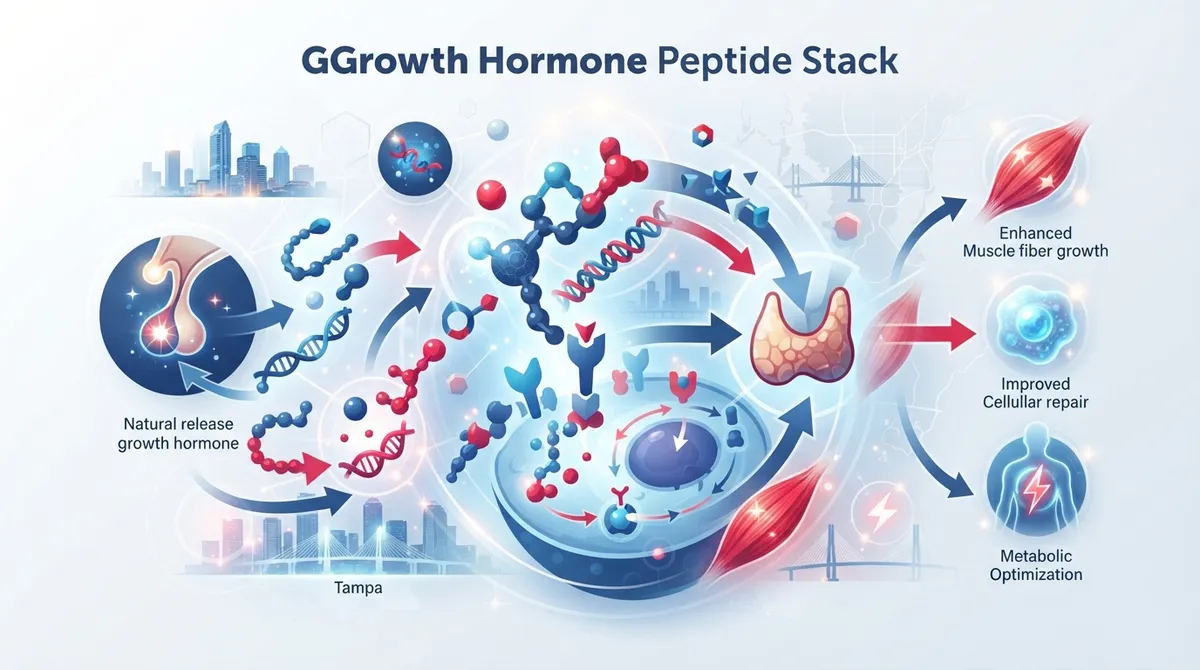
What Is a Growth Hormone Peptide Stack?
A growth hormone peptide stack is a combination of peptides marketed to influence growth hormone signaling in the body. The term does not describe one tested formula. Different sellers combine different ingredients, so two products with the same label may have little in common.
These peptides are often called secretagogues. In theory, they prompt the pituitary gland to release more of the body's own growth hormone rather than supplying the hormone directly. Common names you may see include:
- Sermorelin and tesamorelin, which mimic growth hormone-releasing hormone
- CJC-1295, a related releasing-hormone analog
- Ipamorelin, GHRP-2, and GHRP-6, which act on ghrelin receptors
- Ibutamoren (often called MK-677), an oral ghrelin mimetic
Because the term "stack" is not standardized, always ask for the exact ingredients, doses, and source of any product before you consider it.

What the Science Says About Growth Hormone Therapies
Growth hormone treatment has real, legitimate medical uses. It is appropriate for diagnosed adult growth hormone deficiency, which requires specific testing and specialist oversight. The picture changes sharply when healthy adults use these products for anti-aging or physique goals.
The Endocrine Society's 2023 scientific statement on hormones and aging states that no therapy designed to increase growth hormone secretion or action is approved as an anti-aging intervention. It also concludes that the evidence does not show benefits outweighing risks for growth hormone or secretagogues in otherwise healthy older adults. You can read the full statement in the Endocrine Society's scientific statement on hormones and aging.
What Studies Found in Older Adults
The same statement summarizes a meta-analysis of growth hormone studies in older adults. On average, participants lost about 2.1 kg of fat mass and gained about 2.1 kg of lean mass. That sounds appealing, but the trials also reported side effects, including:
- Fluid retention and swelling (edema)
- Joint pain (arthralgia)
- Carpal tunnel syndrome
- Breast tissue enlargement in men (gynecomastia)
- Higher rates of diabetes or impaired fasting glucose
Long-term outcomes remain uncertain. Modest changes in body composition do not automatically translate into better health, strength, or longer life.
Approved Uses vs. Marketed Uses
Many Tampa-area websites blur the line between what is approved and what is simply promoted. This table separates the two for several commonly mentioned substances.
|
Substance |
Regulatory Picture |
Key Point for Patients |
|---|---|---|
|
Tesamorelin |
FDA-approved to reduce excess abdominal fat in adults with HIV-associated lipodystrophy |
The approval is narrow. It does not make it a general weight-loss or anti-aging drug. |
|
Sermorelin |
Often discussed in wellness settings; status varies by product and use |
Ask which exact product is offered and why it is appropriate for you. |
|
Ipamorelin, GHRP-2, GHRP-6, ibutamoren |
Listed by the FDA among bulk substances that may present significant safety risks in compounding |
Concerns differ by substance, and safety information is limited for some. |
|
Combination "stacks" |
Not a standardized or FDA-reviewed product category |
Combining ingredients adds uncertainty, not proof. |
For a closer look at one frequently asked question, see our guide on ipamorelin FDA approval status in 2026.
Understanding Compounded Peptides
Many peptide stacks sold in clinics are compounded, meaning a pharmacy prepares them for an individual patient. Compounding can be appropriate when legal requirements are met. However, compounded drugs are not FDA-approved, and the agency does not review them for safety, effectiveness, or quality the way it reviews approved medications.
The FDA's page on bulk drug substances that may present significant safety risks in compounding names GHRP-2, GHRP-6, ipamorelin acetate, and ibutamoren. The agency cites concerns such as impurities and immune reactions for some peptides, and limited safety information for others. Clinic supervision does not make an unapproved or investigational product proven or risk-free.
Quality matters just as much as the ingredient list. Our article on ways to verify CJC-1295 quality explains what to look for in sourcing and testing.
Risks and Side Effects to Understand
Risks depend on the specific drug, dose, and your own health. Based on the published research and regulatory guidance, patients should discuss the following with a licensed clinician:
- Blood sugar changes. Growth hormone activity can affect glucose regulation, which matters for anyone with prediabetes, diabetes, or a strong family history.
- Fluid retention and joint symptoms. Swelling, aching joints, and hand numbness were reported in older-adult studies.
- Product quality concerns. Impurities, wrong doses, or mislabeled products are a risk when sourcing is unclear.
- Drug interactions. Peptides can interact with other medications and conditions, so a full medication review is essential.
- Unknown long-term effects. Many peptides lack long-term human safety data.
If you are weighing a combination, read about common errors in our piece on Ipamorelin and CJC-1295 stack mistakes. You may also want to review CJC-1295 contraindications before any consultation.
What a Responsible Tampa Evaluation Should Include
A trustworthy clinic should slow the process down, not speed it up. Whether you live in downtown Tampa or Riverview, a sound evaluation typically includes these steps:
- A review of your symptoms, goals, and full medical history
- A medication and supplement review to flag interactions
- Relevant lab testing, interpreted in the context of your symptoms
- A plain-language discussion of the evidence and FDA status of each ingredient
- A written follow-up plan with defined check-ins
Monitoring is not optional if a clinician and patient decide to proceed. Learn more about what monitoring is needed with growth hormone peptides, and see our 15 questions to ask a peptide therapy clinic in Tampa before booking.
Red Flags to Watch For
Be cautious if a provider does any of the following:
- Offers a one-size-fits-all stack without lab work or a medical history
- Promises anti-aging, muscle gain, or fat loss results
- Cannot name the compounding pharmacy or explain product testing
- Describes a compounded peptide as "FDA-approved"
- Pressures you to prepay for a long package
If any of these sound familiar, step back and ask for the evidence in writing. A clinician who is confident in their care will welcome the questions.
Evidence-Based Options Worth Discussing First
For many people, the goals behind a peptide stack, such as better body composition, energy, sleep, and recovery, can be addressed with approaches that have stronger evidence. A primary care evaluation may uncover sleep problems, thyroid or hormone issues, metabolic concerns, or nutrient gaps that explain how you feel.
Depending on your health profile, your clinician may discuss physician-supervised weight management, targeted lab testing, body composition analysis, or metabolic breath analysis. If sleep is a concern, our guide on when to see a doctor for poor sleep is a useful starting point. For a wider look at the topic, read peptides for athletes: hype vs. medical reality.
How InCare Approaches Peptide Questions
InCare is a personalized primary care and wellness clinic with locations in Tampa and Riverview, plus virtual visits. Our approach is built on prevention, advanced testing, and honest conversation. If you are curious about peptides, we start by understanding your goals and health history, then explain what the evidence does and does not support for each option. You can see what patients say by reading InCare reviews on Google.
We also encourage you to follow our updates on Instagram, Facebook, and TikTok for practical health education. To understand how costs and services compare, see what monthly peptide therapy costs in Tampa.
Conclusion: Start With Evaluation, Not a Stack
A growth hormone peptide stack is not a single proven treatment. Evidence for healthy adults is limited, several ingredients carry FDA safety concerns in compounding, and the potential side effects are real. The smartest first step is a thorough medical evaluation that looks at your whole health, not a pre-built product.
If you are in Tampa or Riverview and want honest, personalized guidance, book an appointment with InCare to talk through your goals with a licensed clinician. Have a question first? Contact our team and we will point you in the right direction.
FAQs
Q: What is a growth hormone peptide stack?
A: It is a marketing term for a combination of peptides promoted to influence growth hormone signaling. It is not one standardized or FDA-reviewed treatment, so the ingredients and doses vary widely between sellers. Always ask for the exact ingredient list before considering any product.
Q: Are growth hormone peptides FDA-approved for anti-aging or muscle gain?
A: No. The Endocrine Society's 2023 scientific statement notes that no therapy to increase growth hormone secretion or action is approved as an anti-aging intervention. Tesamorelin is FDA-approved only to reduce excess abdominal fat in adults with HIV-associated lipodystrophy.
Q: What are the risks of growth hormone-releasing peptides?
A: Research on growth hormone interventions in older adults reports fluid retention, joint pain, carpal tunnel symptoms, and impaired glucose regulation. The FDA also lists several of these peptides among substances that may present significant safety risks in compounding. Long-term outcomes remain uncertain.
Q: What should I ask a Tampa clinician before considering peptide therapy?
A: Ask for each ingredient's FDA status, the evidence behind it, the compounding pharmacy used, and how testing and follow-up will work. A responsible clinician will review your history, medications, and labs before discussing any option. You should also ask what the alternatives are.