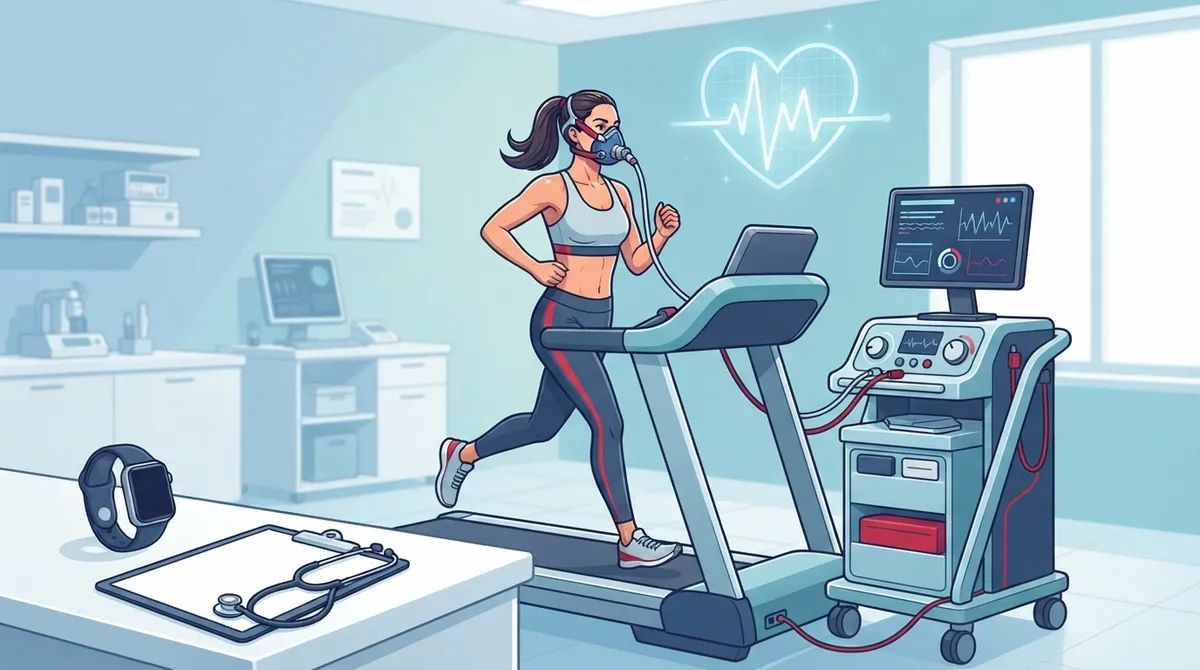
Key Takeaways
- VO2 max measures the highest rate your body can use oxygen during hard exercise, and it reflects overall cardiorespiratory fitness, which is linked to heart health and long-term survival.
- Direct VO2 max testing uses a mask and treadmill or bike to measure oxygen and carbon dioxide, and is the most precise option; smartwatch estimates are easier but generally less accurate.
- Keep your test protocol consistent when retesting, because VO2 max and VO2 peak are reported differently and treadmill and bike results can vary.
- A VO2 max result is one piece of the health picture, not a diagnosis, so a clinician should review your history, symptoms, and medications before any maximal test.
- People with chest pain, fainting, unexplained shortness of breath, or known heart or lung conditions need medical evaluation before testing and may need a gentler submaximal option.
- Regular aerobic exercise, strength work, healthy weight, and good sleep can improve fitness over time, and many people retest after a few months of consistent training to track change.
Most people have heard that a strong heart and lungs help you live longer. Few know how to measure that strength. That is where VO2 max testing comes in. So, what is VO2 max testing? It is a way to measure, or estimate, the most oxygen your body can use during hard exercise. The result gives a clear snapshot of your cardiorespiratory fitness.
In primary care and wellness, this number matters. The American Heart Association has called cardiorespiratory fitness an important health risk marker. It is linked to heart health and long-term survival. For busy professionals, young families, and anyone curious about proactive health, VO2 max testing offers a science-based baseline. It also gives a way to track progress over time.
This guide covers seven key things to know about VO2 max testing in 2026. You will learn how the test works, how to prepare, and who should think twice. You will also see how it fits into whole-body care at InCare, which serves patients in Tampa and Riverview.
1. What VO2 Max Testing Actually Measures
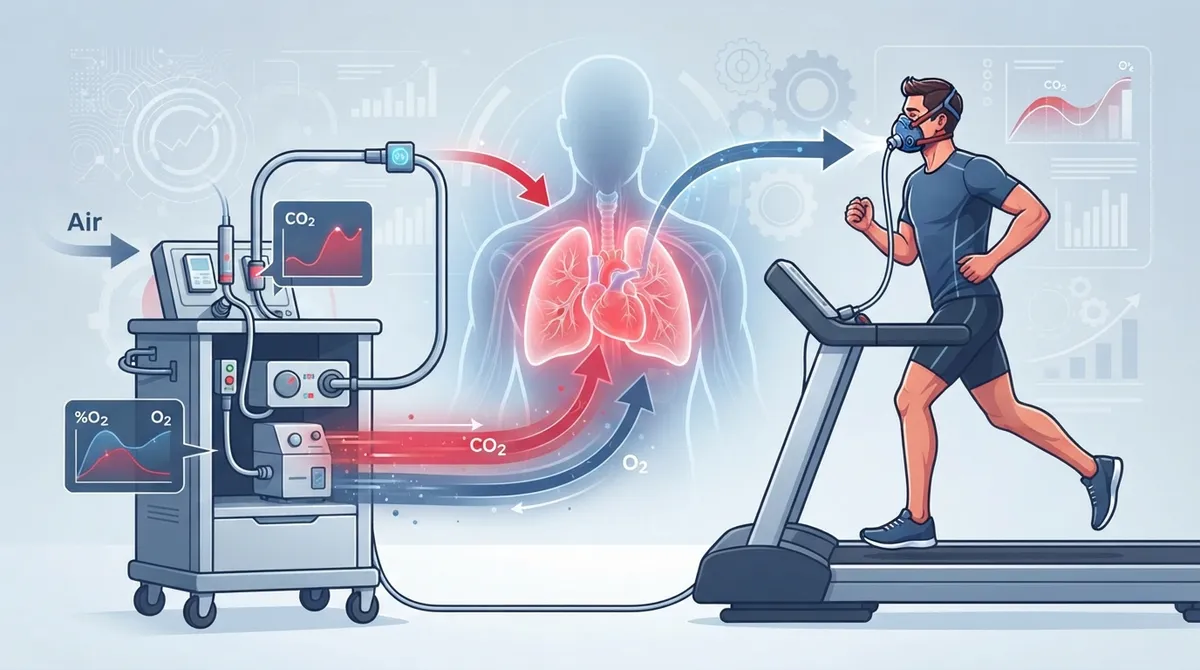
VO2 max stands for maximal oxygen uptake. It is the highest rate at which your body can take in, carry, and use oxygen during intense exercise. The result is usually reported in milliliters of oxygen per kilogram of body weight per minute, written as mL/kg/min.
Think of your body as an engine. Your lungs bring in air. Your heart pumps oxygen-rich blood. Your muscles use that oxygen to make energy. VO2 max shows how well this whole chain works together. A higher number generally means a stronger, more efficient system.
VO2 max testing is one measure of cardiorespiratory fitness. It is not a diagnosis by itself. Results are read in context, including your age, sex, health history, medications, and the exercise method used.
Why Fitness Is Treated Like a Vital Sign
The American Heart Association has advocated treating cardiorespiratory fitness as a clinical vital sign. Researchers found it is independently linked to heart disease and all-cause mortality. Its 2016 scientific statement reported that low fitness, below 5 METs, is tied to higher mortality risk. Levels above 8 to 10 METs are tied to better survival.
These are population-level patterns. They do not predict what will happen to one person. They do explain why doctors pay attention to fitness. Even so, this does not mean every patient needs a maximal VO2 test.
2. How a Direct VO2 Max Test Works
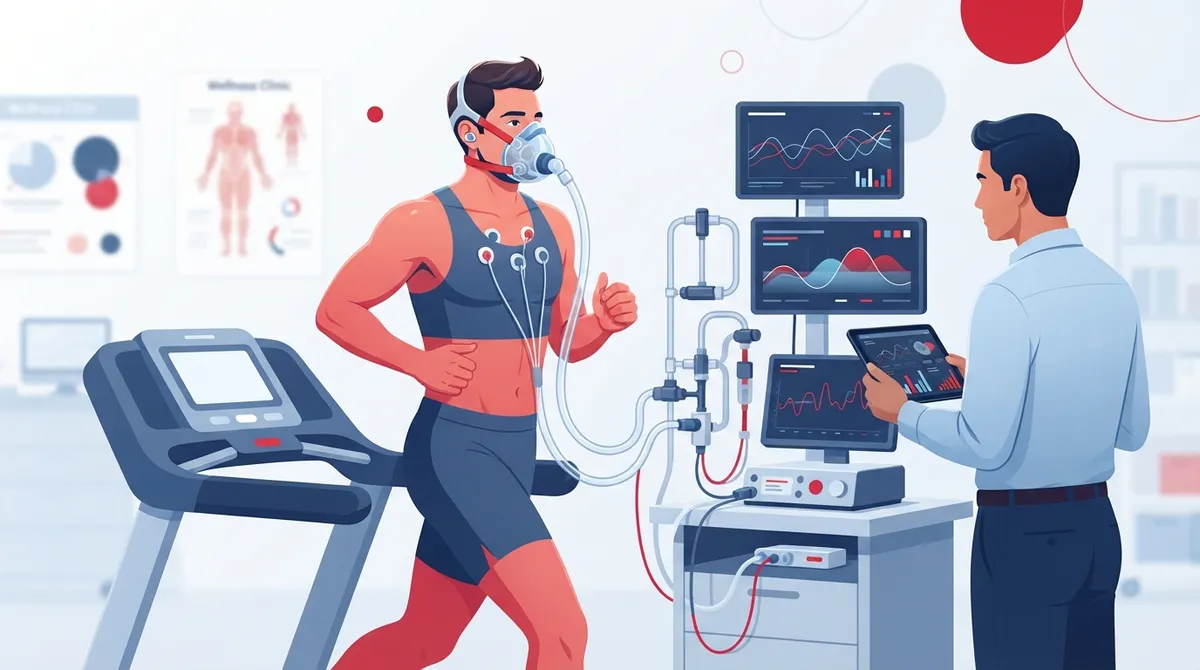
A direct test is a form of cardiopulmonary exercise testing, often called CPET. You exercise on a treadmill or stationary bike while wearing a snug mask. The mask measures the oxygen you take in and the carbon dioxide you breathe out. The effort slowly rises until you reach your limit.
Here is what usually happens, step by step:
- Health review. A clinician checks your symptoms, medical history, and medications to confirm the test is safe for you.
- Setup. You are fitted with a mask and, in some settings, a heart rate monitor.
- Warm-up. You start at an easy pace so your body can settle in.
- Gradual increase. Speed, incline, or resistance rises in steps every minute or two.
- Peak effort. You continue until you cannot go any further or the clinician stops the test.
- Cool-down. You slow down gradually while staff monitor your recovery.
The hard part usually lasts about 8 to 12 minutes. The full visit takes longer because of screening, setup, and review. This is why the test feels demanding but short.
3. VO2 Max vs. VO2 Peak: A Small Difference That Matters
You may see both terms on a report. They are not the same. A test may identify true VO2 max when your oxygen use levels off, or plateaus, even as the workload keeps rising. If you do not reach a clear plateau, the result is often reported as VO2 peak.
This distinction matters when you compare results. The test method, the protocol, and your effort all affect the number. A treadmill result and a bike result can differ. For fair tracking over time, it helps to repeat the same protocol, ideally with the same clinic.
|
Term |
What It Means |
When It Is Used |
|---|---|---|
|
VO2 max |
Oxygen use plateaus despite rising workload |
A clear plateau is seen during the test |
|
VO2 peak |
Highest oxygen use reached during the test |
No clear plateau is reached |
4. Direct Testing vs. Smartwatch Estimates
Many wearables now show a VO2 max number. These are estimates. They rely on heart rate response and other inputs, not on gas analysis. They are easy and low cost, but they are generally less accurate than direct testing.
A 2023 study in Scientific Reports described this split clearly. Direct methods use graded exercise with respiratory gas measurement. Indirect methods estimate fitness from heart rate or similar inputs. The indirect route is more accessible, but less precise.
Direct testing is more precise but needs special equipment, trained staff, time, and cost. Estimates should not be treated as interchangeable with direct measurements. The table below shows the trade-offs.
|
Method |
Accuracy |
Access and Cost |
Best For |
|---|---|---|---|
|
Direct CPET with gas analysis |
Highest |
Needs equipment and staff |
Precise baseline and tracking |
|
Submaximal or field test |
Moderate |
Simple and lower cost |
General fitness checks |
|
Smartwatch or app estimate |
Lower |
Very easy |
Daily trends and motivation |
The American Heart Association notes that CPET is the gold-standard approach for assessing exercise capacity. Less intense methods can still be a good fit when a maximal test is unnecessary or unsuitable.
5. Who Benefits Most From VO2 Max Testing
Testing is not right for everyone. It tends to help people with a clear goal. Whether it is appropriate depends on your health and what you want to learn.
- Tech-savvy professionals who like data and want a precise fitness baseline.
- Wellness seekers building a prevention plan that includes labs, screenings, and fitness metrics.
- Active adults and recreational athletes who want to train smarter.
- Busy parents who want a simple, structured start to better fitness.
- People starting a weight loss program who want a baseline before they begin.
Results can inform an individual exercise plan. They can also give you a starting point for tracking change. If you are curious about this, read more on who should get VO2 max testing before you decide.
Who Should Be Careful
A clinician should review your symptoms, history, and risks before any maximal test. Chest pain, unexplained shortness of breath, fainting, or known heart or lung conditions need medical evaluation first. In those cases, a clinically supervised protocol may be needed. Some people may be better served by a gentler, submaximal option.
6. How to Prepare for Your Test
Good preparation helps you give your best effort. It also keeps the visit safe. Follow any specific instructions from your clinic. As a general guide, consider these steps:
- Wear comfortable workout clothes and supportive athletic shoes.
- Avoid a heavy meal in the hours before the test.
- Limit caffeine and avoid hard workouts the day before, unless told otherwise.
- Stay well hydrated.
- Bring a list of your medications and tell staff about any symptoms.
- Sleep well the night before.
Ask your clinician whether any medicine you take could change your heart rate or exercise response. Some drugs can affect results. That is one reason context matters when your numbers are reviewed.
7. What a Good VO2 Max Is and How to Improve It
There is no single "good" number for everyone. Healthy ranges depend on age and sex. VO2 max also tends to decline with age, but regular training can slow that drop. Your clinician can compare your result against reference values for people like you.
The AHA statement found that each 1-MET gain in fitness is linked to roughly 10% to 20% lower mortality rates. It also noted that gains of 1 to 2 METs are tied to about 10% to 30% fewer adverse heart events. These are population-level links, not guaranteed effects for you. Still, they show why steady fitness work pays off.
Ways to Build Cardiorespiratory Fitness
- Regular aerobic exercise. Brisk walking, cycling, swimming, or jogging done most days of the week.
- Interval training. Short bursts of harder effort mixed with recovery, if your clinician says it is safe.
- Strength work. Muscle supports metabolism and overall performance.
- Healthy weight and sleep. Both affect how well your body uses oxygen. See our guide on when to see a doctor for poor sleep.
- Retesting on a schedule. Many people retest after a few months of consistent training to see change.
Fitness is one piece of the picture. Pairing it with metabolic data can add useful detail. For example, a metabolic breath test looks at how your body uses fuel, while VO2 max looks at your peak capacity.
How VO2 Max Testing Fits Into Primary Care and Wellness
A single number is rarely the full story. The best use of VO2 max testing is inside a wider plan. That plan may include a physical exam, lab work, cancer screenings, and personal goals. A primary care team can tie it all together and decide if testing makes sense for you.
InCare combines primary care, urgent care, and advanced wellness services under one roof. The team uses modern technology with real medical expertise. That means your fitness data is reviewed by clinicians who know your history, not just read from a screen. If you want help choosing a provider, our guide on how to choose a VO2 max clinic in Tampa Bay lists what to look for.
Patients in the Riverview area can also read about VO2 max testing in Riverview. If you want to know what a visit feels like, see what to expect at a VO2 max test. You can also see what other patients say about their care, and read InCare reviews on Google.
Stay connected for health tips and updates. Follow InCare on Instagram, Facebook, and TikTok.
Key Takeaways
- VO2 max measures the most oxygen your body can use during hard exercise.
- Direct testing with a mask is the most precise method. Wearable estimates are less exact.
- VO2 peak and VO2 max are not the same, so keep the protocol consistent when you retest.
- The test is a piece of the health picture, not a diagnosis.
- A clinician should review your history and symptoms before any maximal test.
- Steady training, good sleep, and a healthy weight can improve your fitness over time.
Take the Next Step With InCare
Understanding your fitness is a smart move for long-term health. If you are asking what is VO2 max testing and whether it fits your goals, a conversation with a clinician is the best place to start. The InCare team can review your health history, answer your questions, and help you build a plan that fits your life.
Ready to learn more? Book your appointment with InCare today, or contact our team with questions. We serve patients across Tampa and Riverview with personalized, preventive care.
FAQs
Q: What happens during a VO2 max test?
A: You exercise on a treadmill or stationary bike while wearing a mask that measures the oxygen you use and the carbon dioxide you breathe out. The effort increases in steps until you reach your limit, which usually takes about 8 to 12 minutes. A clinician monitors you throughout and guides your cool-down.
Q: How accurate are smartwatch VO2 max estimates?
A: Wearable estimates rely on heart rate and other inputs rather than direct gas analysis. They are useful for tracking general trends but are generally less accurate than a direct test. They should not be treated as interchangeable with a measured result.
Q: Is a VO2 max test safe, and who should avoid it?
A: For many healthy adults, a supervised test is considered safe after a clinician reviews symptoms, history, and risks. People with chest pain, fainting, unexplained shortness of breath, or known heart or lung conditions need medical evaluation first. They may need a clinically supervised protocol or a gentler submaximal option.
Q: What is the difference between VO2 max and VO2 peak?
A: VO2 max is reported when oxygen use plateaus even as the workload keeps rising. VO2 peak is the highest value reached when no clear plateau appears. Because protocols and effort affect the result, repeat tests should use the same method for fair comparison.
Q: How can I improve my VO2 max, and when should I retest?
A: Regular aerobic exercise, interval training when it is safe for you, strength work, healthy weight, and good sleep can all support fitness. Many people retest after a few months of consistent training to measure change. Your clinician can suggest a schedule that fits your goals and health.