
Key Takeaways
- Longevity supplements are a marketing label, not a medical category, and evidence varies widely by ingredient, so each product needs its own review before you spend money on it.
- The USPSTF found insufficient evidence for multivitamins and most single nutrient supplements to prevent heart disease or cancer in healthy adults, and recommends against beta-carotene and vitamin E for these purposes.
- Supplements can interact with prescription medicines and chronic conditions; a clinician should review your full medication and supplement list, especially if you have heart, kidney, or diabetes issues or are pregnant.
- Because the FDA does not approve supplements for safety and effectiveness before sale, bring every bottle or label photo to a primary care visit so ingredients, doses, and overlaps can be checked.
Walk through any wellness aisle or scroll any social feed in 2026, and you will see bold promises. Products claim to slow aging, boost cellular energy, and add healthy years to your life. It is easy to feel tempted. But a growing question deserves a clear answer: should longevity supplements be doctor supervised?
For most people, the answer is yes, or at least reviewed by a clinician. "Longevity supplement" is a marketing label, not a medical category. The products inside can range from simple vitamins to botanicals and experimental compounds. The evidence for each one is very different.
This guide explains four practical reasons to involve a primary care clinician. It also shows what a good review looks like. Whether you are a busy parent, a health-conscious professional, or a young adult exploring prevention, these points can help you spend less, avoid risk, and focus on what works.

Reason 1: The Evidence Is Limited and Varies by Ingredient
Many longevity products promise to extend lifespan. Human proof for those claims is thin. The U.S. Preventive Services Task Force (USPSTF) reviewed this topic in 2022. It found the evidence was insufficient to judge the benefits and harms of multivitamins and most single or paired nutrient supplements for preventing cardiovascular disease or cancer in generally healthy adults.
That finding matters. It does not say supplements never help. It says we lack strong proof for broad prevention. A clinician can separate three very different situations:
- A documented deficiency, such as low vitamin D or low B12, where treatment is well supported.
- An evidence-based clinical need, such as a supplement for a specific diagnosed condition.
- Speculative anti-aging use, where claims often outrun the research.
Without that sorting, it is hard to know which category your product falls into. A review also helps you avoid paying for products that have little human data behind them.
Why "Longevity" Is a Marketing Term
No standard rule defines what a longevity supplement must contain. One bottle may hold common vitamins. Another may hold an emerging compound with little human research. Claims about extending human lifespan should never be assumed proven. Each ingredient needs its own review. For example, if you are curious about newer compounds, it helps to read about what MOTS-c research studies really show before spending money on them.
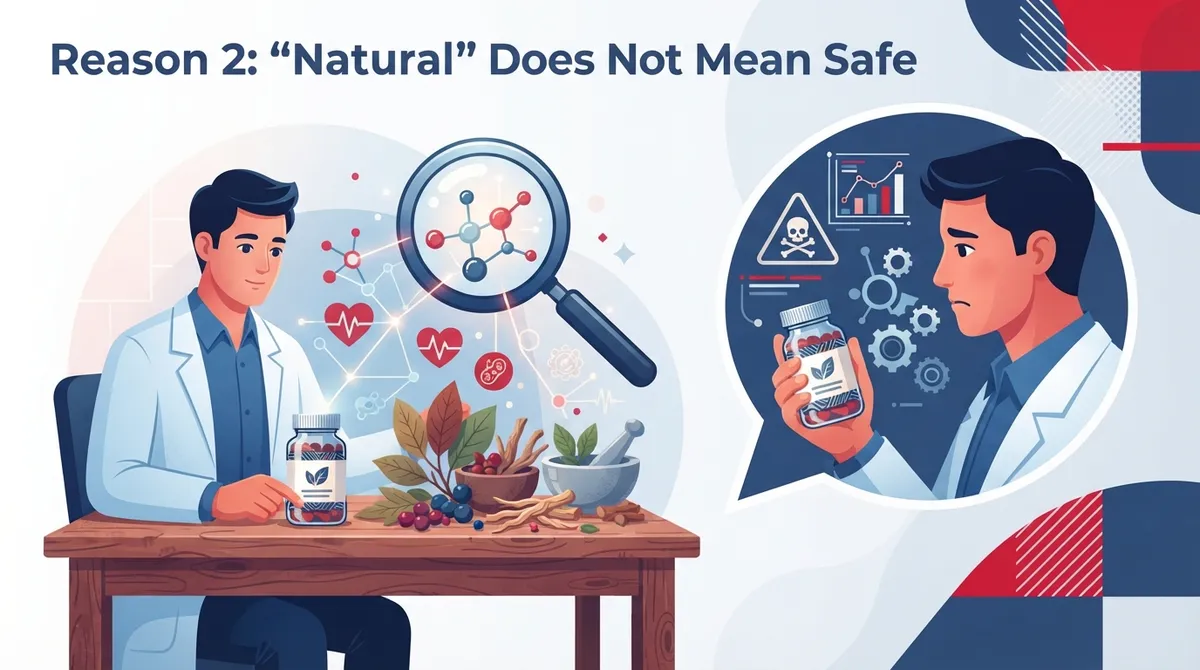
Reason 2: "Natural" Does Not Mean Safe
Many people assume a supplement is harmless because it is sold over the counter. That is not always true. Risks can include excessive intake, side effects, contamination, inaccurate labels, and interactions with medicines or other supplements.
The USPSTF also recommends against two well-known supplements for preventing heart disease or cancer:
- Beta-carotene: Harms outweigh benefits. It can raise lung cancer risk in people at high risk, including smokers and people with occupational asbestos exposure.
- Vitamin E: No net benefit for these purposes.
These are common ingredients in "antioxidant" and "anti-aging" blends. A product can look gentle on the label and still be a poor choice for your health history. A clinician can check each ingredient against your risks.
Common Risk Areas at a Glance
|
Risk |
What It Means |
How a Clinician Helps |
|---|---|---|
|
Excess dose |
Taking more than the body needs can cause harm |
Sets a reasonable dose and duration |
|
Drug interactions |
Supplements can change how medicines work |
Reviews your full medication list |
|
Poor quality |
Labels may not match what is in the bottle |
Guides you toward better-vetted products |
|
Hidden conditions |
Some ingredients are risky in certain illnesses |
Checks your health history first |
|
Stacking products |
Several products may repeat the same ingredient |
Removes overlap and reduces total load |
Reason 3: Supplements Can Interact With Your Medicines and Conditions
Supervision matters most for certain groups. Clinician review is especially wise if you:
- Have a chronic condition, such as heart disease, kidney disease, diabetes, or high blood pressure.
- Take prescription or over-the-counter medicines.
- Are pregnant or may become pregnant.
- Plan to use high doses or several products at once.
Note that the USPSTF recommendation does not apply to people with known nutritional deficiencies, chronic illness, hospitalization, or pregnancy. These groups may have different clinical needs. That is another reason a one-size-fits-all supplement plan can miss the mark.
Interactions are not always obvious. Some supplements affect blood clotting. Others change blood sugar or blood pressure. Some can alter how the liver processes medicine. A clinician or pharmacist can check your full list and flag problems before they happen. If you are also managing medicines, this guide to prescription management tips for better health in 2026 shows how to keep your list organized.
The Same Care Applies to Other Wellness Products
This is not only about pills. Antioxidant products and injectables deserve the same caution. For example, patients asking about antioxidants often benefit from reading glutathione side effects you should know in 2026. And if you are curious about D3 and K2 combinations, see how to decide if vitamin D3 and K2 supplements fit you.
Reason 4: Regulation Does Not Verify Supplements Before Sale
In the United States, dietary supplements are regulated differently from prescription drugs. The FDA generally does not approve supplements for safety and effectiveness before they reach the market. Manufacturers are responsible for product safety and labeling. The FDA can act against products that are unsafe or misbranded, but that usually happens after the product is already on shelves.
This means you carry more of the burden when you buy. A bold claim on a label does not prove a benefit. A clinician can help you:
- Read labels and spot weak or exaggerated claims.
- Check for overlapping ingredients across products.
- Decide whether testing is needed before you start.
- Monitor for side effects once you begin.
For more on this theme, see quality longevity supplements under doctor care in 2026.
What a Doctor-Supervised Supplement Review Looks Like
A good review is simple, practical, and personal. Here is what you can expect at a primary care visit:
- Goal setting. You explain why you want a supplement. Is it energy, sleep, heart health, or general aging?
- History and medication review. Your clinician looks at your conditions, medicines, allergies, and family history.
- Label check. You bring bottles or photos of labels so every ingredient and dose can be reviewed.
- Testing when appropriate. Labs may confirm a deficiency before you take anything. Advanced tools such as a metabolic breath test can add helpful context.
- A clear plan. You leave with a dose, a time frame, and a follow-up date to check progress and side effects.
Never stop prescribed treatment in favor of a supplement. Supplements should add to your care, not replace it.
What to Bring to Your Visit
- Photos or the actual bottles of every supplement you take
- A full list of prescription and over-the-counter medicines
- Notes on symptoms, goals, and any past reactions
- Recent lab results, if you have them
Supervised vs. Unsupervised Supplement Use
|
Factor |
Doctor-Supervised |
Self-Directed |
|---|---|---|
|
Starting point |
Deficiency, need, or clear goal |
Marketing claims or trends |
|
Dose |
Set to your needs and health history |
Often copied from the label or online |
|
Interaction check |
Reviewed against your medicines |
Usually skipped |
|
Monitoring |
Follow-up and labs when needed |
Rarely tracked |
|
Cost control |
Drops products with weak evidence |
Easy to overspend on overlap |
Who Benefits Most From Supervision?
Nearly anyone can gain from a quick review. Still, some readers will see special value:
- Tech-savvy professionals and wellness seekers who track data and want a plan based on labs, not hype.
- Busy parents who need a simple, safe plan that does not add stress or cost.
- Young adults and women exploring prevention who see supplement claims online and want a trusted second opinion.
If you want a longer-term view on prevention, the guide to getting the most from preventive care visits in 2026 is a helpful next read. And if you are comparing clinics, who provides concierge longevity medicine in Tampa can help you ask better questions.
How InCare Supports Safer Longevity Choices
At InCare, our clinicians in Tampa and Riverview combine primary care with advanced wellness tools. That includes lab work, DNA gene testing, metabolic breath analysis, and body composition tracking. These tools help turn guesswork into a plan built around you. We treat supplements as one piece of a bigger picture that includes screening, sleep, nutrition, movement, and chronic condition care. You can also read InCare reviews on Google to see how patients describe their experience, and follow our updates on Instagram, Facebook, and TikTok.
The Bottom Line
So, should longevity supplements be doctor supervised? For most people, clinician review is a smart and low-cost safety step. The evidence for many anti-aging products is limited. Risks can be real, even for products that feel harmless. Interactions with medicines are common. And the supplement market is not checked in advance the way prescription drugs are.
A short conversation with a primary care clinician can save money, protect your health, and keep your focus on what truly supports healthy aging. If you are ready for a personalized, evidence-first plan, book an appointment with InCare today, or contact our team with questions. Bring your bottles, and we will walk through them together.
FAQs
Q: Should I talk to my doctor before taking longevity supplements?
A: Yes. A clinician can review your health history, medicines, and goals to decide whether a supplement is useful and safe. This is especially important if you have a chronic condition, take medication, are pregnant, or plan to use high doses or several products.
Q: Are longevity supplements proven to extend lifespan in humans?
A: No. "Longevity supplement" is a marketing term, not a medical class. Evidence varies by ingredient, and claims of extending human lifespan should not be assumed proven. The USPSTF found insufficient evidence for most vitamin and mineral supplements to prevent cardiovascular disease or cancer in healthy adults.
Q: Can longevity supplements interact with prescription medications?
A: Yes. Supplements can change how medicines work or add to their side effects. A clinician or pharmacist can review your full medication and supplement list to flag interactions before you start.
Q: Are anti-aging supplements FDA approved?
A: Generally, no. The FDA does not approve dietary supplements for safety and effectiveness before they are sold. Manufacturers are responsible for product safety and labeling, and the FDA can act against products that are unsafe or misbranded.
Q: What should I bring to a supplement review?
A: Bring the bottles or clear photos of every label, a list of all medicines, notes on your symptoms and goals, and any recent lab results. This lets your clinician check each ingredient and dose and decide whether testing is needed.