
Key Takeaways
- Verify your preferred doctors, hospitals, and pharmacies are in-network before enrolling in an HMO plan, as out-of-network non-emergency care is typically not covered and can result in full out-of-pocket costs.
- Understand the difference between a referral (PCP's order to see a specialist) and prior authorization (plan's advance approval for a service), as confusion between these can delay care or lead to denied claims.
- Build a strong relationship with your primary care provider rather than treating them as just a gatekeeper; a knowledgeable PCP can streamline referrals, coordinate care, and provide preventive services that maximize plan value.
- Avoid seeking non-emergency care outside your HMO's network unless your plan has a point-of-service option, as you will likely face the full bill for services not covered by the plan.
- Review your plan documents annually and confirm coverage details with your insurer before scheduling any service, as networks and benefits can change year to year and directory information may be outdated.
- Maximize preventive care benefits by scheduling annual wellness visits, age-based screenings, and vaccinations through your PCP, as HMOs emphasize prevention and early detection to manage costs effectively.
Picking a health plan HMO can feel simple at first. The monthly cost looks fair, the plan promises coordinated care, and the brochure says prevention matters. Then a real health need shows up, and the fine print becomes very important.
A health plan HMO (health maintenance organization) is an insurance plan that generally limits non-emergency care to doctors, hospitals, and providers who work for or contract with the plan. Many members also need to live or work in the plan's service area. When you understand these rules, an HMO can support steady, preventive care. When you do not, it can lead to denied claims, surprise bills, and delays.
KFF's 2025 Employer Health Benefits Survey found that 12% of covered workers were enrolled in an HMO. That is a smaller share than PPOs at 46%, but HMOs remain common in some states. In California, 34% of covered workers were in HMOs in 2025. So this choice affects many families and professionals.
This guide covers four common mistakes people make with an HMO. It also shows how to choose a primary care partner who helps you use your plan well.

How a Health Plan HMO Works
Before we look at the mistakes, it helps to know the basics. Every insurer sets its own rules, so always read your plan documents. Still, most HMOs follow the same general pattern.
The Core Features of an HMO
- A defined network: You use doctors, hospitals, labs, and pharmacies that contract with the plan.
- A primary care provider (PCP): Your PCP is your first point of contact and helps coordinate your care.
- Referrals for specialists: Many plans ask for a referral before you see a specialist, though rules vary by plan and service.
- Limited out-of-network coverage: Non-emergency care outside the network is generally not covered.
- Emphasis on prevention: HMOs often highlight wellness visits, screenings, and integrated care.
HMO vs. PPO at a Glance
|
Feature |
HMO |
PPO |
|---|---|---|
|
Network rules |
Must use in-network providers for most non-emergency care |
Can use out-of-network providers at a higher cost |
|
Primary care provider |
Usually required |
Usually not required |
|
Specialist access |
Often needs a referral |
Often no referral needed |
|
Out-of-network care |
Generally not covered except emergencies |
Partially covered |
|
Premiums |
Often lower |
Often higher |
Some plans are hybrids. A point-of-service (POS) option may allow limited out-of-network care at a higher cost. Always confirm what your specific plan offers.
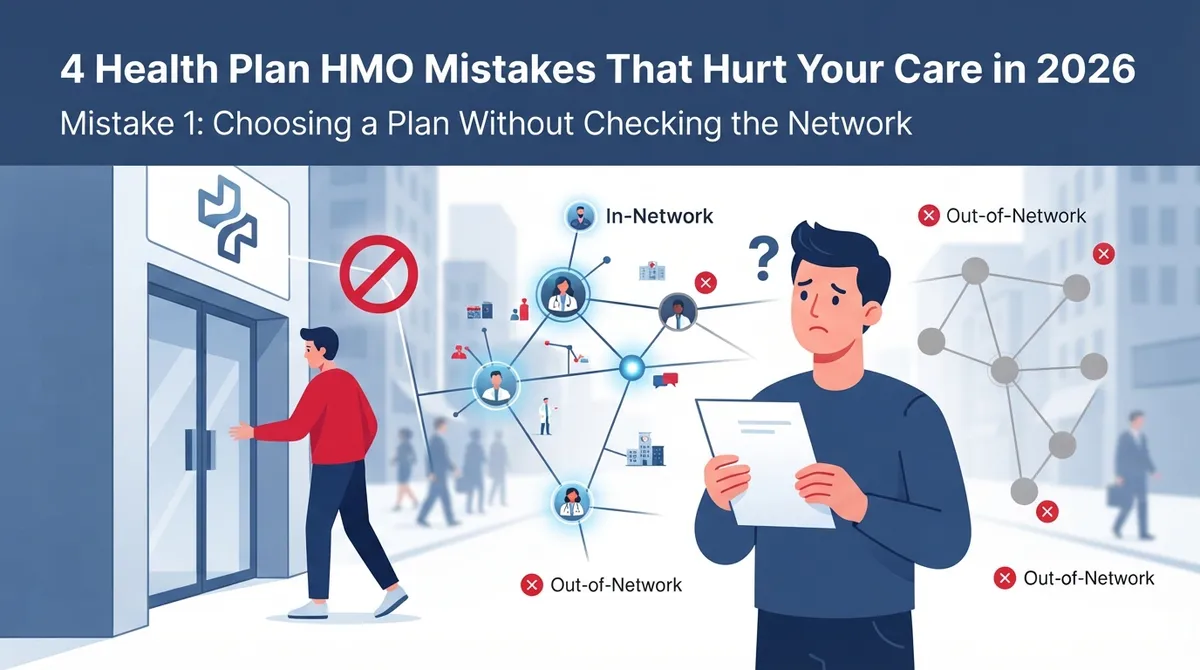
Mistake 1: Choosing a Plan Without Checking the Network
This is the most common and costly error. Many people pick a plan based on price alone. They assume their current doctor, hospital, or pharmacy is included. Then they learn it is not.
Why Network Checks Matter So Much
In an HMO, the network is the core of your coverage. If your doctor is outside the network, the plan may pay nothing for a routine visit. You could face the full bill, even for a simple checkup.
What to Verify Before You Enroll
- Your preferred PCP: Confirm the doctor is in the network and accepting new patients.
- Your specialists: Check any cardiologist, dermatologist, or other specialist you already see.
- Hospitals and urgent care: Know where you can go if you get sick after hours.
- Labs and pharmacies: Make sure routine tests and prescriptions are covered where you will use them.
- Wellness services: If you value services like cancer screenings or weight management, ask what the plan covers.
Do not rely only on an online directory. Directories can be out of date. Call the insurer and the doctor's office to confirm. Ask for the answer in writing if you can.
If you are still searching for a doctor, our guide on how to find doctors accepting new patients near you can help you narrow the list.
Mistake 2: Misunderstanding Referrals and Prior Authorization
Many members mix up these two terms. The confusion can delay care or lead to a denied claim.
Referral vs. Prior Authorization
|
Term |
What It Means |
Who Usually Handles It |
|---|---|---|
|
Referral |
An order or direction from your PCP to see a specialist |
Your primary care provider |
|
Prior authorization |
The plan's advance approval for a specific service |
The provider's office and the insurer |
A plan may require one, both, or neither for a given service. For example, you might need a referral to see a specialist. The specialist might then need prior authorization before ordering an advanced scan.
How to Avoid the Trap
- Ask your PCP's office if a referral is needed before you book a specialist.
- Ask whether the service needs prior authorization, and who will request it.
- Keep notes on dates, names, and reference numbers from calls.
- Do not schedule an expensive test before approval is confirmed.
Referral rules also vary by product. For Medicare Advantage HMO and HMO-POS plans, insurers publish their own referral requirements for specialist services. Check your current plan documents each year, because benefits can change.
A strong primary care team makes this process easier. A good primary care office knows how to handle referrals and will guide you through the steps. For more on why coordination matters, read Fragmented Care vs. Coordinated Care: Which Wins?
Mistake 3: Going Out of Network for Non-Emergency Care
An HMO is built around its network. Going outside it for routine care is one of the fastest ways to get a large bill.
What Counts as an Exception
Out-of-network care is generally not covered except in emergencies. Some plans have exceptions or a point-of-service option. Medicare.gov notes that Medicare Advantage HMO members generally use in-network providers for non-emergency care. The listed exceptions include emergency care, out-of-area urgent care, and temporary out-of-area dialysis. HMO-POS plans may allow some out-of-network care at a higher cost.
Common Situations That Cause Trouble
- Seeing a friend's specialist who is not in your network.
- Using a walk-in clinic without checking if it is covered.
- Traveling and assuming your plan works the same way everywhere.
- Getting lab work at a facility the plan does not contract with.
What to Do Instead
Before any non-emergency visit, confirm that the provider is in-network. If you are traveling, read your plan's rules for urgent care away from home. In a true emergency, go to the nearest emergency room first and sort out coverage afterward.
Knowing where to go for which problem also saves money and time. Our article on urgent care mistakes that could cost you your health explains how to choose the right setting.
Mistake 4: Treating the PCP as Just a Gatekeeper
Many people see the PCP requirement as a hurdle. They pick a name off a list and never build a real relationship. This is a missed opportunity.
What a Strong PCP Relationship Can Do
A good PCP knows your history, your risks, and your goals. That knowledge helps with prevention and early detection. It also speeds up referrals, because your doctor can explain exactly why you need a specialist.
- Preventive care: Annual exams, vaccines, and age-based screenings.
- Chronic condition management: Ongoing care for blood pressure, diabetes, and more.
- Care coordination: One person who keeps the full picture in view.
- Faster problem solving: Quicker answers when something feels wrong.
This matters most for busy professionals and young families. You may not have time to chase paperwork or repeat your history at each visit. A PCP who coordinates care saves you effort.
Questions to Ask a Potential PCP
- Do you accept my specific plan and product?
- How do you handle referrals and prior authorizations?
- Can I book same-day or virtual visits?
- What preventive and wellness services do you offer on site?
To learn what to look for, see 7 Signs You've Found the Right Primary Care Practice and What a Primary Care Physician Does for Your Health.
How to Get the Most From Your HMO Coverage
Once you avoid the four mistakes, you can use your plan to its full value. A few habits make a big difference.
A Simple Yearly Checklist
- Review your plan documents each year. Networks and benefits can change.
- Schedule your annual wellness visit. Preventive care is where many HMOs add the most value. See what happens during an annual wellness visit.
- Ask about screenings. Early detection is often easier when your PCP knows your history.
- Keep your records organized. Our guide to a medical records request in primary care shows how.
- Manage prescriptions carefully. Try these prescription management tips to avoid gaps.
Think Beyond Basic Coverage
Some wellness services are not covered by every plan. These can include advanced testing, weight management support, or IV hydration. If these matter to you, ask your insurer what is covered. Then ask your clinic about self-pay options. Knowing the difference up front prevents surprise bills.
A Note for Medicare Advantage HMO Members
Medicare Advantage HMOs have their own network and coverage rules. Members generally use in-network providers for non-emergency care. Exceptions include emergencies, out-of-area urgent care, and certain dialysis needs. Always check your plan's Evidence of Coverage each year.
If you are on Medicare in the Riverview area, our article on the traits of the best Medicare provider for primary care is a useful next read. You can also review how to use a Medicare HMO for better primary care.
Why Local, Coordinated Care Matters in Tampa Bay
A plan only works if you can actually use it. That means finding a nearby clinic that accepts your coverage, offers flexible scheduling, and treats you as a whole person. InCare provides comprehensive primary care, urgent care, and advanced wellness services from locations in Tampa and Riverview, plus virtual visits. The team focuses on prevention and whole-body health, which fits well with how many HMO members want to use their benefits.
You can see our providers and our locations before you visit. Patient feedback also matters, so read what others say by choosing to see what our InCare patients say on Google. You can also follow our updates on Facebook, Instagram, and TikTok.
Because insurance rules differ by plan, call your insurer and our office to confirm coverage before you book. That one step can save you time and money.
Conclusion
A health plan HMO can be a smart, cost-conscious choice when you understand how it works. The four mistakes to avoid are simple to remember. Check the network before you enroll. Know the difference between a referral and prior authorization. Stay in-network for non-emergency care. Build a real relationship with your PCP.
Coverage rules are plan-specific, so always confirm details in your own documents. With the right preparation and a trusted primary care partner, you can use your HMO to support steady, preventive, and coordinated care all year long.
Ready to put your plan to work? Book your appointment with InCare today, or contact our team with questions about coverage and services.
FAQs
Q: What is an HMO health plan, and how does it work?
A: An HMO (health maintenance organization) is a health insurance plan that generally limits non-emergency care to providers who work for or contract with the plan. Members usually choose a primary care provider who coordinates preventive care, ongoing conditions, and referrals. Rules vary by insurer, so review your plan documents.
Q: Do I need a referral to see a specialist with an HMO?
A: Many HMO plans require a referral from your primary care provider before you see a specialist, but rules vary by plan and service. A referral is different from prior authorization, which is the plan's advance approval for a specific service. Ask your PCP's office and your insurer before booking.
Q: Can I see an out-of-network doctor with an HMO?
A: Out-of-network care is generally not covered under an HMO, except in emergencies. Some plans have exceptions or a point-of-service (POS) option that allows limited out-of-network care at a higher cost. Check your plan documents before receiving non-emergency care outside the network.
Q: What is the difference between an HMO and a PPO?
A: An HMO usually requires you to use in-network providers and choose a primary care provider, and it often needs referrals for specialists. A PPO offers more flexibility to see out-of-network providers, though at a higher cost. HMO premiums are often lower, but the trade-off is less freedom in choosing providers.
Q: How can I check if my primary care doctor is in my HMO network?
A: Start with your insurer's online provider directory, then call both the insurer and the doctor's office to confirm. Directories can be outdated, so verify that the doctor accepts your specific plan and is taking new patients. Ask for confirmation in writing when possible.