
Key Takeaways
- There is no official certification that makes a peptide clinic 'legitimate,' so verify the clinician's active Florida license, the dispensing pharmacy's license, and the clinic's written plan yourself.
- A legitimate clinic starts with a health history, physical review, and often lab work before offering any peptide, rather than selling treatments from a menu.
- Products labeled 'research use only' or 'not for human use' should never be offered for self-injection, and their presence is a serious red flag.
- A prescription and a licensed pharmacy do not make a compounded peptide FDA-approved; a certificate of analysis shows limited quality data, not proven safety or efficacy.
- Be wary of guaranteed results, pressure to buy large prepaid packages, and any claim of 'FDA approval' for a clinic, since the FDA does not vet or endorse individual wellness clinics.
- Check for a written monitoring plan, clear dosing and storage instructions, and an itemized price estimate before booking, paying, or injecting anything.
Peptide therapy is a growing topic in wellness circles across Florida. Social media, gyms, and online shops all promote injections that promise better recovery, leaner bodies, and younger skin. That buzz makes it hard to tell real medical care from marketing. If you are searching for a legitimate peptide clinic in Tampa Bay, you need a clear way to judge what you are being offered.
Here is the key point: there is no official certification that makes a clinic "legitimate." Instead, you have to check the clinician, the product, the pharmacy, and the plan. The FDA also warns that compounded drugs are not FDA-approved, and the agency has flagged safety and evidence gaps for several peptides sold in wellness settings.
This guide gives you 12 practical checks. Use them before you book, pay, or inject anything. They apply whether you are a busy parent, a health-minded professional, or a young adult curious about prevention and optimization.

Why Verification Matters Before You Start
Peptides are short chains of amino acids. Some are approved medicines. Others are sold as compounded products or labeled "for research use only." The difference matters for your safety.
According to the FDA's compounding safety page (updated October 2026), several peptides promoted by wellness clinics carry real concerns. For example, the agency cites potential immune reactions and impurities for BPC-157. It also notes limited safety information for ipamorelin and reports of serious adverse events, including death, in a published study of intravenous use for gastric motility.
A clinic that takes these facts seriously will talk about them openly. A clinic that ignores them is a red flag. For a deeper look at this topic, see our guide on FDA-approved vs. compounded peptides.
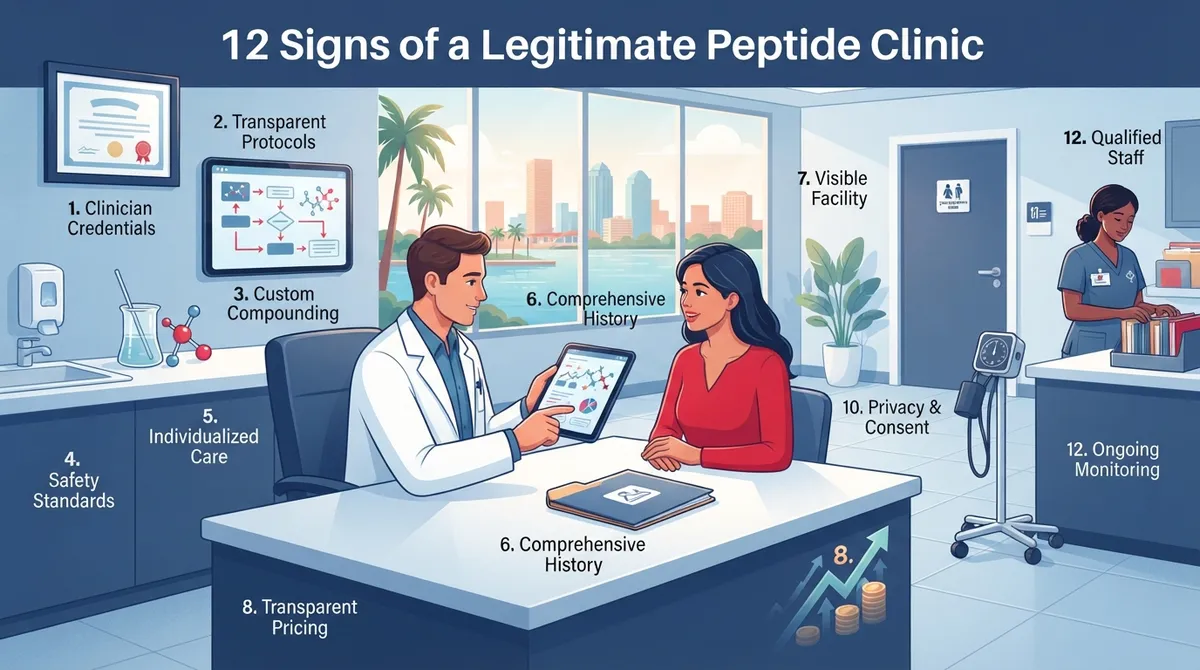
The 12 Signs of a Legitimate Peptide Clinic
1. The Treating Clinician Holds an Active Florida License
Start with the person who will prescribe your treatment. Ask for the clinician's full name and license type. Then look them up through the Florida Department of Health license verification tool. Check that the license is active and see whether there are any disciplinary actions.
A real medical practice will give you this information without hesitation. If a clinic only lists a "wellness coach" or avoids naming a prescriber, walk away.
2. You Get a Real Medical Evaluation First
A legitimate clinic does not sell peptides from a menu. It starts with a health history, a physical review, and often lab work. The goal is to learn whether a treatment fits your body and your goals.
Primary care settings are well suited for this. A doctor who knows your full history can spot drug interactions, hormone issues, or conditions that make a peptide unsafe. Learn what a careful first visit looks like in what medically guided peptide use in Tampa involves.
3. The Clinic Explains the Specific Peptide and Its Evidence
Ask three simple questions. What is this peptide? What is it meant to treat? What does the evidence show?
A trustworthy provider will explain what is known and what is still uncertain. Many popular peptides have limited human data. If the answer is full of big promises and short on facts, be cautious.
4. The Clinic Discusses Risks, Alternatives, and Uncertainty
Good care includes honest talk about downsides. Your provider should cover side effects, the route of administration, and why an FDA-approved option may or may not fit your case.
Broad promises of healing, anti-aging, muscle gain, or guaranteed results are not proof of effectiveness. They are marketing. Our article on peptides for athletes: hype vs. medical reality explains how to separate the two.
5. The Dispensing Pharmacy Is Named and Licensed
Ask which pharmacy will prepare your product. Then ask for the pharmacy's name and license. You can check pharmacy credentials through the relevant state board.
A prescription and a licensed pharmacy do not make a compounded peptide FDA-approved. They only mean the product passed through a legal supply chain. That is a start, not a guarantee of proven safety.
6. The Product Is Not Sold as "Research Use Only"
This is a major warning sign. Products labeled "research use only" or "not for human use" should never be offered for self-injection. The FDA has warned that such labels do not make an unapproved drug lawful for human use.
If a clinic or website hands you a vial with this wording and tells you how to inject it, treat that as a serious concern. See the risks in 5 BPC-157 buying mistakes that put your health at risk.
7. Certificates of Analysis Are Treated as Limited Proof
Some clinics wave a certificate of analysis as proof of quality. A lab report can help show purity, but it does not mean a drug is FDA-approved or proven safe and effective.
Ask what was tested, who tested it, and when. A legitimate clinic will not oversell a single document. Learn more about quality checks in 6 ways to verify CJC-1295 quality.
8. There Is a Clear Monitoring and Follow-Up Plan
Treatment does not end at the injection. Ask how the clinic tracks your response, your labs, and any side effects. Ask what happens if you feel unwell.
For growth hormone–related peptides, monitoring matters even more. Read what monitoring is needed with growth hormone peptides to see what a solid plan includes.
9. Storage, Dosing, and Handling Are Explained in Detail
You should leave with written instructions. These should cover how to store the product, how much to use, how to inject safely, and when to stop and call the clinic.
Vague advice such as "just take what feels right" is not safe. Dosing for many peptides is not firmly established, so your clinician must be able to explain the basis for any plan.
10. Pricing Is Transparent
A legitimate clinic can explain what you pay for. That includes the visit, labs, product, and follow-up. Be wary of heavy pressure to buy large packages upfront.
Costs vary widely, so ask for a written estimate. Our overview of monthly peptide therapy costs in Tampa can help you set a realistic budget.
11. The Clinic Does Not Claim FDA Endorsement
The FDA does not vet or endorse individual wellness clinics. If a clinic says it is "FDA-approved" or "FDA-vetted," ask exactly what that means. Often it refers to a facility registration or an ingredient, not the clinic or the finished product.
Do not assume a local clinic is endorsed by any federal agency based on its own claims. Always verify through official sources.
12. The Clinic Fits Into Your Larger Health Picture
The best peptide discussions happen inside real primary care. A clinic that also handles screenings, chronic conditions, and preventive care is more likely to put your overall health first.
InCare is a primary care and wellness clinic with locations in Tampa and Riverview, Florida. Our approach centers on prevention, advanced testing, and personalized plans. You can read more about what to know before visiting InCare's peptide clinic in Tampa.
Quick Comparison: Legitimate Clinic vs. Red-Flag Seller
|
What to Check |
Legitimate Clinic |
Red-Flag Seller |
|---|---|---|
|
Prescriber |
Named, licensed Florida clinician |
Unnamed staff or "coach" only |
|
Evaluation |
History, exam, and labs first |
Order from a menu, no exam |
|
Product label |
Dispensed by a licensed pharmacy |
"Research use only" vials |
|
Claims |
Honest about uncertainty |
Guaranteed results |
|
Monitoring |
Written follow-up plan |
No plan after purchase |
|
Pricing |
Clear, itemized estimate |
Pressure for large prepaid bundles |
Your Pre-Visit Checklist
Print or save this list before your first appointment. Having it ready keeps you in control of the conversation.
- The clinician's full name and Florida license number
- The name and license of the dispensing pharmacy
- The exact peptide name, ingredient, and route of use
- A written explanation of benefits, risks, and alternatives
- A plan for lab testing, follow-up visits, and side effects
- A written price estimate with no hidden fees
How to Verify a Clinician and Pharmacy in Florida
Verification takes only a few minutes. Follow these steps:
- Ask the clinic for the prescriber's full name and license number.
- Search that name on the Florida Department of Health license lookup.
- Confirm the license is active and review any public complaints.
- Ask for the dispensing pharmacy's name and license number.
- Check the pharmacy through the state's pharmacy licensing resources.
- Write down anything that does not match and ask the clinic to explain it.
If you want to compare providers side by side, our list of 15 questions to ask a peptide therapy clinic in Tampa gives you a ready script. You can also review 9 things to know before choosing a peptide specialist in Tampa.
Who Should Be Extra Careful
Some people need a more cautious approach. Talk with a primary care doctor first if any of these apply to you:
- You are pregnant, nursing, or trying to conceive
- You have a history of cancer or an active tumor
- You take daily prescription medicines
- You have a chronic condition such as diabetes or heart disease
- You compete in tested sports
A doctor who knows your history can say whether a peptide is worth the risk. They can also point you to proven options, such as lifestyle changes, screenings, or approved medicines.
What About Reporting a Problem?
If you have a bad reaction to a compounded medicine, tell your clinician right away. You can also report problems to the FDA through its MedWatch program. Reports help the agency track safety issues across the country.
Keep the packaging, the label, and the lot number if you have them. These details help investigators trace the product.
The Bottom Line
A legitimate peptide clinic in Tampa Bay earns trust through transparency, not hype. It verifies your health first, names its clinician and pharmacy, explains the evidence, and follows you after treatment. It never hides behind "research only" labels or big promises.
Apply the 12 checks above, and you will filter out most of the risk. You can also see what other patients say by reading reviews: see what InCare patients say on Google. For updates and wellness tips, you can follow InCare on Instagram or Facebook, or watch short health videos on TikTok.
Ready to talk with a licensed team about your goals? Book your InCare appointment now to start with a full evaluation, or contact our team with questions before you visit our Tampa or Riverview locations.
FAQs
Q: How can I check whether a peptide clinic in Tampa Bay is legitimate?
A: Verify the prescriber's active Florida license, ask for the dispensing pharmacy's name and license, and confirm you will receive a real medical evaluation. A legitimate clinic also explains the evidence, risks, and follow-up plan in writing.
Q: Are peptide therapies FDA-approved?
A: Some peptide drugs are FDA-approved, but many peptides sold in wellness settings are compounded or unapproved. The FDA states that compounded drugs are not reviewed for safety, effectiveness, or quality before marketing.
Q: Does a prescription mean a peptide is FDA-approved?
A: No. A prescription and a licensed pharmacy do not make a compounded peptide FDA-approved. They only show the product was dispensed through a legal channel, so you should still ask about evidence and safety.
Q: What are the risks of BPC-157 or ipamorelin?
A: The FDA cites potential immune reactions and impurities for BPC-157. For ipamorelin, it notes limited safety information and a published report of serious adverse events, including death, with intravenous use for gastric motility.
Q: How can I report a problem with a compounded medication?
A: Contact your clinician first, then report the event to the FDA through its MedWatch program. Keep the label, packaging, and lot number to help investigators trace the product.