
Key Takeaways
- Compounded semaglutide is not FDA-approved and bypasses safety reviews, unlike brand-name Ozempic or Wegovy; the shortage-based legal flexibility ended in April-May 2025, making ordinary strict rules apply today.
- Vial-based compounded semaglutide creates serious dosing error risks, with reported cases of patients receiving 5-20 times intended doses causing hospitalization, nausea, pancreatitis, and dehydration.
- Some compounders use semaglutide salt forms (sodium or acetate) instead of the FDA-approved base, with unknown safety properties and no lawful compounding basis according to FDA warnings.
- FDA-approved options should be your first choice; compounding is only justified when an approved product cannot meet documented individual medical needs, not for cost or convenience alone.
If you have looked into weight loss medicine lately, you have likely seen the term "compounded semaglutide." Prices, ads, and online claims make it hard to know what the term really means. This guide explains it in plain language.
In short, compounded semaglutide is a custom-prepared drug made by a pharmacy for one patient. It is not the same as the FDA-approved brand-name products. That difference affects safety, dosing, and legal status in 2026.
Below, you will learn how compounded semaglutide works, how it differs from approved options, what the risks are, and how to decide on a safe path. Whether you are a busy parent, a wellness-focused professional, or a young adult exploring prevention, the facts here can help you ask better questions.

What Is Compounded Semaglutide?
Compounded semaglutide is a prescription drug prepared by a licensed pharmacy or other authorized compounder for a specific patient's medical need. A compounding pharmacy mixes or adjusts ingredients by hand or with special equipment. The goal is a medicine that fits one person's needs.
Semaglutide itself is a GLP-1 receptor agonist. It mimics a natural gut hormone that helps control blood sugar and appetite. The approved brand versions are made by the drug maker and reviewed by the FDA. A compounded version is not.
Here is the key point. Compounded semaglutide is not an FDA-approved generic. It is also not an interchangeable copy of Ozempic or Wegovy. The FDA does not review compounded products for safety, effectiveness, or quality before they reach patients.
How Compounding Works in General
Compounding is a long-standing and legitimate part of pharmacy practice. It helps people who cannot use a standard drug. For example, a patient may need a liquid form because they cannot swallow pills. Or a patient may have an allergy to a dye in the standard product.
Federal and state rules shape what compounders can do. The FDA says compounded drugs should generally be used only when a patient's medical needs cannot be met by an available approved drug. Compounding is not meant to be a routine route to a cheaper or more convenient copy.
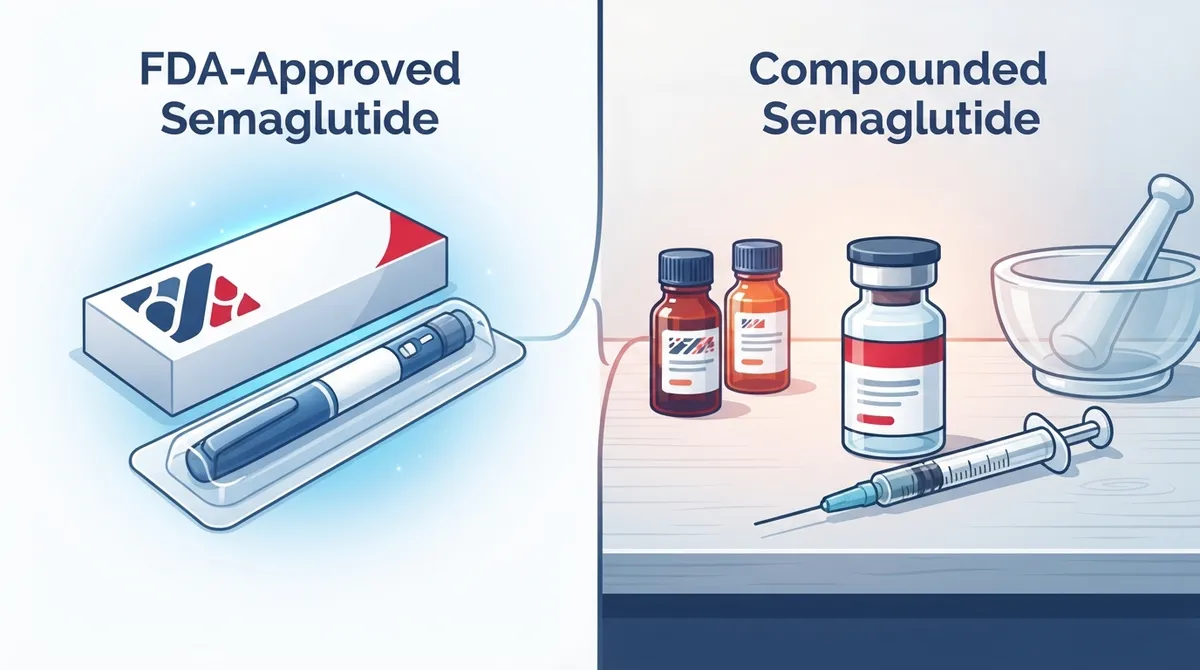
Compounded Semaglutide vs. FDA-Approved Semaglutide
The two types may share a name, but they are not the same thing. The table below shows the main differences.
|
Feature |
FDA-Approved Semaglutide (Ozempic, Wegovy) |
Compounded Semaglutide |
|---|---|---|
|
FDA review before sale |
Yes, for safety, effectiveness, and quality |
No |
|
Made by |
The approved drug manufacturer |
A compounding pharmacy or outsourcing facility |
|
Dosing format |
Standard, pre-set pens |
Often vials, with varied concentrations |
|
Labeled uses |
Defined by FDA labeling |
Not an approved product |
|
Consistency |
Standardized |
May vary by pharmacy and batch |
|
Legal basis today |
Fully approved |
Must meet ordinary legal requirements |
What Each Approved Product Is For
Ozempic is approved for type 2 diabetes and certain related risk-reduction uses. Wegovy is approved for chronic weight management in eligible adults, along with a reduced-calorie eating plan and more physical activity. Wegovy also has certain added risk-reduction indications. A clinician should check current labeling and your eligibility.
Is Compounded Semaglutide Legal in 2026?
This is one of the most common questions, and the answer has changed. For a time, semaglutide was in national shortage. During shortages, the FDA allowed extra flexibility for compounding.
That flexibility has ended. The FDA determined the national semaglutide injection shortage was resolved on February 21, 2025. The shortage had begun in 2022. The FDA then ended its temporary enforcement-discretion periods for shortage-related compounding of essentially copied products.
- April 22, 2025: the period ended for state-licensed pharmacies and physicians under section 503A.
- May 22, 2025: the period ended for outsourcing facilities under section 503B.
This does not mean all compounding is banned. It means the shortage-based flexibility is gone. Any compounding today must meet the ordinary legal requirements. These rules are strict about making essentially copied versions of approved drugs.
Key Safety Concerns With Compounded Semaglutide
Because compounded products skip FDA review, patients and clinicians face added uncertainty. The FDA has raised several specific concerns.
Different Salt Forms
The FDA has warned that some compounders may use semaglutide sodium or semaglutide acetate. These are salt forms. They are different active ingredients from the semaglutide base used in approved products.
The FDA says it lacks information showing these salts have the same properties as the approved ingredient. It is also not aware of a lawful basis for using them in compounding. If you use a compounded product, ask which form it contains.
Dosing Errors
Compounded injectables often come in vials. They may have different concentrations. Patients may need to draw a dose with a syringe. This creates room for mistakes.
The FDA reports dosing errors linked to confusion when converting milligrams to syringe units or milliliters. These errors happened with patients and with health professionals. In reports, some patients took five to 20 times the intended dose. Some provider calculation errors involved doses five to 10 times higher than intended.
Reported Symptoms
Reports tied to dosing errors have included the following:
- Nausea and vomiting
- Abdominal pain
- Fainting and headache
- Dehydration
- Acute pancreatitis
- Gallstones
Some cases led to hospital stays. These reports do not prove that every event was caused by the product. Still, they show why clinical oversight matters. Seek prompt care if you have severe stomach pain, repeated vomiting, or fainting.
Who Might Be Considered for Compounded Semaglutide?
For most people, an FDA-approved option is the first choice. A compounded product may be considered only in limited cases. This happens when a patient's individual medical needs cannot be met by an available approved drug.
A clinician should weigh several things:
- Can an approved product meet the patient's needs?
- Is there a documented medical reason for a custom formulation?
- Does the pharmacy meet all applicable federal and state rules?
- Can the patient receive clear, product-specific dosing instructions?
Cost and convenience alone do not justify compounding under FDA policy. A good clinician will talk through these points openly with you.
How to Use Any Injectable Medicine Safely
Safe use starts with clear instructions. If your clinician prescribes any vial-based injectable, follow these steps.
- Confirm the concentration. Read the label and ask your prescriber or pharmacist to verify it.
- Confirm the dose in the right unit. Ask for the dose in milligrams and in syringe units or milliliters.
- Practice the technique. Have your clinician or pharmacist show you how to draw and inject.
- Write it down. Keep a written dose log and bring it to each visit.
- Report symptoms early. Call your clinic if you feel unwell after a dose.
Questions to Ask Before You Start
Good questions protect you. Before you use any compounded product, ask your primary care clinician or pharmacy the following:
- Why is an approved product not right for me?
- Does this contain semaglutide base or a salt form?
- Which pharmacy prepares it, and is it licensed?
- What is the exact concentration and my exact dose?
- How will you monitor my progress and side effects?
Why Medical Supervision Matters for Weight Loss
Weight loss medicine works best as part of a full care plan. That includes nutrition, movement, sleep, and ongoing check-ins. Medication alone rarely tells the whole story.
At InCare, we combine primary care with advanced wellness tools. Our weight loss program is physician-guided and personalized. We can review your health history, check labs, and discuss FDA-approved options first. You can also read our guide on what makes medical weight loss different from dieting.
Technology helps us track real progress. Tools like body composition analysis and metabolic breath analysis show how your body responds. That data lets us adjust your plan with care instead of guesswork.
Making Sense of Costs
Price is a major reason people look at compounded options. It helps to understand your full choices first. Our article on weight loss injections cost in 2026 breaks down what to expect. You can also learn how to choose the best injection for weight loss.
For a deeper look at the approved medicine, see our overview of semaglutide as a primary care guide to GLP-1 therapy. Local patients can also read about semaglutide in Tampa and semaglutide in Riverview.
How InCare Supports Your Care
Our team treats you as a whole person. We offer primary care, preventive screenings, and wellness services in Tampa and Riverview. You can learn more about our providers and see our locations.
Patient feedback matters to us. See what our InCare patients say by visiting us on Google — InCare. You can also follow our updates on Instagram, Facebook, and TikTok.
Conclusion
Compounded semaglutide is a custom-prepared medicine made for one patient. It is not an FDA-approved copy of Ozempic or Wegovy. The FDA does not review it for safety, effectiveness, or quality. Shortage-based flexibility for compounding ended in 2025, so ordinary legal rules apply today.
The main risks are product uncertainty, unclear salt forms, and dosing mistakes from vial and syringe use. For most people, FDA-approved options are the safer starting point. If a compounded product is ever considered, it should come with clear instructions and close clinical oversight.
Ready to talk through your options with a trusted team? Book Now to schedule a visit, or contact InCare with questions. Our team will help you build a safe, personalized plan that fits your goals.
FAQs
Q: What is compounded semaglutide, and how is it different from Ozempic or Wegovy?
A: Compounded semaglutide is a prescription drug prepared by a licensed compounding pharmacy for a specific patient. Ozempic and Wegovy are FDA-approved products made by the drug manufacturer. Compounded versions are not FDA-approved and are not reviewed for safety, effectiveness, or quality before sale.
Q: Is compounded semaglutide legal after the FDA declared the shortage resolved?
A: The FDA ended its shortage-based enforcement-discretion periods in April and May 2025. This does not ban all compounding. It means any compounding must now meet the ordinary legal requirements, which are strict about essentially copied versions of approved drugs.
Q: What are the risks and side effects of compounded semaglutide?
A: Risks include uncertain product quality, different concentrations, and dosing errors from vial and syringe use. The FDA has received reports of nausea, vomiting, abdominal pain, fainting, dehydration, pancreatitis, and gallstones linked to dosing errors. Clinical oversight and clear dosing instructions are essential.
Q: How can I tell whether a compounded semaglutide product contains semaglutide base or a salt form?
A: Ask your prescriber and the dispensing pharmacy to confirm the exact active ingredient in writing. The FDA warns that semaglutide sodium and semaglutide acetate are different from the semaglutide base in approved products. The FDA is not aware of a lawful basis for using these salts in compounding.
Q: What should I ask my primary care clinician before using compounded semaglutide?
A: Ask why an FDA-approved option is not right for you and which pharmacy prepares the product. Confirm the active ingredient, the concentration, and your exact dose in syringe units or milliliters. Also ask how your progress and side effects will be monitored.