
Key Takeaways
- Longevity testing is not a standardized test; the best programs are clinician-guided and combine medical history, physical exam, proven screenings, and targeted labs.
- Start with well-supported, actionable measures like blood pressure, cholesterol, blood sugar, liver and kidney function, and age-appropriate cancer screening and vaccines.
- Biological-age tests lack a consensus standard, can give different results for the same person, and should not be treated as a diagnosis or precise lifespan prediction.
- Judge a provider by who interprets results, what follow-up is offered, how abnormal findings are confirmed, and whether claims are realistic, not by the number of biomarkers tested.
- Build testing step by step: establish a baseline, add age-appropriate screenings, assess fitness and body composition, then add genetic or hormone tests only with a clear reason.
- Repeat measurements under consistent conditions and pair every result with a concrete action plan covering nutrition, exercise, sleep, and medication decisions.
Search for longevity testing in Tampa, and you will find a wide range of offers. Some clinics advertise panels with more than 100 biomarkers. Others promise a "biological age" score. Many readers are left asking a simple question: what is actually worth testing?
The answer starts with one fact. Longevity testing is not a single, standardized test. It is a clinician-guided process that looks at health risks and measurable factors linked to healthy aging. The best programs combine a careful medical history, a physical exam, proven preventive screenings, and targeted lab work.
This guide explains what longevity testing in Tampa typically includes, which measures are well supported, and where the science is still limited. It also offers a practical checklist for choosing a provider. Whether you are a busy parent, a tech-savvy professional, or a young adult who wants to start early, you will learn how to turn test results into a clear plan.

What Longevity Testing Means in Tampa
In primary care and wellness, longevity testing means assessing the factors that shape how well and how long you live. It is not a promise of a longer life. It is a structured way to find modifiable risks early.
Services vary by provider. Local offerings may include:
- Blood panels for heart, metabolic, and liver health
- Hormone testing when symptoms or history support it
- Body-composition and fitness assessments
- Genetic testing for personalized health insights
- Biological-age testing
Because no standard definition exists, two clinics can offer very different programs under the same name. That is why the quality of the clinician matters more than the length of the test list.
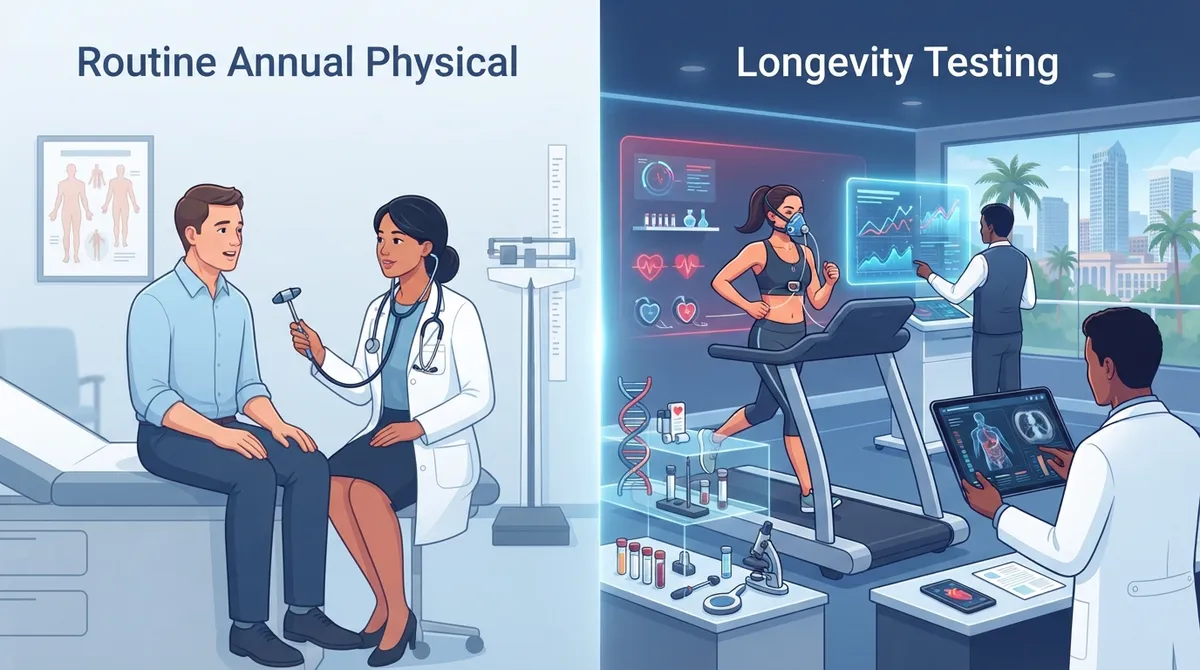
Longevity Testing vs. a Routine Annual Physical
An annual physical focuses on screening and prevention. It checks vital signs, reviews medications, updates vaccines, and orders age-appropriate screenings. You can learn more about what to expect in what happens during an annual physical exam.
Longevity testing builds on that foundation. It adds deeper measurement and tracking over time. The two are not competitors. A sound longevity plan still starts with the basics of primary care, because established screening and vaccination recommendations are better grounded in evidence than many commercial "longevity" scores.
|
Feature |
Routine Annual Physical |
Longevity Testing |
|---|---|---|
|
Main goal |
Screen for disease and update prevention |
Identify modifiable risks and track trends |
|
Typical tests |
Blood pressure, cholesterol, diabetes screening |
Expanded labs, body composition, fitness, genetics |
|
Evidence base |
Strong, guideline-driven |
Mixed; some measures well validated, others emerging |
|
Follow-up |
Yearly or as needed |
Often repeated over months or years |
Core Measures With the Strongest Evidence
Some of the most useful longevity measures are also the most familiar. They are actionable, which means you can do something about the results.
Cardiovascular and Metabolic Health
- Blood pressure: A key driver of heart and brain health. See our guide to blood pressure management strategies.
- Cholesterol and lipids: These help estimate cardiovascular risk.
- Blood sugar markers: Diabetes and prediabetes screening is recommended when indicated.
- Liver and kidney function: Basic labs that flag problems early.
Body Composition and Fitness
Weight alone does not tell the full story. Muscle mass, visceral fat, and cardiorespiratory fitness all matter for long-term health. Tools such as body composition analysis and VO2 max testing give a clearer picture than a bathroom scale. Metabolic data can also show how your body uses fuel, as explained in our overview of metabolic breath analysis.
Cancer Screening and Vaccines
Age- and risk-appropriate cancer screening remains one of the most proven longevity tools. The U.S. Preventive Services Task Force publishes A and B recommendations that list screenings and services with strong support. Vaccines belong in this category too.
Genetic and Hormone Testing
Genetic testing can provide personal insight into inherited risks. It does not predict your future, but it can guide which screenings to start earlier or which habits to prioritize. Learn more about DNA gene testing and how it fits into a prevention plan.
Hormone testing should be tied to symptoms, medical history, and a clear clinical question. Low energy, poor sleep, or changes in libido can have many causes. A clinician should rule out common issues first. Some patients later explore options discussed in our comparison of TRT, peptide therapy, and hormone replacement therapy.
Biological-Age Tests: Useful or Overhyped?
Biological-age tests are among the most talked-about tools in longevity medicine. They estimate how "old" your body is compared with your calendar age. The idea is appealing. The science is still developing.
Here is what the research tells us:
- Methods differ. Some tests use clinical biomarker algorithms. Others use DNA-methylation patterns. They measure different features and use different reference populations.
- Results can disagree. The same person may receive different estimates from different tests.
- No consensus standard exists. A 2024 review on validating aging biomarkers noted there is no agreed method for validation before clinical use, and that benefits for patient outcomes still need testing in prospective trials.
- A score is not a diagnosis. It should never be treated as a precise prediction of lifespan.
The National Institute on Aging has also described multiple approaches to measuring aging, including biomarkers of human aging, and does not endorse a single accepted clinical biological-age test. In short, a biological-age result can be an interesting data point. It should not drive major medical decisions on its own.
How to Read a Single Result With Care
Test results can shift based on the method, the sample, and your current health. A poor night of sleep, a recent illness, or a hard workout may change a number. For that reason, one result is best interpreted cautiously.
If your clinician uses a measure for monitoring, consistency matters. Use the same lab, the same conditions, and a clear plan for what you will do with the data. Testing without a meaningful action plan is just collecting numbers.
How to Choose a Longevity Testing Provider in Tampa
Marketing claims in this space can be bold. Some clinics advertise tracking biomarkers several times per year, while others highlight panels with more than 100 markers. A long list is not proof of clinical value. Use these questions to evaluate any provider:
- Which tests are included, and why? Each test should answer a clinical question.
- Who interprets the results? A licensed physician or qualified clinician should review them with you.
- What follow-up is offered? Results need a plan, not just a printout.
- How are abnormal findings confirmed? A single outlier should be rechecked.
- What does it cost, and is it covered? Ask which parts bill to insurance and which are self-pay.
- Are the claims realistic? Be cautious of any promise that a test can definitively reveal biological age or guarantee a longer life.
Continuity also matters. A clinic that knows your history can connect test results to your daily life. Our guide to why longevity medicine starts with primary care explains this approach in more detail, and you can compare options in our look at the best longevity clinic in Tampa.
A Practical Longevity Testing Roadmap
You do not need to test everything at once. A step-by-step approach is more affordable and easier to act on.
- Establish a baseline. Begin with a medical history, medication review, physical exam, and core labs.
- Add age-appropriate screenings. Cover cancer screening, vaccines, and blood pressure checks.
- Assess fitness and body composition. Identify muscle, fat distribution, and cardiorespiratory fitness.
- Consider targeted add-ons. Genetic or hormone testing makes sense when there is a clear reason.
- Create an action plan. Pair results with nutrition, exercise, sleep, and medication decisions.
- Retest at a sensible interval. Your clinician will advise how often based on your risk and results.
Who Benefits Most From Longevity Testing?
Different groups use these tools in different ways:
- Busy families: Efficient screening and preventive visits that fit a packed schedule.
- Women without a primary care relationship: Whole-body wellness visits that go beyond reproductive care.
- Young adults: A baseline early in life makes future changes easier to spot.
- High-income wellness seekers: Advanced testing paired with expert interpretation to avoid wasted spending.
- Tech-savvy professionals: Data-driven care with virtual follow-up options.
For many, the greatest value comes from habits that improve with data, such as better sleep, strength training, and smarter nutrition. You can explore related services such as medical weight loss and IV hydration therapy if they fit your goals.
Why Primary Care Is the Right Starting Point
Longevity is built on the basics: blood pressure control, metabolic health, proven screenings, and healthy habits. A primary care team can order the right tests, explain what they mean, and keep you on track year after year.
InCare is a personalized healthcare clinic in Tampa and Riverview that combines advanced technology with medical expertise. The practice offers primary care, cancer screening, body composition analysis, DNA gene testing, metabolic breath analysis, and wellness services under one roof. That means your results are interpreted by clinicians who know your full health picture, not by an isolated lab report. You can see what InCare patients say on Google and learn more about our providers and locations. You can also follow our updates on Instagram, Facebook, and TikTok.
Conclusion
Longevity testing in Tampa can be a smart investment when it is guided by a qualified clinician and built on proven prevention. The most reliable gains come from familiar measures, such as blood pressure, cholesterol, blood sugar, cancer screening, and fitness, paired with a plan you can follow. Newer tools like biological-age scores can add interest, but they are not yet a substitute for sound medical care.
Choose a provider who explains why each test matters, interprets results with you, and offers real follow-up. If you are ready to build a personalized prevention plan, book your visit with InCare today, or contact our team with questions.
FAQs
Q: What does longevity testing include in Tampa?
A: It varies by provider, but it commonly includes blood panels, body-composition and fitness assessments, and sometimes hormone, genetic, or biological-age testing. The strongest programs start with a medical history, physical exam, and proven preventive screenings.
Q: Are biological-age tests accurate?
A: They can be interesting, but they are not yet validated as a standard clinical tool. Different tests use different methods and can give different results for the same person, so a score should not be treated as a diagnosis or a precise lifespan prediction.
Q: How should I choose a longevity clinic in Tampa?
A: Ask which tests are included and why, who interprets the results, what follow-up is offered, and how abnormal findings are confirmed. Be cautious of any clinic that guarantees a longer life or claims a single test can definitively reveal biological age.
Q: How often should longevity biomarkers be retested?
A: The right interval depends on your risk factors and results. Your clinician will recommend a schedule, and consistent testing conditions help make comparisons over time meaningful.
Q: What is the difference between longevity testing and an annual physical?
A: An annual physical focuses on screening and prevention using established guidelines. Longevity testing builds on that with deeper measurement and tracking over time, and the best programs keep the annual physical as their foundation.