
Key Takeaways
- Anti-aging and longevity doctors overlap in services, but neither term is an official medical specialty in the US, so the clinician's license and core training matter more than the label.
- Anti-aging care usually centers on slowing visible or biological aging, while longevity care focuses on disease prevention and extending healthspan, the years lived in good health.
- Proven prevention, including screening, blood pressure and cholesterol control, vaccination, exercise, nutrition, sleep, and quitting smoking, forms the strongest foundation for healthy aging.
- Biological age tests are not yet definitive; they should not be the sole basis for starting treatment, and hormones or supplements should be justified by your labs, symptoms, and evidence.
You have probably seen both labels on clinic websites and social media. One practice promotes an anti-aging doctor. Another promotes a longevity doctor. Both promise a longer, healthier life. So is an anti aging doctor the same as longevity doctor care, or are these two different paths?
The short answer is that the terms overlap, but they are not exact synonyms. In 2026, patients ask this question more often, especially tech-savvy adults who want proactive, data-driven care. This guide explains the difference in plain language. You will learn what each label usually means, what credentials matter, and how to judge a clinician before you book. You will also learn how primary care can serve as a strong, evidence-based foundation for healthy aging.

The Short Answer: Similar Goals, Different Emphasis
Anti-aging doctors and longevity doctors often provide similar preventive and wellness services. The labels, however, signal different priorities.
- Anti-aging language usually focuses on slowing or reversing visible or biological signs of aging.
- Longevity language usually focuses on preventing disease and extending healthspan, the years you live in good health.
Neither term is an official medical specialty. In the United States, neither "anti-aging medicine" nor "longevity medicine" is recognized as a specialty by the American Board of Medical Specialties. There is also no single, universally accepted clinical definition of longevity medicine. That means the label on the door tells you very little. What matters is the clinician's license, core training, and the quality of the evidence behind each recommendation.
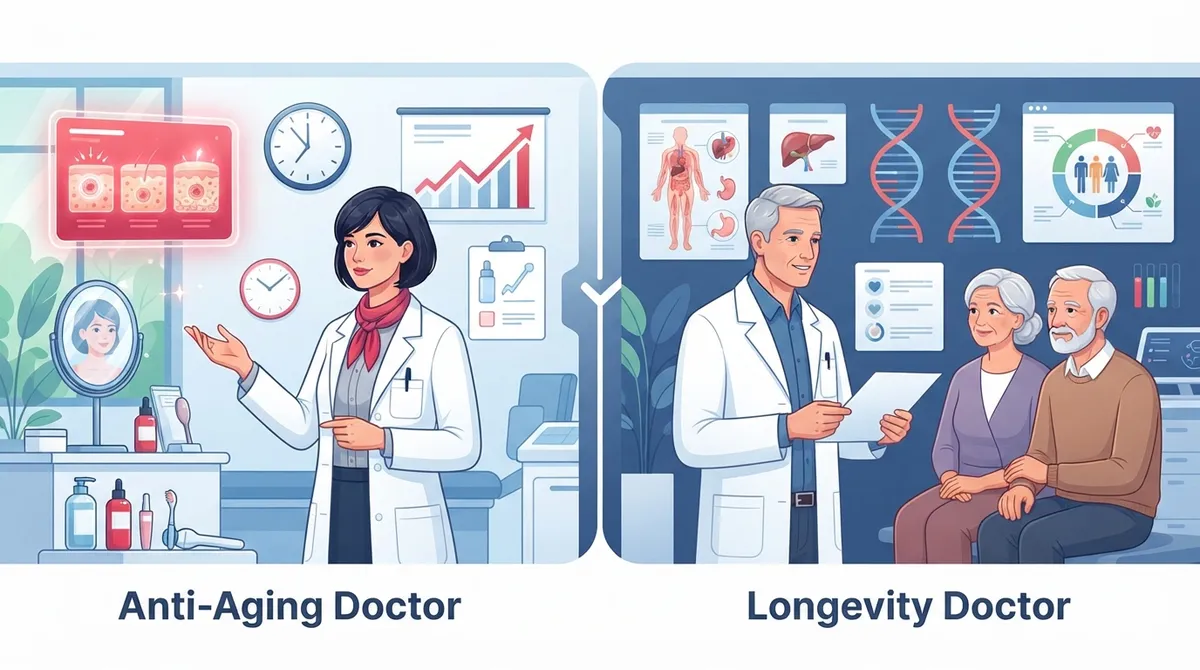
Anti-Aging Doctor vs. Longevity Doctor: A Side-by-Side Look
The table below shows how the two labels are commonly used. Individual practices vary, so treat this as a general guide rather than a rule.
|
Feature |
Anti-Aging Doctor |
Longevity Doctor |
|---|---|---|
|
Main framing |
Slowing or reversing signs of aging |
Extending healthspan and preventing disease |
|
Common focus |
Hormones, skin, appearance, vitality |
Screening, risk reduction, metabolic and heart health |
|
Typical tools |
Supplements, hormone therapy, aesthetic services |
Lab work, screenings, lifestyle coaching, risk assessment |
|
Official specialty? |
No |
No |
|
Evidence level |
Varies widely by treatment |
Strongest for standard preventive care |
Notice that both labels sit outside formal board certification. A clinician can use either term without a special exam. This is why patients should look beyond branding.
Why the Labels Are Not Interchangeable in Every Practice
Some clinics use the two terms as marketing synonyms. Others use them to describe truly different approaches. A practice that leads with "anti-aging" may center on hormones, injectables, or products aimed at reversing the signs of aging. A practice that leads with "longevity" may center on disease prevention and long-term function.
The distinction matters because evidence differs by approach. A 2002 scientific review found no convincing evidence at that time that then-promoted anti-aging remedies slowed aging or increased human longevity. That is a dated assessment, not a verdict on every treatment today. Still, it is a useful reminder to ask for evidence before you pay for any product that claims to reverse aging.
By contrast, established prevention measures have a firmer foundation. These include screening, vaccination, blood pressure control, exercise, nutrition, sleep, and smoking cessation. The National Institute on Aging notes that physical activity, appropriate nutrition, and avoiding smoking can help people live longer, delay disability, and improve function at older ages.
What a Longevity-Focused Primary Care Doctor Actually Does
Many people assume longevity care requires an exotic specialty clinic. In practice, a thoughtful primary care physician can deliver most of what matters. A longevity-focused primary care clinician may provide:
- Age-appropriate screening, including cancer screening
- Vaccinations and risk-factor management for blood pressure, cholesterol, and blood sugar
- Support for exercise, nutrition, sleep, and quitting tobacco
- Individualized review of family history and age-related risks
This is the same foundation described in our guide to why longevity medicine starts with primary care. Prevention comes first, and advanced options come second. For a deeper look at how care teams approach this, see what a longevity doctor is.
How to Evaluate Any Anti-Aging or Longevity Doctor: 6 Steps
Use this checklist before you commit to a clinic. It works for both labels.
- Verify the state license. Confirm the clinician holds an active medical license in Florida through the state licensing board.
- Check core specialty training. Look for board certification in a recognized specialty such as internal medicine or family medicine.
- Ask about added credentials. If the clinician lists an anti-aging or longevity certificate, ask who issues it and what training it required. Many are private credentials, not government or ABMS certifications.
- Request the evidence. For each test or treatment, ask what research supports it and how strong that research is.
- Discuss risks, costs, and alternatives. A trustworthy doctor explains downsides openly and offers lower-cost, lower-risk options first.
- Look for coordinated care. Your clinician should connect your results to your overall health plan, not sell isolated products.
You can find helpful background on choosing wisely in our article on how to choose the right primary care physician in Tampa Bay.
Biological Age Tests: Promising, but Not Definitive
Many longevity and anti-aging clinics offer biological age tests. These tests estimate how fast your body may be aging using biomarkers. They are exciting, and they appeal to patients who love data. Yet they have limits.
The National Institute on Aging notes that aging biomarkers remain an active research area. Their validity and usefulness still need to be established. A 2024 review also found no consensus on how aging biomarkers should be validated before they move into clinical use. In plain terms, a biological age number is not a definitive measure of how fast you personally age. It should not be the sole basis for starting a treatment.
A smarter approach pairs any advanced test with proven measures you can act on today. Tools such as body composition analysis, metabolic breath analysis, and DNA gene testing can add useful context when a physician interprets them alongside your history and labs. They support decisions. They do not replace clinical judgment.
Questions to Ask Before Starting Hormones, Supplements, or Other Treatments
Hormones, supplements, peptides, and infusions are popular in this space. Some have a legitimate medical role for the right patient. Others are marketed well ahead of the science. Ask these questions every time:
- What problem is this treatment meant to solve for me specifically?
- What lab results or symptoms justify it?
- What does the research show, and in which kind of patients?
- What are the risks and side effects?
- How will we measure whether it is working?
- What happens if I stop?
Be cautious with any claim that a single supplement, hormone, drug, or procedure can broadly reverse aging or extend human lifespan. If a clinician cannot explain the evidence clearly, pause. Our resources on BHRT versus traditional HRT and peptide therapy for anti-aging explain how to weigh these options with a physician.
Lifespan vs. Healthspan: Why the Difference Matters
Lifespan is how long you live. Healthspan is how many of those years you spend in good health, with strength, independence, and mental clarity. Most people say they want healthspan more than raw lifespan.
This is where longevity framing can be helpful. It keeps attention on function, such as walking easily, thinking clearly, and avoiding chronic disease. It also points toward the habits with the best track record. For many busy families and professionals, the biggest gains come from consistent basics rather than expensive extras. Our guide on how to make preventive care work for your health shows how to build those habits into a busy schedule.
Where InCare Fits In
At InCare, we believe the best longevity plan starts with a trusted primary care relationship. Our team combines medical expertise with modern tools to support prevention and whole-body optimization at our Tampa and Riverview locations. Services range from comprehensive primary care and screenings to weight loss programs and IV hydration and vitamin drips. You can meet our providers, learn more about us, or find the nearest of our locations.
Patients value this evidence-first approach. See what our InCare patients say by visiting our InCare reviews on Google. You can also follow our updates on Instagram, Facebook, and TikTok for practical health tips.
The Bottom Line
So, is an anti aging doctor the same as longevity doctor care? Not exactly. The two terms share many goals and often share the same services. Anti-aging tends to emphasize slowing visible or biological aging. Longevity tends to emphasize preventing disease and extending healthspan. Neither is an official specialty, so credentials and evidence matter far more than the label.
Choose a licensed, board-certified clinician. Start with proven prevention. Ask hard questions about every test and treatment. Then add advanced tools only when they make sense for you.
Ready to build a smart, evidence-based plan for healthy aging? Book Now to see an InCare provider, or contact our team with any questions. We will help you separate the science from the hype.
FAQs
Q: Is an anti-aging doctor the same as a longevity doctor?
A: Not exactly. The two roles often overlap, but anti-aging usually emphasizes slowing visible or biological signs of aging, while longevity usually emphasizes preventing disease and extending healthspan. Neither is an official medical specialty, so always check the clinician's license and core training.
Q: Are anti-aging or longevity doctors board-certified in the United States?
A: Neither anti-aging medicine nor longevity medicine is an American Board of Medical Specialties specialty. A doctor may hold board certification in a recognized field such as internal medicine or family medicine, so verify that credential separately from any private anti-aging or longevity certificate.
Q: Can a doctor measure my biological age accurately?
A: Biological age tests are an active research area, not a definitive clinical measure. The National Institute on Aging notes that their validity and usefulness still need to be established, so use results as one piece of context alongside proven screening and lab work.
Q: What is the difference between healthspan and lifespan?
A: Lifespan is the total number of years you live. Healthspan is the number of those years you spend in good health with strong function and independence. Longevity-focused care generally aims to extend healthspan.
Q: What should I ask before starting hormones, supplements, or other longevity treatments?
A: Ask what problem the treatment solves for you, what evidence supports it, what the risks and costs are, and how progress will be measured. A trustworthy clinician will explain alternatives and encourage proven prevention habits first.