Key Takeaways
- Florida requires an in-person initial exam with the physician in the same room, so an online-only first visit does not qualify; plan to travel to the clinic at least once.
- Convenience depends on the specific clinic, not just the neighborhood: check appointment access, parking, transit, follow-up options, and whether the physician is qualified to certify patients.
- Certification and the state ID card are separate steps: after the doctor enters certification in the registry, you must apply to OMMU for the card, which took five business days for a complete application per an August 2026 update.
- Physician certifications must be renewed at least every 30 weeks, and the state ID card has its own renewal clock, so ask your clinic how it tracks both timelines.
- Downtown Tampa suits professionals near the urban core and transit users, while suburban locations like Riverview often offer easier parking and shorter drives for southern county residents.
- Gather a valid Florida photo ID, proof of residency if needed, medical records documenting your qualifying condition, a current medication list, and prior imaging or lab results before your visit.
Is downtown Tampa convenient for medical cannabis certification? For many Florida residents, the answer is yes, but only if the clinic meets a few practical and legal requirements. Convenience is not just about distance. It also depends on appointment access, parking, follow-up care, and whether the physician is qualified to certify patients under Florida law.
In 2026, patients have more choices than ever. Some live and work near the urban core and want a quick visit. Others prefer a suburban clinic with easier parking. Busy professionals, young families, and wellness-minded patients all weigh time, access, and quality of care. This guide compares downtown Tampa with other service areas so you can decide which option fits your life.
You will learn what Florida law requires, how the process works, and what makes a location truly convenient. You will also see how a full-service primary care clinic can make the process smoother. Throughout this article, the focus stays on one question: is downtown Tampa convenient for medical cannabis certification, and when does another location make more sense?
What Florida Law Requires Before You Pick a Location
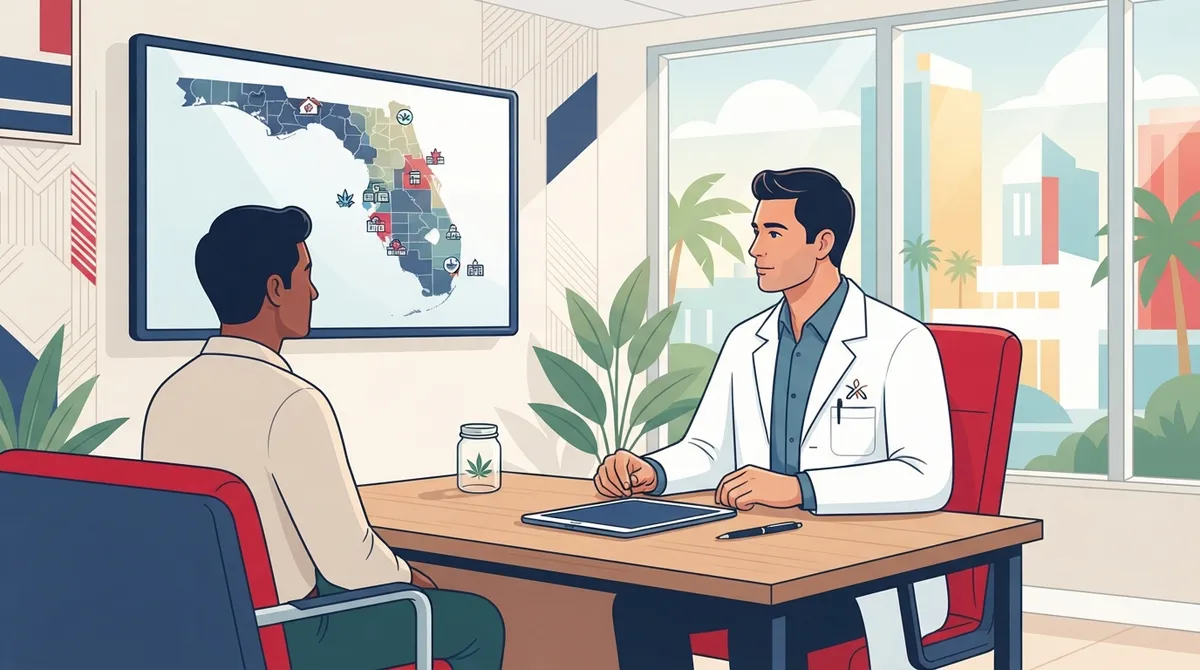
Before comparing locations, it helps to know the rules. Florida requires an in-person initial examination. The physician must be in the same room as the patient. An online-only first visit does not meet the legal standard.
That rule shapes the entire question of whether downtown Tampa is convenient for medical cannabis certification. You must travel to the clinic at least once, so location matters more than it would for a telehealth-only service.
Basic Eligibility Requirements
To qualify, a patient generally needs the following:
- Florida residency, either permanent or seasonal
- A qualifying medical condition under state law
- A physician's finding that the likely benefits outweigh the risks
Qualifying conditions listed in state law include cancer, epilepsy, glaucoma, HIV/AIDS, PTSD, ALS, Crohn's disease, Parkinson's disease, and multiple sclerosis. Terminal conditions, certain comparable conditions, and qualifying chronic nonmalignant pain may also apply.
What the Physician Must Do
The certifying physician has several duties. They must review your medical history and check the state prescription drug monitoring database. They also check the Medical Marijuana Use Registry (MMUR) for any active certification from another doctor. Finally, they document the certification and authorized forms and amounts in the registry.
This is why a clinic with strong primary care skills matters. A physician who understands your full health picture can make safer decisions. If you want to learn more about how a broad medical practice supports whole-person care, read what comprehensive primary care is and why it matters.
Certification vs. the State Card: A Key Difference
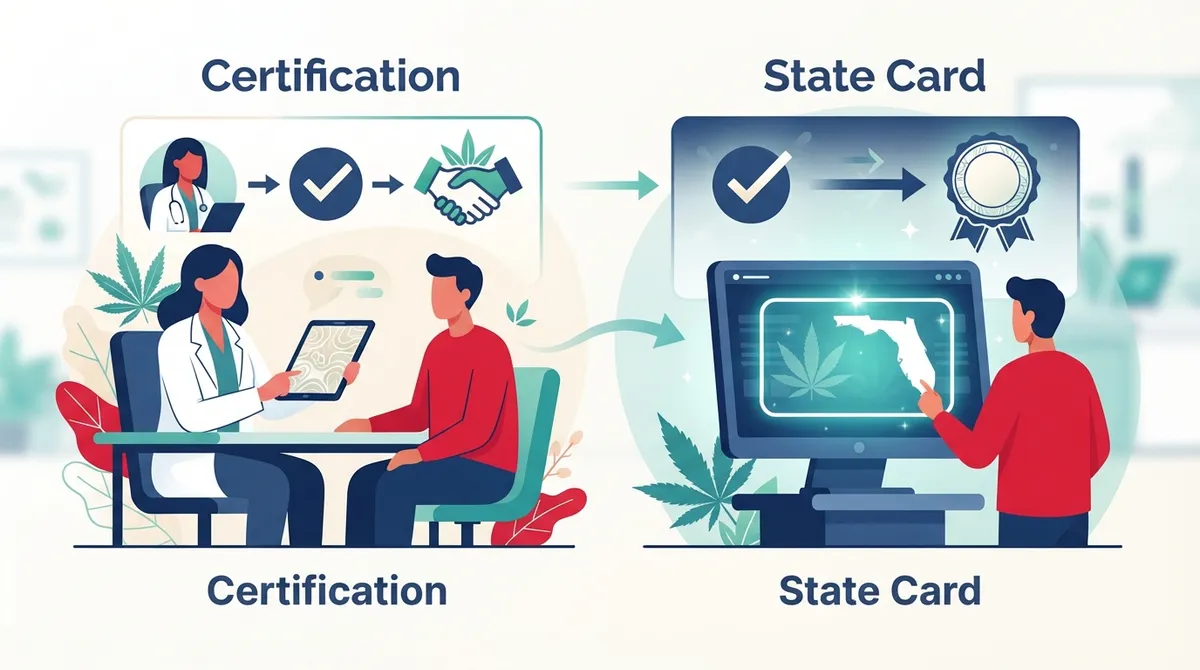
Many patients mix up two separate steps. A physician certification is not the same as a state identification card. After the doctor enters your certification in the MMUR, you must apply to the Office of Medical Marijuana Use (OMMU) for the card.
OMMU said in an August 7, 2026 update that a complete application took five business days to process. Processing times can change, so always check the latest OMMU update before you apply. The state also says an approval email can be used to fill an order at an approved Medical Marijuana Treatment Center while your physical card is mailed.
Why This Matters for Convenience
Convenience covers the whole process, not only the first visit. A clinic that explains both steps clearly saves you time and stress. It also helps you avoid delays caused by incomplete applications.
The state's scale shows how common this process has become. In its August 29, 2025 update, OMMU reported 923,629 qualified patients with active identification cards and 2,418 qualified physicians. With that many patients, a well-organized clinic makes a real difference.
Downtown Tampa vs. Suburban Locations: A Side-by-Side Look
So, is downtown Tampa convenient for medical cannabis certification compared with suburban options? The table below summarizes the typical tradeoffs. Actual details vary by clinic, so confirm everything before you book.
|
Factor |
Downtown Tampa |
Suburban Area (such as Riverview) |
|---|---|---|
|
Travel for workers in the urban core |
Often shorter |
May require a longer drive |
|
Parking |
Can be limited or paid |
Often easier and free |
|
Transit access |
More options in some areas |
Fewer options |
|
Traffic at peak hours |
Can be heavy |
Often lighter |
|
Proximity to home for south county residents |
Farther |
Closer |
|
Follow-up care |
Depends on the clinic |
Depends on the clinic |
Who Benefits Most From a Downtown Location
- Professionals who work in or near the city center
- Patients who prefer public transit or ride-share
- Tech-savvy millennials who want a fast, efficient visit during a lunch break
- Visitors with seasonal Florida residency who stay near downtown
Who May Prefer Another Location
- Families who need easy parking with children
- Residents of southern Hillsborough County who want a shorter drive
- Patients who dislike heavy traffic or paid garages
Neither option is always better. The right choice depends on where you live, where you work, and what your schedule looks like.
What Makes a Clinic Truly Convenient
Distance is only one piece. A convenient clinic removes friction from every step. Use this checklist when you compare locations.
- Confirm the physician is qualified. Ask whether the doctor is registered to certify patients in Florida.
- Check appointment availability. Look for flexible hours and short wait times.
- Review accessibility. Ask about parking, transit, and accessible entrances.
- Ask about follow-up options. Find out whether renewals can be handled by telehealth.
- Understand the full cost. Ask what the visit includes and what it does not.
- Verify current details directly. Hours and access arrangements change, so call before you go.
The available research does not establish a reliable public list of downtown Tampa clinics or their hours. That means you should always verify details directly with the clinic rather than relying on outdated listings.
Renewals: Where Telehealth Can Add Convenience
The initial visit must be in person, but later steps can be easier. Renewal visits may be conducted by telehealth after the required in-person initial examination. This is subject to Florida law and the physician's clinical judgment.
Timing matters here. A physician certification must be renewed at least every 30 weeks. The state identification card has its own separate renewal process. Many patients lose track of these two clocks, so ask your clinic how they handle reminders.
This split is a big advantage for busy adults and young families. You make one trip for the first visit. After that, a virtual visit may save time. If you want a clinic that blends in-person and virtual care, review our Tampa and Riverview locations.
Why a Primary Care Clinic Is a Smart Choice
Medical cannabis is a medical decision. It works best when it fits into your larger health plan. A clinic that offers primary care, urgent care, and wellness services can manage your whole picture in one place.
Consider the benefits:
- Your physician already knows your history, medications, and risks
- Drug interaction concerns can be reviewed in one visit
- Chronic conditions can be managed alongside your certification
- You avoid repeating tests and paperwork at multiple offices
InCare is a personalized healthcare clinic that pairs advanced technology with medical expertise. The practice serves patients in Tampa and Riverview, with in-person and virtual options. You can learn more about our approach on the medical marijuana card page for Tampa, Florida. For a deeper look at how our clinicians guide patients, see InCare's expert guidance for medical cannabis patients.
Patients in 2026 also expect modern care. That includes clear communication, fast scheduling, and a team that explains each step. You can read what patients say on our InCare Google profile, where the clinic holds a 4.8 out of 5 rating across 359 reviews.
What to Bring to Your Appointment
Preparation makes your visit faster. Gather these items before you go:
- A valid Florida photo ID that shows residency
- Proof of Florida residency if your ID does not show it
- Medical records that document your qualifying condition
- A list of current medications and supplements
- Any prior imaging, lab work, or specialist notes
Records are especially important for conditions that depend on documentation. If you need help collecting them, our guide on how to request medical records in primary care walks through the process. For tips on getting ready, see how to prepare for a medical marijuana evaluation in Tampa.
Common Pitfalls That Cost Patients Time
A few avoidable mistakes slow down many patients. Watch for these:
- Booking an online-only first visit. It does not satisfy the in-person requirement.
- Confusing certification with the card. You still must apply to OMMU.
- Skipping record preparation. Missing documents can delay approval.
- Ignoring the 30-week renewal window. A lapse means starting over with scheduling.
- Assuming hours without checking. Always confirm current availability.
Patients exploring other options can also review our overview of what medical cannabis is and how it may support relief. If you are weighing it for pain, see medical cannabis for chronic pain.
So, Is Downtown Tampa the Right Choice for You?
Downtown Tampa can be a strong choice when the clinic is easy to reach, offers timely appointments, and employs a qualified physician. Convenience is clinic-specific, so judge each option on its own merits instead of the neighborhood alone.
If you live or work near the urban core, downtown may save you time. If you prefer easier parking or live in the southern part of the county, a suburban clinic may fit better. The best answer is the location that meets the legal requirements and fits your schedule.
For broader context on social channels where InCare shares health tips, you can also follow the practice on Instagram. For official program details, always check the state's own updates at the Office of Medical Marijuana Use website. To review Florida's statute directly, see the Florida House statute text.
Take the Next Step With InCare
You do not have to sort through these details alone. InCare offers a patient-first approach with experienced clinicians, modern tools, and locations in Tampa and Riverview. Our team can explain eligibility, walk you through the registry and card steps, and connect your certification to your overall health plan.
Ready to get started? Book your appointment now to schedule your visit, or contact our team with any questions about the process.
FAQs
Q: Can I get an initial Florida medical marijuana certification through telehealth?
A: No. Florida law requires the physician to be physically present in the same room for the initial examination. An online-only first visit does not meet that requirement. Renewal visits may be done by telehealth after the in-person initial exam, subject to state law and the physician's judgment.
Q: What is the difference between a physician certification and a Florida medical marijuana card?
A: A physician certification is entered by your doctor in the Medical Marijuana Use Registry. The state identification card is a separate credential that you apply for through the Office of Medical Marijuana Use after certification. You need both steps to complete the process.
Q: How often do I need to renew my medical cannabis certification?
A: Florida law requires a physician certification renewal evaluation at least once every 30 weeks. The state identification card has its own separate renewal process. Ask your clinic how it tracks both timelines so you avoid a lapse.
Q: How long does Florida take to approve a medical marijuana card application?
A: An Office of Medical Marijuana Use update dated August 7, 2026 reported a five business day processing time for a complete application. Processing times can change, so check the current OMMU update before you apply. An approval email can be used to fill an order while the physical card is mailed.
Q: How can I confirm a Tampa clinic's physician is qualified to certify patients?
A: Ask the clinic directly whether the physician is qualified and registered to certify patients in Florida. You can also review the state's published program information and verify details with the clinic before booking. Confirming this first helps you avoid wasted visits.