

Key Takeaways
- Vitamin D3 with K2 is not a proven cure-all: evidence shows modest bone density gains but does not establish fracture prevention or protection against arterial calcification or heart disease.
- Anyone taking warfarin or other vitamin K-antagonist blood thinners should not start, stop, or change a K2 product without first talking to their anticoagulation clinician, since it can shift INR and raise clotting or bleeding risk.
- Keep total vitamin D within the 4,000 IU daily upper limit from all sources (adults 19-70 need 600 IU, over 70 need 800 IU), and remember that more vitamin D is not better.
- Watch for signs of too much vitamin D, including nausea, excess thirst, frequent urination, constipation, weakness, or confusion, and contact your clinician if they appear on high-dose supplements.
- You do not need K2 to absorb vitamin D; the pairing is a marketing choice, so a vitamin D blood test (25-hydroxyvitamin D) may be worth discussing if you have bone, kidney, or absorption risks.
- Check your total calcium intake from food and pills when combining D3 and K2 with calcium, especially if you are an older adult, have kidney stones, or take diuretics.
Walk into any supplement aisle in 2026, and you will see bottles labeled D3 plus K2 promising stronger bones and a healthier heart. The pairing sounds smart, and it is popular. But what does the science actually support? Many people buy a d vitamin with k2 product without knowing the right dose, the possible risks, or whether they need it at all.
This guide breaks down eight key facts in plain language. You will learn what the combination does, what the research shows, and where the evidence falls short. You will also see who should be careful, especially people who take blood thinners. Our goal is simple: help you make a safe, informed choice with your primary care team. Busy families, wellness-focused adults, and first-time supplement buyers will all find practical takeaways here.
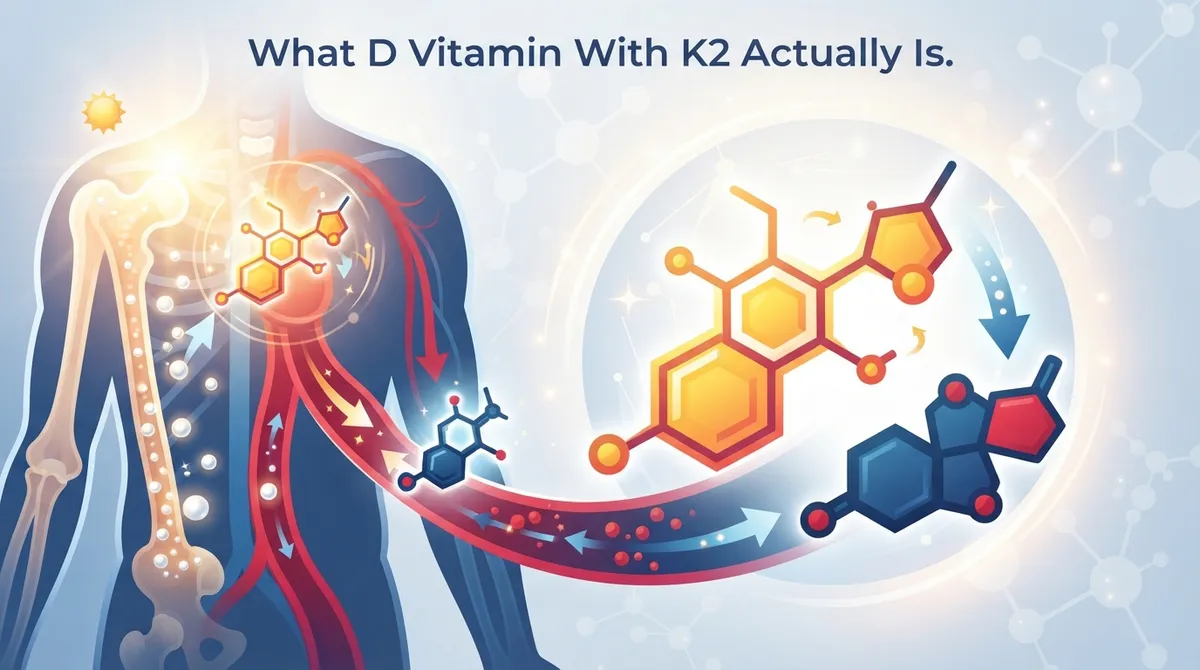
Fact 1: What D Vitamin With K2 Actually Is
A d vitamin with k2 supplement usually combines vitamin D3 (cholecalciferol) with vitamin K2, a form called menaquinone. The two most common K2 forms are MK-7 and MK-4. They are separate nutrients with different jobs.
Many labels imply you must take them together for vitamin D to work. That is not true. You do not need K2 to absorb vitamin D. The combination is a marketing choice built on a scientific idea, not a requirement.

Fact 2: Why Researchers Study the Pair
Vitamin D helps your body absorb calcium and supports bone mineralization. Vitamin K helps activate proteins that handle calcium, including osteocalcin in bone and matrix Gla protein in blood vessels. Vitamin K is also needed for normal blood clotting.
That teamwork gives scientists a reason to study the two together. But a good reason to study something is not proof that it works. The mechanism is promising. The real-world results are still mixed.
Fact 3: What the Evidence Shows for Bones
Some research points to modest bone benefits. A 2020 meta-analysis cited in a 2024 review included eight randomized trials and 971 participants. It found a significant rise in total bone mineral density when vitamin K was combined with vitamin D3.
This is encouraging, but it has limits. Higher bone density does not automatically mean fewer fractures. Results also vary by age, dose, form, and study length. At this time, the evidence does not support using D3 plus K2 as a proven way to prevent fractures.
Fact 4: The Heart and Artery Claims Are Not Proven
Many products claim K2 keeps calcium out of your arteries. This is the most common marketing promise, and it goes further than the science. Studies have looked at vitamin K-dependent biomarkers and cardiometabolic risk factors. Some show changes in those markers.
However, evidence does not establish that the combination prevents arterial calcification or cardiovascular disease. If you are worried about your heart, proven tools matter more. These include blood pressure control, cholesterol management, and regular screening. Our team covers these steps in our guide to 12 proven strategies for blood pressure management in 2026.
Fact 5: Know the Daily Numbers
Dose matters, especially for vitamin D. The table below shows the U.S. reference values from the National Academies and the NIH Office of Dietary Supplements.
|
Nutrient |
Group |
Reference Amount |
|---|---|---|
|
Vitamin D (RDA) |
Adults 19-70 |
600 IU (15 mcg) daily |
|
Vitamin D (RDA) |
Adults over 70 |
800 IU (20 mcg) daily |
|
Vitamin D (upper limit) |
Adults |
4,000 IU (100 mcg) daily from all sources |
|
Vitamin K (adequate intake) |
Men |
120 mcg daily |
|
Vitamin K (adequate intake) |
Women |
90 mcg daily |
The 4,000 IU upper limit is a safety ceiling, not a goal. No upper limit has been set for vitamin K. Higher doses of vitamin D should only be used with a clinician's guidance for a specific reason.
Fact 6: More Vitamin D Is Not Better
The 2024 Endocrine Society guideline offers a useful reminder. Healthy adults under 75 generally should not take vitamin D above the recommended intake just to prevent disease. The guideline also does not set one blood-level target for every healthy person.
Too much vitamin D can cause real harm. Excess intake, usually from high-dose supplements, can raise blood calcium (hypercalcemia) and urine calcium (hypercalciuria). In severe cases, it may lead to kidney injury, soft-tissue calcification, or heart rhythm problems. The NIH Office of Dietary Supplements advises avoiding blood 25-hydroxyvitamin D levels above roughly 125-150 nmol/L (50-60 ng/mL).
Common Signs of Too Much Vitamin D
- Nausea, vomiting, or poor appetite
- Excess thirst and frequent urination
- Constipation and stomach pain
- Weakness, confusion, or fatigue
If you notice these signs while taking high-dose supplements, stop and call your clinician.
Fact 7: Blood Thinners and K2 Do Not Mix Casually
This is the most important safety point in the article. Vitamin K supplements can strongly interfere with warfarin and similar vitamin K-antagonist blood thinners. Starting, stopping, or changing a K2 product can shift your INR and raise your risk of clotting or bleeding.
If you take one of these medicines, do not add a d vitamin with k2 product on your own. Talk to the clinician who manages your anticoagulation first. Steady vitamin K intake and regular INR monitoring are essential.
Medications to Review Before You Start
- Warfarin and related blood thinners (major interaction with K2)
- Thiazide diuretics (may raise calcium when combined with vitamin D)
- Steroids and orlistat (can affect vitamin D handling)
- Some statins (possible interactions with vitamin D)
A full medication review is a core part of primary care. Our guide on 11 prescription management tips for better health in 2026 shows how to keep your list organized and safe.
Fact 8: Your Needs Should Be Personal
Not everyone needs a supplement. Needs depend on your age, diet, sun exposure, skin tone, body weight, medical conditions, and medicines. Some people truly benefit from vitamin D. Others get enough from food and daily life.
Testing can help in the right situation. A blood test for 25-hydroxyvitamin D may make sense if you have bone disease, malabsorption, kidney problems, or other risk factors. It is not a must for every healthy adult. The best path is an individualized plan built with your clinician.
How to Decide Step by Step
- Review your diet, sun exposure, and current supplements.
- List all medicines, especially blood thinners.
- Ask whether a vitamin D blood test fits your risk profile.
- Choose a dose that stays within safe limits.
- Recheck with your clinician if your health or medicines change.
Food First: Natural Sources Worth Knowing
Supplements are one tool, not the only one. Food and lifestyle can cover part of your needs.
- Vitamin D: fatty fish like salmon, fortified milk or plant milks, eggs, and safe sun exposure
- Vitamin K1: leafy greens such as spinach, kale, and broccoli
- Vitamin K2: fermented foods like natto, certain cheeses, and egg yolks
If you take warfarin, keep your leafy green intake consistent from week to week. Sudden changes can affect your blood thinner just like a supplement can.
Can You Take D3 and K2 With Calcium?
Many people do, but it deserves a plan. Vitamin D raises calcium absorption, so stacking high-dose calcium, vitamin D, and other products can push total intake too high. More is not safer here.
Total calcium from food and pills should fit your needs. A clinician can help you calculate that. This matters most for older adults, people with kidney stones, and anyone on diuretics.
How InCare Supports Safe Supplement Decisions
Supplement choices work best inside a bigger picture of prevention. At InCare, our team combines medical expertise with modern tools to build whole-body plans. We offer primary care visits, in-house lab testing, and advanced wellness services like DNA gene testing and IV hydration and vitamin drips.
You can learn how an annual visit fits into this process in our article on what happens during an annual wellness visit. With locations in Tampa and Riverview, plus virtual visits, InCare makes it easy for busy professionals and families to get expert answers. You can find your nearest location or meet our providers. Patients also share their experiences, and you can see what InCare customers say when you visit us on Google — InCare.
Quick Comparison: D3 Alone vs. D3 With K2
|
Factor |
Vitamin D3 Alone |
Vitamin D3 With K2 |
|---|---|---|
|
Main purpose |
Calcium absorption, bone support |
Adds K2 for vitamin K-dependent proteins |
|
Proven fracture prevention |
Limited, depends on group |
Not established |
|
Blood thinner concern |
Low |
High with warfarin |
|
Best for |
People with a documented need |
People cleared by a clinician |
Practical Tips Before You Buy
- Check the label for D3 (cholecalciferol) and the K2 form (MK-7 or MK-4).
- Add up vitamin D from all products, including multivitamins.
- Choose products with third-party testing when possible.
- Keep the dose within the 4,000 IU daily limit unless your clinician directs otherwise.
- Bring the bottle to your next appointment so your care team can review it.
Who Should Be Extra Careful
Some groups need a clinician's review before starting any d vitamin with k2 product.
- Anyone taking warfarin or another vitamin K-antagonist
- People with kidney disease or a history of kidney stones
- Adults with high blood calcium or parathyroid conditions
- Pregnant or breastfeeding women
- Older adults on several medicines
Staying in touch with a primary care doctor helps you catch these issues early. Read more about the value of a steady relationship in our post on what a primary care physician does for your health.
The Bottom Line
A d vitamin with k2 supplement is a reasonable topic to explore, but it is not a proven cure-all. The pairing has a sound biological rationale and some promising bone data. It has not been shown to prevent fractures, arterial calcification, or heart disease. Safety comes first, especially around dose and blood thinners.
The smartest step is a personal one. Share your diet, health history, and medicines with a clinician who can guide you. If you want expert, individualized advice, book an appointment with InCare today or contact our team with your questions. You can also follow our health tips on Instagram, Facebook, and TikTok.
FAQs
Q: What does vitamin D3 with K2 do?
A: Vitamin D3 helps your body absorb calcium and supports bone mineralization. Vitamin K2 helps activate proteins involved in bone metabolism and calcium handling. Together they are studied for bone health, though evidence does not prove they prevent fractures or heart disease.
Q: Can vitamin D with K2 interact with warfarin or other blood thinners?
A: Yes. Vitamin K supplements can significantly interfere with warfarin and similar medicines. Never start, stop, or change a K2 product without speaking to your anticoagulation clinician, who may need to adjust monitoring.
Q: How much vitamin D should I take daily?
A: The U.S. recommended dietary allowance is 600 IU daily for adults through age 70 and 800 IU after age 70. The upper limit is 4,000 IU daily from all sources. Higher doses should only be used under clinician supervision.
Q: Should I get a vitamin D blood test before taking a supplement?
A: Not every healthy adult needs one. Testing is most useful if you have risk factors, bone or kidney conditions, or absorption problems. Your clinician can decide if a 25-hydroxyvitamin D test fits your situation.
Q: Does vitamin K2 prevent calcium from building up in arteries?
A: The idea is based on how K2 activates matrix Gla protein, but current evidence does not establish that supplements prevent arterial calcification or cardiovascular disease. Proven heart protection still relies on blood pressure, cholesterol, and lifestyle management.


