
Key Takeaways
- Executive longevity programs are not a standard medical specialty, so contents vary widely; ask for specifics on tests, follow-up, and how each test will change your care before booking.
- Prioritize evidence-based prevention: screen blood pressure, cholesterol, blood sugar, and cancer risk per USPSTF guidance, and act on results rather than ordering tests indiscriminately.
- Be skeptical of add-on therapies like IV drips, cryotherapy, and plasma exchange; evidence that they extend lifespan is limited, so ask for evidence, risks, and costs.
- Choose a program with physician oversight, personalized testing, transparent pricing, and ongoing follow-up, and confirm insurance coverage since advanced testing is often self-pay.
Busy leaders rarely lack ambition. What they often lack is time to look after their own health. An executive longevity program in Tampa aims to fix that gap. It combines a thorough physical, targeted testing, and a clear plan to lower disease risk and protect long-term health. Yet the term is not a standard medical specialty, and no two programs look alike.
That makes it important to know what you are actually buying. Some services rest on strong evidence. Others are popular but unproven for extending life. This guide walks through ten things to understand before you commit. It is written for professionals, business owners, and health-minded adults who want a smart, medically grounded approach.
Whether you are a tech-savvy millennial, a busy parent, or a high-income wellness seeker, the goal is the same: more healthy years, not just more tests. The sections below explain how to separate real prevention from marketing.

1. An Executive Longevity Program Is Preventive Primary Care at Its Core
In Tampa, an executive longevity program usually means physician-led preventive care. It pairs a detailed executive-style physical with an individual review of heart, metabolic, and cancer risk. It is not one uniform package. Each provider builds it differently.
The best programs start with the basics. A clinician reviews your history, family background, medications, and lifestyle. Then tests are chosen to fit you. A one-size-fits-all panel often creates noise, extra cost, and needless worry.
This is why a strong primary care relationship matters. A doctor who knows you can interpret results in context and follow up over time. You can learn more about this foundation in our guide to why longevity medicine starts with primary care.
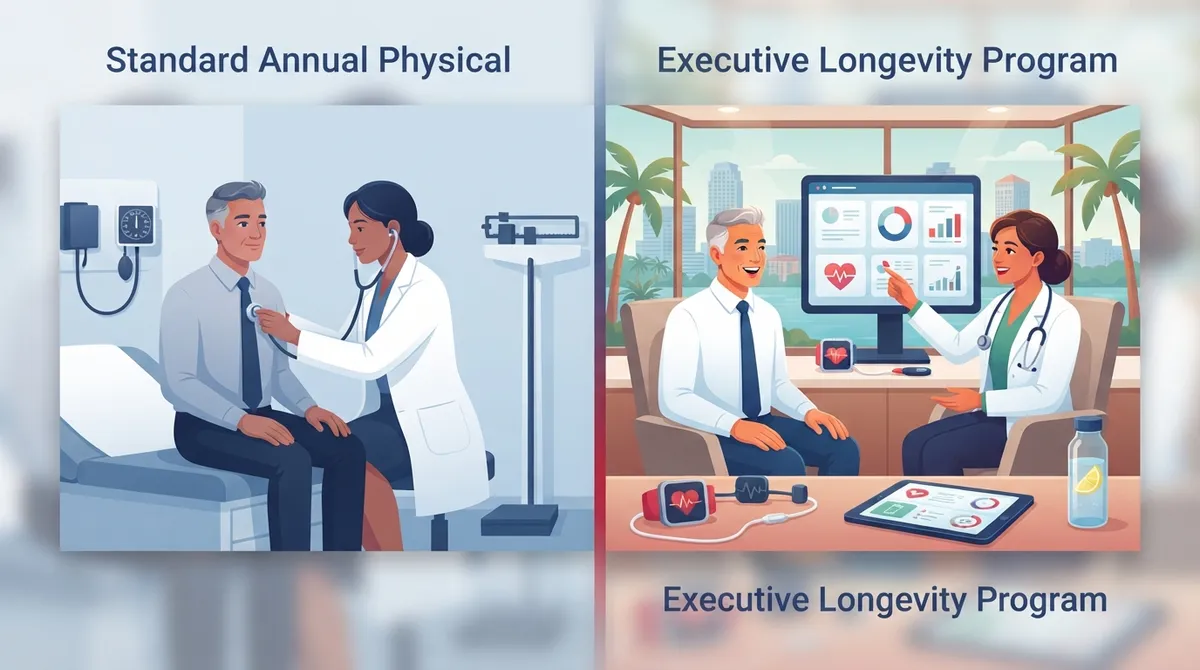
2. How It Differs From a Standard Annual Physical
A standard annual visit is often short. It covers vitals, a basic exam, and routine screening. An executive program is longer and more detailed. It usually adds deeper lab work, risk scoring, and a written plan.
|
Feature |
Standard Annual Physical |
Executive Longevity Program |
|---|---|---|
|
Visit length |
Short, often 20-30 minutes |
Extended, with follow-up review |
|
Lab testing |
Basic panels |
Expanded, risk-based testing |
|
Risk assessment |
General |
Heart, metabolic, and cancer focus |
|
Planning |
Verbal advice |
Personalized prevention plan |
|
Follow-up |
As needed |
Scheduled check-ins |
For a closer look at the baseline visit, see what happens during an annual physical exam. Understanding the basics helps you judge what extra value a longer program should add.
3. What an Executive Physical Typically Includes
Most executive physicals share a core set of elements. The exact list varies, so ask for specifics before you book.
- Detailed history review: personal, family, and workplace stress factors.
- Full physical exam: heart, lungs, skin, and more.
- Blood pressure and heart risk checks: including cholesterol and blood sugar.
- Advanced lab work: chosen based on your risk factors.
- Cancer screening review: age- and risk-appropriate tests.
- Personalized plan: clear next steps in plain language.
A good program ends with a plan you can act on, not just a stack of numbers. If a provider cannot explain how each test changes your care, treat that as a warning sign.
4. Start With Evidence-Based Prevention
Longevity-focused care works best when it builds on proven prevention. The U.S. Preventive Services Task Force (USPSTF) provides clear guidance here. For example, it recommends screening all adults 18 and older for high blood pressure. Elevated office readings should be confirmed with measurements outside the clinic before treatment begins.
The USPSTF also recommends statins for primary prevention in adults ages 40 to 75. This applies to those with at least one cardiovascular risk factor and an estimated 10-year heart event risk of 10% or greater. It is an individual decision made with a clinician, not a rule for every executive.
These recommendations show the right mindset. Test with purpose, act on results, and avoid indiscriminate screening. For practical steps, read about proven strategies for blood pressure management.
5. Heart and Metabolic Risk Assessment Comes First
Heart disease and metabolic disease are leading threats to long-term health. A solid program puts them near the top of the list. That means checking blood pressure, cholesterol, blood sugar, body weight, and waist size.
Some people may also discuss a coronary artery calcium scan with their doctor. This test can be useful in the right clinical context, but it is not right for everyone. Your clinician should explain the reason, the possible downsides, and what you would do with the result.
Metabolic insight can go deeper too. Tools like metabolic breath analysis and body composition testing show how your body uses energy and where fat and muscle sit. These help guide nutrition and training choices.
6. Biomarker and Genetic Testing: Useful, With Limits
Advanced biomarker panels and genetic tests are common in longevity programs. They can add helpful detail when chosen carefully. They can also produce confusing results that lead to extra testing.
Ask three questions before any advanced test:
- What decision will this result help me make?
- Is there good evidence that acting on it improves outcomes?
- What follow-up or cost could it trigger?
Genetic insight can help in some cases, such as understanding inherited risk. Learn how it works through DNA gene testing. Remember that genes are only one piece. Lifestyle, screening, and treatment of known risks still do most of the work.
7. Be Careful With Add-On Therapies
Many Tampa-area wellness offerings include IV therapy, cryotherapy, and therapeutic plasma exchange. Some centers have announced plans to bundle these with executive physicals. These services may have a place for specific needs. However, strong evidence that they extend lifespan is limited.
An honest provider will say so. They should separate what is proven from what is experimental. Services like IV hydration and vitamin drips may help with hydration and certain deficiencies, but they should never replace core prevention.
The same caution applies to newer options. Ask for the evidence, the risks, and the cost. If the answers are vague, keep looking.
8. Cancer Screening and Immunizations Stay Essential
No longevity plan is complete without age- and risk-appropriate cancer screening and up-to-date vaccines. These are among the most reliable ways to protect your future health. Skipping them for trendier tests is a common mistake.
Screening schedules depend on age, family history, and personal risk. A clinician can tailor the timing so you get what you need and avoid what you do not. Explore available cancer screening services to see how early detection fits into your plan.
For a yearly checklist, see what screenings adults should get every year.
9. Lifestyle Coaching Delivers the Biggest Gains
Tests identify risks. Lifestyle changes reduce them. Nutrition, physical activity, sleep, stress control, and avoiding tobacco drive much of long-term health. For executives, sleep and stress deserve special attention.
Look for a program that turns results into small, doable habits. Weight management may be part of this. A physician-led approach, like a medical weight loss program, can address the biology behind weight, not just willpower.
Fitness testing can also help. Measuring aerobic capacity, as described in VO2 max testing in Tampa and Riverview, gives a clear baseline to track progress.
10. How to Choose the Right Tampa Program
Choosing well protects your time and money. Use this checklist when comparing options.
- Physician oversight: A licensed doctor should lead your care and review results.
- Personalized testing: Tests should match your history and goals.
- Clear evidence: The provider should explain what is proven and what is not.
- Transparent pricing: Ask about costs, and whether insurance covers any part.
- Continuity: You should have ongoing access, not a one-time event.
- Convenient access: Look for flexible scheduling and virtual visits.
Verify current services and prices directly, since offerings change. Insurance may cover standard preventive services, while advanced testing and wellness add-ons are often self-pay. Confirm this before you start.
This is where InCare stands out. InCare is a personalized primary care and wellness clinic serving Tampa and Riverview. It combines physician-led care with technology such as body composition analysis, metabolic testing, DNA gene testing, and cancer screening. Patients also benefit from a strong reputation, with a 4.8 out of 5 rating on Google. You can visit us on Google — InCare to read patient reviews, or see our best longevity clinic in Tampa overview for more detail. You can also meet the providers behind the care.
How Often Should You Repeat the Assessment?
Most healthy adults benefit from a yearly review, with testing adjusted to risk. Someone with a known condition or elevated risk may need more frequent follow-up. Your doctor can set the schedule based on results, not on a fixed calendar.
Between visits, stay in touch with your care team. Small changes in weight, blood pressure, or energy are worth discussing early. Staying connected is a core benefit of having a dedicated primary care physician.
Take the Next Step Toward Healthier Years
A strong executive longevity program is built on proven prevention, smart testing, and a doctor who knows you. Be wary of programs that promise to extend life through unproven add-ons. Choose a team that explains the evidence and follows through.
If you live or work in Tampa or Riverview, InCare can help you build a plan that fits your schedule and goals. Book your visit now or contact our team with questions. You can also follow our updates on Instagram, Facebook, and TikTok.
FAQs
Q: What is an executive longevity program, and how is it different from an annual physical?
A: An executive longevity program is a physician-led preventive care service that adds a longer visit, expanded testing, and a written prevention plan to a standard physical. It is not a standardized medical specialty, so contents vary by provider.
Q: What does an executive physical in Tampa typically include?
A: It usually includes a detailed history, a full exam, heart and metabolic risk checks, risk-based lab work, and a review of cancer screening and vaccines. The best programs end with a personalized plan and scheduled follow-up.
Q: Are IV therapy, cryotherapy, or plasma exchange proven to extend lifespan?
A: No. These services may help specific needs, but strong evidence that they increase lifespan is limited. Ask any provider to explain the evidence, risks, and costs before you agree to them.
Q: Does insurance cover executive physicals and longevity services?
A: Insurance often covers standard preventive services, while advanced testing and wellness add-ons are frequently self-pay. Confirm coverage and pricing with the clinic and your insurer before you begin.
Q: How often should I repeat a longevity assessment?
A: Most healthy adults benefit from a yearly review, adjusted to their risk level and results. Your doctor may recommend more frequent follow-up if you have a known condition or elevated risk.