
Key Takeaways
- High purity scores (like 99.79% HPLC) do not prove safety for human use; quality testing must include sterility, endotoxin, heavy metal, and residual solvent testing tied to specific batches.
- MOTS-c is not FDA-approved for any human use and almost all evidence comes from animal and cell studies, not human trials; it should never replace proven treatments like GLP-1 drugs or metformin.
- The CB4211 compound studied in humans is a different, modified version of MOTS-c with different chemical structure, so that short Phase 1 trial does not prove safety or effectiveness of MOTS-c products sold commercially.
- Unregulated MOTS-c peptides carry documented risks including unknown dosing, contamination, immune reactions, injection site infections, and delayed proper care for chronic conditions.
- Products labeled 'research use only' are not FDA-approved for self-injection and sellers often misleadingly imply medical supervision or legal compounding when none exists; always verify independent lab reports and ask about licensed provider involvement.
- Buyers should request batch-specific certificates of analysis including identity confirmation, concentration verification, sterility testing, and heavy metal screening before considering any MOTS-c product.
Interest in MOTS-c has grown fast among people who follow wellness trends on social media and podcasts. Many wonder if this mitochondrial peptide can boost energy, help with weight control, or slow aging. But before anyone considers a product like this, one question matters most: what does "quality" really mean for MOTS-c, and is a high purity score enough to make it safe?
At InCare, our teams in Tampa and Riverview believe patients deserve clear, honest answers about emerging compounds like MOTS-c. This guide explains what MOTS-c is, what the science actually shows, and why lab purity reports do not equal proof of safety or effectiveness. If you are exploring wellness options, understanding these facts can help you make smarter, safer choices.

What Is MOTS-c and Why Is It Getting Attention?
MOTS-c is a small peptide made of 16 amino acids. It comes from a section of mitochondrial DNA called the 12S rRNA region. Mitochondria are the tiny structures inside cells that produce energy. Researchers first described MOTS-c in a 2015 study published in Cell Metabolism by Lee and colleagues.
Since that discovery, scientists have studied MOTS-c in cell cultures and animal models. Early research looked at its possible role in:
- Energy metabolism and glucose use
- Insulin sensitivity
- Exercise adaptation
- Inflammation response
- Cellular aging processes
These early findings sound promising. However, almost all of this evidence comes from lab dishes and animal studies, not human trials. This is a critical distinction that anyone considering MOTS-c should understand fully.
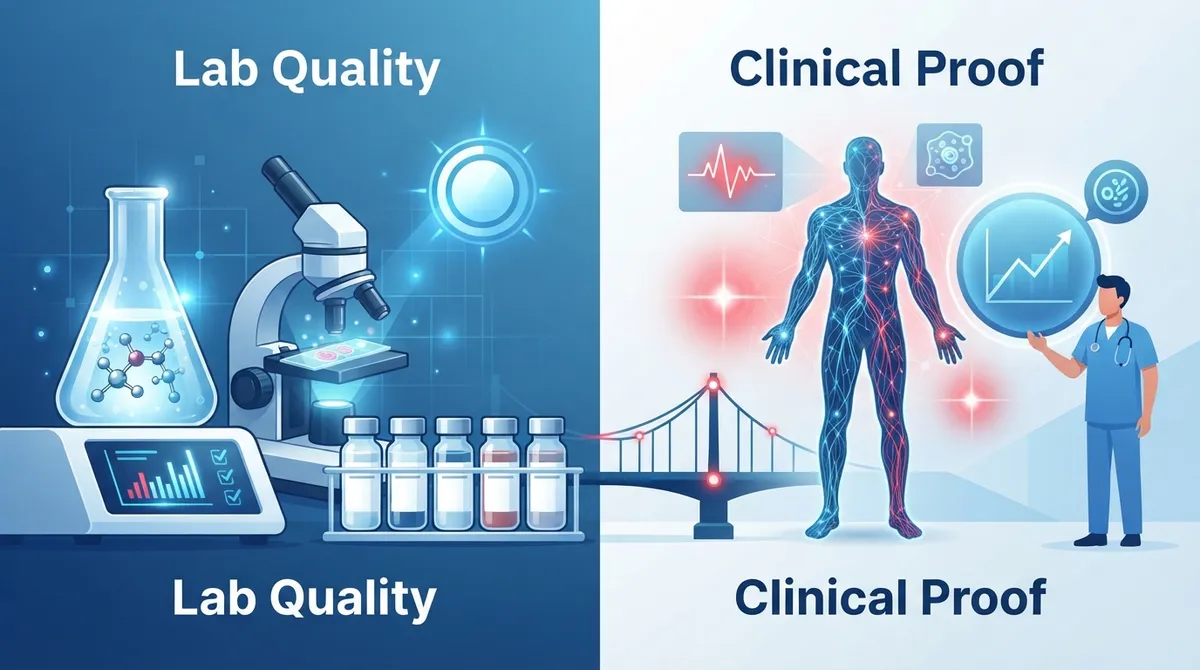
The Difference Between Lab Quality and Clinical Proof
Many companies selling MOTS-c products advertise "high quality" or "pharmaceutical grade" peptides. These claims usually refer to laboratory testing results, not medical evidence. Quality and clinical proof are two very different things.
A vendor lab report we reviewed showed 99.79% peptide purity by HPLC testing for one MOTS-c batch. That number sounds impressive. But HPLC purity only measures how much of the sample matches the expected peptide structure. It says nothing about whether the product works safely in the human body.
What Real Quality Testing Should Include
If a product claims to be high quality, a proper certificate of analysis should include several elements, not just one purity percentage. Here is what buyers should look for:
- Identity confirmation: Proof the substance is actually MOTS-c through sequence testing
- Concentration verification: Accurate measurement of net peptide content
- Sterility testing: Confirmation the product is free from harmful microbes
- Endotoxin testing: Screening for bacterial toxins that can cause serious reactions
- Heavy metal screening: Testing for contaminants like arsenic, lead, cadmium, and mercury
- Residual solvent testing: Checking for leftover chemicals from manufacturing
- Stability data: Information on how the product holds up under storage conditions
- Batch-specific documentation: Reports tied to the exact lot being sold, not a generic template
One lab report we examined listed arsenic at 0.301 parts per million, with cadmium, lead, and mercury not detected under that lab's specifications. This shows why heavy metal testing matters. But remember, this result reflects only one batch from one supplier. It cannot be generalized to every MOTS-c product on the market.
Why Purity Alone Cannot Prove Safety
A common mistake people make is assuming a high purity score means a product is safe to inject or use at home. This is not true. HPLC area percentage has real limits:
- It may miss certain non-peptide contaminants entirely
- It does not confirm the product is sterile
- It cannot verify the peptide folds correctly or behaves as expected in the body
- It does not confirm accurate labeling or dosing
- It says nothing about whether the manufacturing process meets safe injectable standards
This gap between lab testing and real-world safety is exactly why primary care providers urge caution. A product can look clean on paper and still carry serious risks when used by an actual patient.
What Does Human Research on MOTS-c Actually Show?
Human evidence for MOTS-c is extremely limited. Most people searching for information online will not find completed human trials studying the actual MOTS-c peptide. What has been studied is an analog called CB4211.
MOTS-c vs. CB4211: An Important Distinction
CB4211 is a modified version of MOTS-c, not the original molecule. A Phase 1a study of CB4211, registered as NCT03998514, tested single and multiple ascending doses over a short period of up to seven days. Reported results described short-term tolerability with no serious adverse events during that limited window.
This sounds encouraging, but it does not prove MOTS-c itself is safe or effective. CB4211 has a different chemical structure than natural MOTS-c. As of the most recent evidence summaries reviewed through early 2025, no completed Phase 2 randomized controlled trial of exogenous MOTS-c had been published anywhere.
In simple terms: the peptide people are buying and injecting is not the same substance studied in that human trial. This is a major gap that many marketing claims tend to gloss over.
Is MOTS-c FDA Approved for Any Use?
No. MOTS-c has not been approved by the FDA for weight loss, diabetes management, anti-aging treatment, athletic performance, or any other human use. Regulatory summaries reviewed also indicate MOTS-c is not currently on the FDA's Section 503A bulk drug list, which affects whether pharmacies can legally compound it.
This matters because regulatory status can change over time. Anyone considering a MOTS-c product should verify current FDA and state pharmacy board rules directly, rather than relying on marketing claims from a seller or wellness influencer.
MOTS-c Should Not Replace Approved Treatments
Some marketing suggests MOTS-c could work as an alternative to proven medications like GLP-1 drugs, metformin, or insulin. This is not supported by evidence. These approved treatments have gone through extensive clinical trials showing real benefits and known risks. MOTS-c has not.
Delaying proven treatment for diabetes, obesity, or cardiovascular disease in favor of an unproven peptide carries real health risks. If you are managing a chronic condition, working with a primary care provider who understands your full health picture is the safer path forward.
Common Risks Associated With Unregulated Peptides
Because MOTS-c is not FDA approved and lacks strong human safety data, several risks apply to anyone considering it:
|
Risk Category |
Why It Matters |
|---|---|
|
Unknown dosing |
No established dose-response relationship exists in humans |
|
Contamination |
Research-grade products may lack sterile manufacturing standards |
|
Immune reactions |
The body may react unpredictably to synthetic peptides |
|
Injection site issues |
Poor technique or non-sterile products can cause infection |
|
Incorrect concentration |
Mislabeled products can lead to overdosing or underdosing |
|
Drug interactions |
Effects when combined with other medications are unknown |
|
Delayed proper care |
Using unproven products may delay treatment for real conditions |
Long-term human safety data for MOTS-c simply does not exist yet. This is not a minor detail. It is the central reason primary care providers recommend extreme caution.
What About Products Labeled "Research Use Only"
Many MOTS-c products carry a "research use only" label. This label exists for a legal reason: these products have not gone through the FDA process required for human use. A research use only label does not mean the product is automatically safe for self-injection at home.
Some sellers imply these products are legally compounded or medically supervised when they are not. Before trusting any such claim, ask direct questions about manufacturing standards, legal status, and whether a licensed provider is actually involved in oversight.
How Primary Care Providers Think About Emerging Peptides
Clinicians distinguish between three different types of evidence when evaluating a new compound like MOTS-c:
- Preclinical research: Studies in cells or animals that suggest a possible mechanism, but do not prove human safety or benefit
- Observational data: Biomarker studies that show correlations but cannot prove cause and effect
- Controlled clinical trials: Randomized studies in humans that test safety and effectiveness directly
MOTS-c currently sits almost entirely in the first category. This means claims about weight loss, muscle gain, longevity, or disease prevention based only on animal or mechanistic research should be treated as investigational, not proven fact.
Our physicians at InCare, including Dr. Naveen Paddu and Dr. Pramjeet Ahluwalia, take this same evidence-based approach with every wellness conversation. Patients deserve honest context, not hype.
Questions to Ask Before Considering Any Peptide Product
If you are researching MOTS-c or any similar compound, consider asking these questions first:
- Does the seller provide a batch-specific certificate of analysis from an independent lab?
- Does that report include sterility and endotoxin testing, not just purity?
- Is there any completed human clinical trial studying this exact compound?
- What is the current FDA and state regulatory status?
- Is a licensed medical provider involved in any part of sourcing or administration?
- What known risks or side effects have been documented?
If a seller cannot answer these questions clearly, that is a warning sign worth taking seriously.
Why Whole-Body Wellness Starts With a Trusted Provider
Many people turn to peptides like MOTS-c because they want more energy, better metabolic health, or support for healthy aging. These are valid goals. But there are proven, well-studied paths to reach them.
At InCare, our weight loss programs use evidence-based approaches supported by real clinical data. Our metabolic breath analysis and body composition testing give patients accurate, measurable insight into their metabolism, without relying on unproven compounds. For those curious about genetic health factors, our DNA gene testing offers personalized insight grounded in established science.
Patients interested in energy and recovery support can also explore our IV hydration and vitamin drips, delivered under medical supervision at our Tampa and Riverview locations. These options provide real, trackable benefits without the uncertainty that comes with unregulated peptides.
Talking to Your Doctor About MOTS-c
If you are already considering MOTS-c or have started using it, tell your primary care provider. This is not about judgment. It is about safety. Your doctor needs a complete picture of what you are taking to manage interactions, side effects, and any changes in your bloodwork or symptoms.
Our providers, including Dr. Teshy John, work with patients across Tampa and Riverview to build honest, judgment-free conversations around wellness trends. We believe informed patients make the best decisions for their long-term health.
The Bottom Line on MOTS-c Quality
Quality testing for MOTS-c should go far beyond a single purity percentage. Real quality assessment includes identity confirmation, sterility, endotoxin testing, heavy metal screening, and stability data, all tied to a specific batch. Even then, quality testing cannot answer the bigger question: is this substance proven safe and effective for humans?
Right now, the honest answer is no. MOTS-c remains investigational. It is not FDA approved for any human condition, and human trial data is limited mostly to a different analog compound, CB4211, studied for only a short period. Anyone considering MOTS-c should approach marketing claims with healthy skepticism and prioritize conversations with a licensed medical provider.
Our team follows patient feedback closely, and you can visit us on Google — InCare to see what our Tampa and Riverview patients say about their experience with evidence-based wellness care. You can also connect with us on Facebook, follow our wellness updates on Instagram, or catch quick health tips on TikTok.
If you want to explore proven, medically supervised wellness options instead of unregulated peptides, our team is ready to help. Reach out to our care team with your questions, or schedule your visit today to start a wellness plan built on real evidence, not hype.
FAQs
Q: What is MOTS-c and how does it work?
A: MOTS-c is a 16-amino-acid peptide encoded in mitochondrial DNA. Researchers study it for possible roles in energy metabolism, insulin sensitivity, and exercise adaptation. Most evidence comes from cell and animal studies, not human trials.
Q: Is MOTS-c FDA approved for weight loss or anti-aging treatment?
A: No. MOTS-c has not been approved by the FDA for any human use, including weight loss, diabetes, or anti-aging purposes. It should not be treated as an alternative to approved medications.
Q: What is the difference between MOTS-c and the CB4211 analog studied in humans?
A: CB4211 is a modified version of MOTS-c tested in a short Phase 1 human trial. It has a different structure than natural MOTS-c, so results from that study do not confirm the safety or effectiveness of MOTS-c products sold by wellness vendors.
Q: Can a high purity certificate of analysis prove MOTS-c is safe to use?
A: No. HPLC purity testing measures how closely a sample matches the expected peptide structure, but it does not confirm sterility, correct biological activity, or safety for human use. Complete quality testing must also include sterility, endotoxin, and heavy metal screening.
Q: Should I tell my doctor if I am using MOTS-c?
A: Yes. Your primary care provider needs complete information about any peptide or supplement you use to monitor for interactions, side effects, or changes in your health. Open communication helps ensure safer, more informed care.