
Key Takeaways
- MOTS-c is a 16-amino-acid mitochondrial peptide discovered in 2015 that showed promise in animal studies for insulin resistance and weight management, but lacks FDA approval and validated human dosing despite being marketed online.
- Only one MOTS-c-related compound (CB4211) underwent early-phase human testing with 88 participants as a safety evaluation—not a proof of efficacy—making unregulated online MOTS-c products risky without established clinical data.
- Exercise naturally boosts MOTS-c levels in humans and is proven to improve metabolic health, supporting existing primary care recommendations of 150 minutes weekly moderate exercise and strength training over experimental peptide injections.
- Established metabolic treatments including physician-supervised weight loss programs, metabolic testing, and lifestyle changes remain the evidence-based standard, while MOTS-c remains experimental and should only be discussed with licensed healthcare providers.
Peptide science moves fast, and the MOTS-c discovery has become one of the most talked-about topics in wellness circles today. Patients researching metabolism, weight management, and healthy aging keep asking the same question: is this mitochondrial peptide the future of primary care, or is it still just a promising lab finding? At InCare, we believe patients deserve straight answers grounded in real evidence, not hype. This article compares what the MOTS-c discovery actually shows against the proven, evidence-based strategies your primary care team already uses to improve metabolic health.
Understanding this comparison matters because unregulated peptide products are increasingly marketed online with bold claims about weight loss, longevity, and blood sugar control. Before you consider any experimental compound, it helps to know exactly what scientists have found, what remains unproven, and what actually works today. We will walk through the discovery itself, the research findings, and the practical steps our primary care providers recommend for patients in Tampa and Riverview who want real, measurable results.

What Is the MOTS-c Discovery?
MOTS-c stands for mitochondrial open reading frame of the 12S rRNA type-c. It is a small protein made of just 16 amino acids. Researchers discovered it in 2015 while studying short, hidden genetic codes inside human mitochondria.
Mitochondria are the energy factories inside your cells. Scientists always assumed mitochondrial DNA only made a limited set of proteins. The MOTS-c discovery proved that assumption wrong. It revealed a new class of signals called mitochondrial-derived peptides.
The exact sequence of MOTS-c is MRWQEMGYIFYPRKLR. This peptide appears in muscle tissue and circulates in the bloodstream. That dual presence suggests it may act locally inside cells and also send messages between different tissues in the body.
Why Scientists Got Excited
The original study, published in the journal Cell Metabolism, found that MOTS-c helped prevent insulin resistance in mice. It also reduced weight gain in animals fed a high-fat diet. These are exactly the kinds of problems many adults face today, so the findings sparked serious scientific interest.
Since then, researchers have studied MOTS-c in relation to several other conditions, including:
- Blood sugar regulation and insulin sensitivity
- Exercise response and muscle signaling
- Fat storage and obesity-related metabolism
- Inflammation and immune function
- Bone health and age-related decline
Most of this research remains in the early stages. Much of it comes from animal models or small observational studies in humans, not large clinical trials.
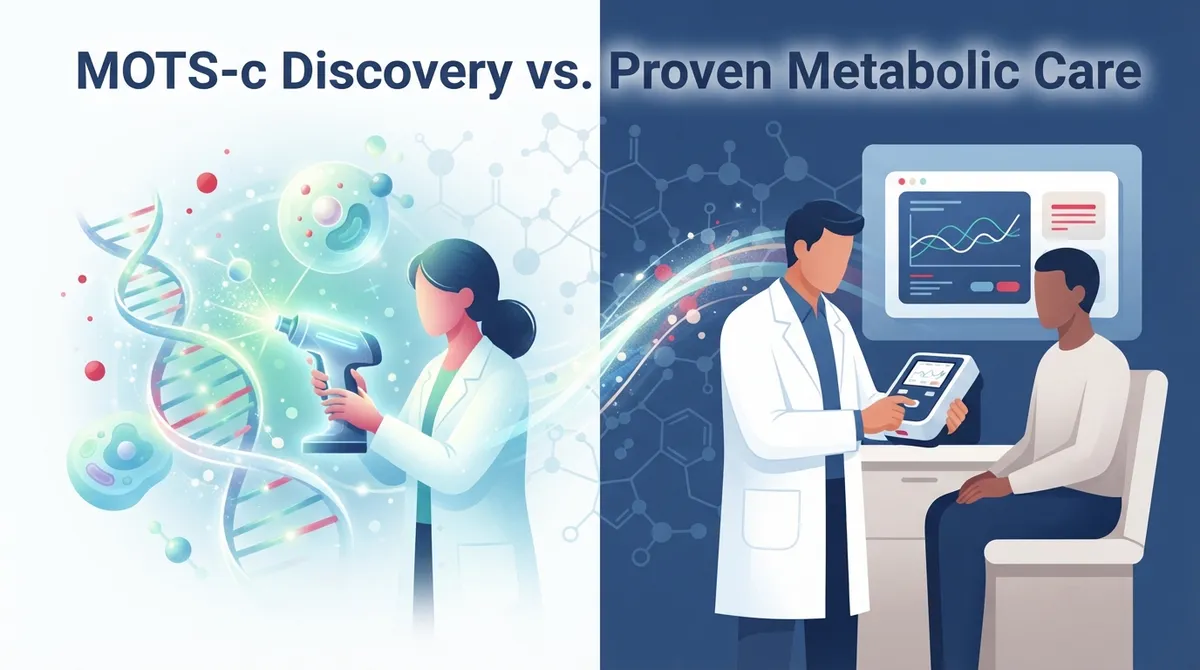
MOTS-c Discovery vs. Established Metabolic Treatments
Here is where the comparison becomes important for patients. The MOTS-c discovery is exciting science. But excitement in a lab does not always translate to safe, effective treatment in a clinic. Let's compare what we actually know about each approach.
|
Factor |
MOTS-c Peptide |
Established Primary Care Approach |
|---|---|---|
|
Human clinical trials |
Limited; one related analog (CB4211) tested in 88 participants |
Decades of large-scale trials |
|
FDA approval status |
Not approved for any use |
Approved medications and lifestyle protocols available |
|
Established dosing |
No validated human dose exists |
Doses are studied and standardized |
|
Blood sugar benefits |
Shown in mice, not confirmed in humans |
Proven improvements with diet, exercise, and medication |
|
Safety monitoring |
Long-term safety unknown |
Well-documented safety profiles |
|
Availability |
Unregulated online products only |
Physician-supervised care at licensed clinics |
This comparison shows a clear pattern. The MOTS-c discovery opened a fascinating research direction. But when it comes to actual patient care, proven methods still lead by a wide margin.
What Happened With the CB4211 Trial?
Researchers did test a MOTS-c-related compound called CB4211 in a registered clinical study. This trial, listed under ClinicalTrials.gov identifier NCT03998514, included a single-ascending-dose and multiple-ascending-dose design in healthy adults.
According to a 2023 evidence review, the study involved 88 participants. It was an early-phase safety evaluation, not a proof of long-term benefit. Short trials like this tell researchers whether a compound is likely safe to study further. They do not confirm that a product works for weight loss, diabetes, or anti-aging goals.
This distinction matters. Marketing materials sometimes cite early research to suggest a peptide is proven. In reality, early-phase data is just the first small step in a very long process.
Does Exercise Naturally Boost MOTS-c?
One of the more interesting findings involves physical activity. Several human studies suggest that exercise and cellular stress can raise MOTS-c levels in the body. Researchers have also observed that MOTS-c levels tend to decline as people get older.
This has led some scientists to describe MOTS-c as a possible marker of healthy aging or fitness. It is a compelling idea. But it also supports something your InCare providers already recommend: regular exercise is one of the best tools you have for metabolic health, with or without any peptide involved.
Steps to Naturally Support Metabolic Health
- Aim for at least 150 minutes of moderate exercise each week
- Include strength training two to three times weekly to support muscle metabolism
- Prioritize seven to nine hours of quality sleep each night
- Maintain a balanced diet with adequate protein and fiber
- Schedule regular checkups to monitor blood sugar and cholesterol
- Work with your primary care doctor to manage existing risk factors
These steps are backed by decades of research. They remain the most reliable path to improved insulin sensitivity and long-term metabolic wellness.
Why Unregulated MOTS-c Products Raise Concerns
Despite the lack of human safety data, some online sellers offer injectable MOTS-c products marketed for weight loss and anti-aging. This creates real risks for consumers.
Here are key concerns our team wants every patient to understand:
- No clinically validated dose exists for human use
- Products sold online are not FDA-approved and may lack quality control
- Long-term safety and effectiveness have not been studied in large trials
- Sourcing and purity of compounded peptides vary widely
- Self-injecting unregulated substances carries infection and dosing risks
If you are curious about peptide therapy in Tampa, always talk with a licensed provider first. A qualified physician can explain which therapies have real evidence behind them and which ones remain experimental.
What Primary Care Actually Offers Today
While the MOTS-c discovery continues to develop in research labs, primary care already has effective tools to manage weight, blood sugar, and metabolic risk. These include:
Comprehensive Metabolic Testing
Our clinics offer metabolic breath analysis and body composition tracking. These tools give you a clear, measurable picture of how your body burns energy right now, not a theoretical prediction based on mouse studies.
Personalized Weight Loss Programs
Structured, physician-guided weight loss programs combine nutrition guidance, activity planning, and when appropriate, FDA-approved medications. These programs have measurable outcomes tracked over time.
DNA and Genetic Insight
Our DNA gene testing service helps identify your personal risk factors for metabolic conditions. This gives your care team real data to build a plan around, rather than relying on unproven peptide claims.
Ongoing Chronic Disease Management
For patients already managing diabetes or metabolic syndrome, consistent primary care follow-up remains essential. Learn more about how primary doctors help manage chronic illnesses through regular monitoring and medication adjustments.
Frequently Overlooked Questions About MOTS-c
Patients often ask whether MOTS-c is the same as a hormone. It is not a hormone in the traditional sense. It is a mitochondrial-derived peptide, a newer category of cell signal that scientists are still working to fully understand.
Another common question involves testing. Currently, there is no universally accepted blood test or reference range for MOTS-c levels in clinical practice. Any product claiming to measure or optimize your MOTS-c level should be viewed with caution until validated testing standards exist.
How InCare Approaches Emerging Wellness Trends
Our team at InCare stays current on peptide research and mitochondrial science because our patients ask about it often. We believe in transparency. When a treatment is backed by strong evidence, we offer it. When something remains experimental, like native MOTS-c peptide injections, we tell you honestly where the science stands.
This approach has helped build trust across our Tampa and Riverview locations. You can see what real patients say about their experience by visiting our InCare location on Google, where our clinics maintain strong reviews for quality, honesty, and personalized care.
We also share ongoing wellness education through our social channels, including Facebook, Instagram, and TikTok, where we break down complex topics like mitochondrial peptides into information you can actually use.
Making the Right Choice for Your Health
So, does the MOTS-c discovery win, or does proven metabolic care win? For now, the answer is clear. The discovery represents an exciting research direction with real scientific merit. But it has not yet become a validated, safe treatment option for humans.
Proven methods, including regular activity, balanced nutrition, weight management support, and physician-guided care for metabolic conditions, still offer the most reliable path to better health. These strategies are backed by decades of data and monitored by licensed providers who understand your full health picture.
If you want to explore your metabolic health with real, evidence-based tools, our team is ready to help. Schedule your appointment today and let our providers build a plan based on your actual body, not unproven online claims. You can also reach out to our team with any questions about weight management, metabolic testing, or peptide therapy options available at InCare.
FAQs
Q: What is MOTS-c and how was it discovered?
A: MOTS-c is a 16-amino-acid peptide encoded by mitochondrial DNA. Researchers discovered it in 2015 while screening short genetic codes hidden inside the mitochondrial genome, revealing a new class of cell signals.
Q: Is MOTS-c approved for human use or available by prescription?
A: No. MOTS-c is not an FDA-approved medication or supplement. There is no established human dose, and it should not be treated as a proven prescription therapy.
Q: Can MOTS-c help with weight loss or blood sugar control?
A: Animal studies showed promising effects on insulin resistance and weight gain, but these results have not been confirmed in large human trials. Proven weight management strategies remain the safer, evidence-based choice.
Q: Does exercise really increase MOTS-c levels?
A: Some human studies suggest exercise and cellular stress can raise MOTS-c activity, while levels tend to decline with age. This supports the value of regular physical activity for overall metabolic health.
Q: Are MOTS-c injections sold online safe to use?
A: No. Unregulated MOTS-c products lack FDA approval, validated dosing, and consistent quality control. Patients should consult a licensed primary care provider before considering any experimental peptide.