Key Takeaways
- No FDA-approved KP-10 dose or product exists for humans; any dosing figures from animal studies were research-development parameters never validated for home use.
- Online KP-10 products labeled 'research use only' carry documented risks including contamination, mislabeling, incorrect concentration, and lack of quality controls or batch testing.
- KP-10 directly affects the reproductive hormone axis and poses heightened risks for pregnant individuals, those with hormone-sensitive cancers, and people currently undergoing fertility treatment.
- A primary care evaluation involving lab testing, medication review, and personalized hormone assessment provides safer, evidence-based alternatives to unsupervised peptide use.
- Long-term human safety data for KP-10 does not exist; animal metabolism differs significantly from human physiology, making species-based dose conversions unreliable for personal use.
- Seek immediate medical attention if experiencing injection-site reactions, unusual menstrual changes, allergic symptoms, or mood and energy changes after using unapproved peptide products.
Searching for KP-10 usage recommendations often leads to confusing forums, unverified product listings, and conflicting dosing charts. If you are looking for guidance on kisspeptin-10, also known as KP-10, it helps to understand what this compound actually is before considering any next step. This peptide has drawn attention for its role in reproductive hormone signaling, but the honest answer is that no approved human dosing guideline exists. This article compares the risky path of self-directed KP-10 use against the safer, evidence-based route of working with a primary care team to address the hormone or fertility concerns that lead people to search for it in the first place.
Whether you are a busy parent trying to understand a hormone panel, a wellness-focused professional curious about peptide trends, or someone exploring fertility options, this guide breaks down the facts. We will look at what KP-10 does in the body, why unsupervised use carries real risk, and what a qualified clinician actually recommends instead. For deeper background on this specific peptide, you can also read our related article, Kisspeptin Explained: The Hormone Peptide Behind Fertility.
What Is KP-10 and Why Does It Matter?
KP-10, or kisspeptin-10, is a small fragment of the naturally occurring kisspeptin hormone. It is also called metastin 45-54 in scientific literature. Your body already makes kisspeptin as part of your normal reproductive hormone system.
KP-10 works by activating a receptor called KISS1R, sometimes labeled GPR54. This receptor sits in the hypothalamus, a control center in your brain. When activated, it triggers the release of gonadotropin-releasing hormone, or GnRH.
GnRH then signals your pituitary gland to release two more hormones:
- Luteinizing hormone (LH), which drives testosterone production in men and ovulation in women
- Follicle-stimulating hormone (FSH), which supports sperm production and egg development
This chain reaction explains why researchers have studied KP-10 for conditions tied to low reproductive hormone output. But studying a compound in a lab is very different from recommending it for home use.
Where Research Currently Stands
Human studies involving KP-10 have mostly been small, short-term, and conducted under strict medical supervision. Researchers have looked at conditions like hypogonadotropic hypogonadism and hypothalamic amenorrhea, both linked to disrupted hormone signaling.
According to DrugBank, kisspeptin-10 remains classified as investigational. One listed trial, NCT03771326, examined how KP-10 affects insulin secretion in men. Being part of a clinical trial does not mean a substance is approved or ready for public use.

Is There an Approved KP-10 Dose for Humans?
This is the most searched question, and the answer is straightforward: no. There is no FDA-approved KP-10 product, no standardized formulation, and no official home-use dose for fertility support, testosterone enhancement, weight management, or anti-aging purposes.
Some numbers do appear in preclinical research, but they are easy to misread. A 2021 safety evaluation found a no-observed-adverse-effect level of 1,000 micrograms per kilogram in dogs given intravenous KP-10 daily for 14 days. That same study proposed a human-equivalent dose near 500 micrograms per kilogram, with a suggested clinical dose closer to 0.313 micrograms per kilogram.
These figures were research-development parameters. They were never meant as a treatment plan you could follow at home. Animal safety data does not translate directly into a safe human protocol, and long-term human safety data for KP-10 simply does not exist yet.
Why Animal Data Cannot Guide Personal Use
Dosing based on body weight conversions from dogs ignores major differences in metabolism, hormone sensitivity, and organ function between species. A number that looked safe in a controlled 14-day animal study tells us little about what happens after months of unsupervised human use.
Researchers have tested KP-10 through several delivery methods, including:
- Intravenous infusion in hospital or lab settings
- Subcutaneous injection under close monitoring
- Intranasal delivery in early-phase studies
Each of these reflects a controlled research design, not a recommendation for primary care patients to replicate independently.
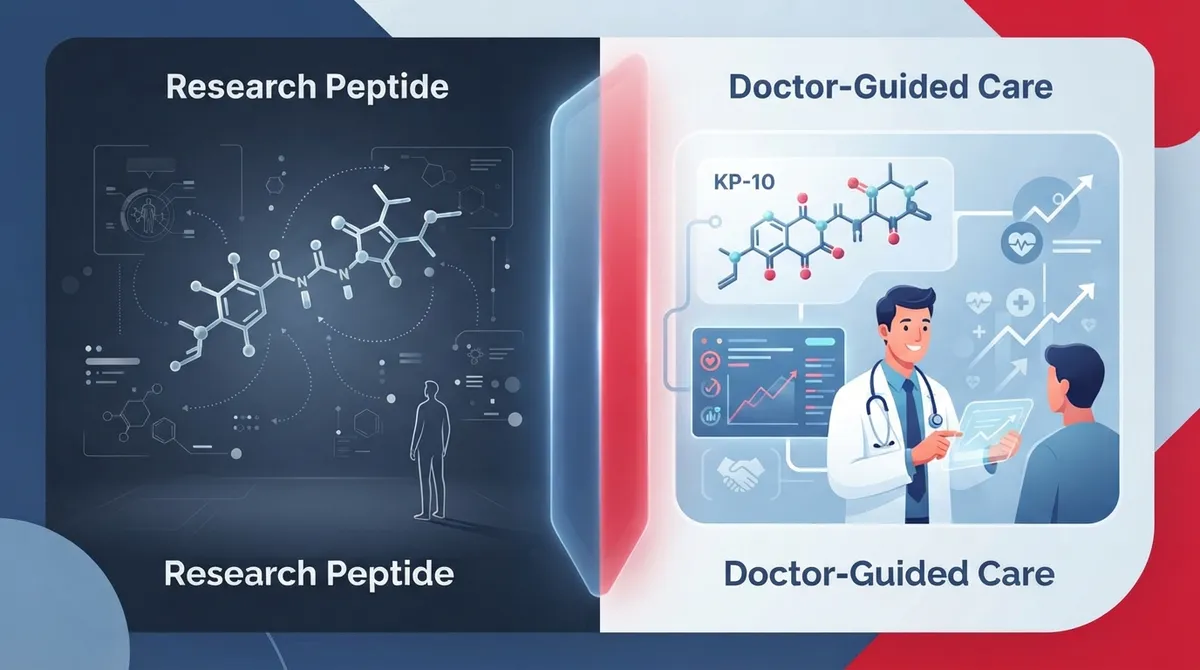
KP-10 Usage Recommendations: Research Compound vs. Clinical Care
Many people find KP-10 online labeled as "research use only." This label is a legal and safety warning, not a technicality to work around. Research-only products are not intended for human consumption and often lack basic quality controls.
|
Factor |
Unsupervised KP-10 Use |
Clinician-Guided Hormone Evaluation |
|---|---|---|
|
Regulatory status |
Not FDA approved for any use |
Uses approved diagnostic tools and treatments |
|
Dosing accuracy |
No verified human dose exists |
Based on labs, history, and exam findings |
|
Product quality |
Risk of contamination or mislabeling |
Pharmaceutical-grade, tested medications |
|
Monitoring |
No safety oversight |
Ongoing follow-up and lab tracking |
|
Risk of interactions |
Unknown, unmanaged |
Reviewed against current medications |
The gap between these two columns is significant. A qualified primary care evaluation looks at the whole picture instead of a single unverified compound.
Quality Risks With Online KP-10 Products
Peptides sold online without regulation carry several documented risks:
- Incorrect concentration or mislabeled dosage strength
- Contamination from unsterile manufacturing conditions
- Counterfeit labeling that misrepresents the actual ingredient
- Improper storage that degrades the product before it even reaches you
- No batch testing to confirm identity or purity
Self-injecting or ingesting a substance with these unknowns is not a measured wellness decision. It is an unmonitored experiment on your own reproductive endocrine system.
Who Should Never Consider KP-10 Outside Clinical Research?
Because KP-10 directly affects the reproductive hormone axis, certain groups face heightened risk from any unsupervised use. This list is not exhaustive, but it highlights the clearest concerns:
- Pregnant or breastfeeding individuals, due to unknown effects on hormone-sensitive processes
- People with hormone-sensitive cancers or endocrine disorders
- Anyone currently pursuing fertility treatment under a specialist's care
- Patients taking medications that affect hormone levels
- Adolescents whose reproductive hormone systems are still developing
If you fall into any of these categories, or you are simply unsure, the safest step is a conversation with a licensed clinician before considering any peptide, supplement, or hormone-related product.
Warning Signs That Require Prompt Medical Attention
Anyone who has already used an unapproved peptide product and experiences a reaction should seek care right away. Watch for:
- Unusual swelling, rash, or injection-site reactions
- Sudden changes in menstrual cycle or unexpected bleeding
- Signs of an allergic reaction, including difficulty breathing
- New or worsening symptoms related to mood, energy, or libido
Our urgent care team can evaluate sudden symptoms quickly, while your primary care provider can coordinate longer-term follow-up.
What Does a Primary Care Evaluation for Hormone Symptoms Actually Involve?
Instead of guessing at a KP-10 protocol, a structured clinical workup gives you real answers. Here is what that process typically looks like:
- A detailed medical history, including reproductive goals and current symptoms
- A full medication and supplement review to check for interactions
- Blood testing for LH, FSH, testosterone, estrogen, and related hormones
- Additional testing based on findings, such as thyroid or metabolic panels
- A personalized discussion of treatment options based on your specific results
This approach treats the root cause rather than chasing an unproven compound. Our providers, including Dr. Pramjeet Ahluwalia, work with patients across Tampa and Riverview to build these evaluations around each person's actual health history.
Evidence-Based Alternatives Worth Discussing
Depending on your specific hormone or fertility concern, your doctor may discuss several established options:
- Testosterone replacement therapy for confirmed low testosterone, explained further in our guide on testosterone replacement therapy
- Specialist referral for hypothalamic amenorrhea or complex fertility cases
- Lifestyle and nutrition adjustments that support natural hormone balance
- Targeted lab monitoring to track progress over time
- Peptide therapies that do have clinical backing and oversight, discussed in our peptide therapy program
These paths give you a documented, monitored plan rather than a self-sourced product with unverified contents.
How InCare Approaches Hormone and Wellness Concerns
At InCare, we combine lab testing, physician oversight, and personalized planning for patients asking about hormone health, fertility concerns, or peptide trends like KP-10. Our clinics in Tampa and Riverview offer DNA gene testing, body composition analysis, and comprehensive cancer screening alongside primary care, so you get a full picture of your health rather than a single isolated answer.
Patients consistently mention our attentive staff and thorough approach, which you can see reflected in our reviews when you visit us on Google — InCare. We also share ongoing wellness education across our Facebook and Instagram pages, and shorter wellness tips on Tik Tok.
Why Riverview and Tampa Patients Choose Coordinated Care
Local patients often come to us after searching for answers to hormone symptoms on their own. A coordinated care model, explained in our article on fragmented care vs. coordinated care, consistently outperforms piecing together information from unverified sources.
If irregular cycles, low energy, or fertility questions have led you to consider KP-10, a same-day conversation with our team can clarify safer next steps. Many patients also explore our weight loss and IV hydration and vitamin drip services as part of a broader wellness plan once underlying hormone issues are addressed.
Frequently Considered Questions Before Trying KP-10
Before making any decision about KP-10, it helps to step back and ask whether the goal is really about a specific peptide or about the underlying symptom. Fatigue, low libido, irregular cycles, and fertility struggles all have established diagnostic pathways that do not require experimenting with unapproved research chemicals.
A short list of good questions to bring to your next appointment includes:
- What lab results would explain my current symptoms?
- Are there FDA-approved options that address the same concern?
- What lifestyle factors might be contributing to my hormone imbalance?
- How will my provider monitor progress once treatment begins?
Bringing these questions to a licensed clinician turns a vague online search into a clear, actionable plan.
Take the Safer Path Toward Hormone Health
KP-10 usage recommendations remain unsettled because the science is still early, the regulatory approval is absent, and the safety data in humans is limited. Rather than relying on unverified online products, a conversation with a qualified primary care team gives you real testing, real oversight, and a real plan tailored to your body. If hormone symptoms, fertility questions, or general wellness concerns have brought you here, our team is ready to help you find answers grounded in evidence. Book Now to schedule an evaluation, or reach out to our team with any questions about your next step.
FAQs
Q: Is there a safe KP-10 dose for humans?
A: No standardized or approved human dose exists for KP-10. Preclinical animal studies proposed research-development figures, but these were never validated for routine human use and should not guide self-treatment.
Q: Can KP-10 increase testosterone or LH levels?
A: Controlled research settings have shown KP-10 can raise LH and sometimes FSH or testosterone through activation of the kisspeptin receptor. However, this evidence comes from short, supervised studies, not from long-term or unsupervised use.
Q: Is it safe to buy KP-10 online and self-inject it?
A: This is not recommended. Products labeled research use only often carry risks involving contamination, incorrect concentration, and counterfeit labeling, and self-administration bypasses the clinical oversight needed for hormone-active substances.
Q: Can kisspeptin-10 treat infertility or hypothalamic amenorrhea?
A: Small, medically supervised studies have examined KP-10 for these conditions, but findings remain investigational. Patients with fertility or menstrual concerns should pursue evaluation through a licensed reproductive specialist rather than self-directed peptide use.
Q: What tests should a primary care clinician order before addressing hormone symptoms?
A: A thorough evaluation typically includes a detailed medical history, medication review, and blood testing for hormones like LH, FSH, and testosterone. Additional labs may follow based on initial findings to identify the true cause of symptoms.