
Key Takeaways
- Exercise naturally increases MOTS-c levels by 11.9-fold in muscle tissue and 1.5-1.6-fold in blood, so your body already triggers this response without supplementation or injection.
- No MOTS-c product has received clinical approval, validated dosing protocols, or established long-term human safety data, making unapproved peptide use risky despite promising animal studies.
- Human evidence for MOTS-c improving endurance remains limited and inconsistent; most studies measure natural peptide levels during exercise rather than testing whether supplemental MOTS-c actually enhances performance.
- Endurance-type cardiovascular training stimulates MOTS-c responses more effectively than resistance training alone, supporting traditional recommendations for aerobic activity in metabolic health programs.
- Evidence-based endurance strategies—structured cardio training, balanced nutrition, quality sleep, and regular health screening—provide proven results now, rather than waiting for unproven peptide therapies.
- Athletes in sanctioned sports should avoid unapproved MOTS-c due to potential anti-doping concerns and regulatory violations, plus unresolved safety questions around dosing and long-term effects.
Scroll through any fitness forum today and you may spot claims that MOTS-c can boost your endurance overnight. This tiny peptide has become a hot topic among runners, cyclists, and biohackers looking for an edge. But what does the actual science say about MOTS-c and endurance? At InCare, our providers in Tampa and Riverview believe patients deserve clear, honest answers before considering any emerging wellness trend. This guide breaks down what MOTS-c really is, what the research shows, and how to think about endurance in a way that's grounded in evidence rather than hype.
Whether you're a busy parent trying to keep up with your kids, a weekend athlete chasing a personal best, or simply someone curious about mitochondrial health, understanding MOTS-c matters. Let's separate the promising lab findings from the marketing claims you may have seen online.

What Is MOTS-c and Why Is It Linked to Endurance
MOTS-c stands for mitochondrial open reading frame of the 12S rRNA-c. It's a mouthful, but the concept is simple. This is a small peptide made up of just 16 amino acids. Your mitochondria, the tiny power plants inside your cells, produce it naturally.
Scientists classify MOTS-c as a mitochondrial-derived peptide. Researchers are studying its role in several body processes, including:
- Energy metabolism and how your cells use fuel
- Blood sugar regulation and insulin sensitivity
- Cellular stress responses during exercise
- Muscle adaptation to physical activity
Because mitochondria play a central role in producing energy for muscles, researchers wondered if MOTS-c might influence stamina and endurance. This question has driven a wave of animal and human studies over the past several years.
How Exercise Naturally Raises MOTS-c Levels
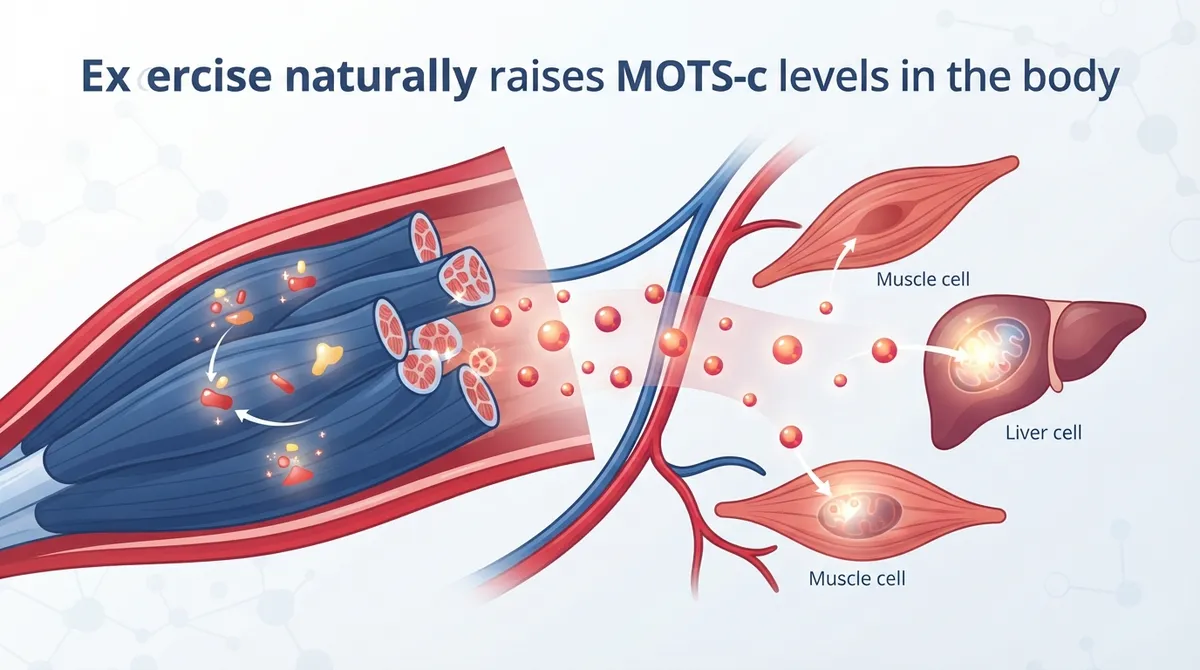
Here's something interesting. Your body already makes more MOTS-c when you exercise. You don't need an injection to trigger this response.
A human study involving healthy young men looked at what happens during high-intensity cycling. According to results summarized in Nature Communications (2021), skeletal-muscle MOTS-c increased approximately 11.9-fold after acute exercise. Circulating MOTS-c in the blood rose about 1.6-fold during exercise and 1.5-fold afterward.
The same research, as summarized by the Alzheimer's Drug Discovery Foundation, reported circulating MOTS-c levels around 125 pg/mL before exercise and about 190 pg/mL during exercise in a small group of 10 healthy young men. One review even noted muscle MOTS-c levels stayed elevated, showing an approximately 18.9-fold increase four hours after exercise.
These numbers sound impressive, but the study group was small. Researchers caution against drawing big conclusions from limited data. Still, the pattern suggests your body's own exercise response may already be doing meaningful metabolic work.
Endurance Training vs. Resistance Training Responses
Not all exercise types trigger MOTS-c the same way. A 2021 study on acute endurance and resistance exercise found that endurance-type activity stimulated circulating mitochondrial-derived peptide responses more clearly than resistance training did.
This finding lines up with what many primary care providers already recommend: regular cardiovascular activity supports metabolic health in ways that strength training alone may not fully replicate. For patients working on weight loss or blood sugar management, this distinction can guide smarter exercise programming.
What Animal Studies Show About MOTS-c and Running Capacity
Much of the excitement around MOTS-c comes from mouse studies. Researchers gave mice doses of MOTS-c, typically between 5 and 15 mg/kg per day, according to a review published by the American Physiological Society. Mice that received treadmill training alongside MOTS-c showed improved running capacity, in both young and older animals.
This is genuinely interesting laboratory science. It suggests MOTS-c may interact with pathways like AMPK signaling, which helps regulate how cells produce and use energy. It may also influence glucose uptake and how muscles adapt to repeated exertion.
However, there's a big gap between a mouse on a treadmill and a human training for a marathon. Doses used in animal studies cannot simply be scaled down and applied to people. The biology, metabolism, and safety profile in humans remain far less understood.
Why Human Evidence Remains Limited
Here's the honest truth: almost all human research on MOTS-c has measured naturally occurring peptide levels during exercise. Very few studies have tested whether injected or supplemental MOTS-c actually improves endurance, athletic performance, or metabolic health in people.
Reviews published in 2023 stated plainly that effective clinical application of MOTS-c has not been established. There is no validated therapeutic protocol, no standard dosing, and no routine clinical approval for MOTS-c as a treatment.
Some research also shows inconsistent results. While certain studies report associations between circulating MOTS-c and aerobic performance, other acute-exercise research found no clear relationship between mitochondrial-derived peptide levels and a person's baseline fitness. This inconsistency matters. It means we can't yet say confidently that higher MOTS-c equals better endurance in humans.
Key Facts About Current MOTS-c Research
|
Research Area |
What We Know |
What Remains Unclear |
|---|---|---|
|
Exercise response |
Acute exercise raises endogenous MOTS-c in small human studies |
Whether this response predicts long-term endurance gains |
|
Animal studies |
Administered MOTS-c improved running capacity in mice |
Human dosing, safety, and effectiveness |
|
Clinical approval |
No MOTS-c therapy has routine clinical approval |
Long-term safety, immunogenicity, drug interactions |
|
Fitness correlation |
Some studies link MOTS-c to aerobic performance |
Other studies found no clear link to baseline fitness |
Is MOTS-c Safe for Human Use
This is the question every patient should ask before considering any unapproved peptide. The honest answer is that we don't fully know yet.
No MOTS-c product has received routine approval for clinical use. Long-term safety data in humans is limited. Key unknowns include:
- Appropriate and safe dosing for different age groups and health conditions
- Potential drug interactions with common medications
- Immunogenicity, meaning whether the body might react against the peptide over time
- Effects during pregnancy or in people managing chronic diseases like diabetes or heart conditions
- Quality control and purity of compounded or unregulated products
Because so much remains unknown, primary care providers generally advise against using unapproved MOTS-c products for endurance or performance goals. This caution isn't about dismissing promising science. It's about protecting your health while research continues.
Evidence-Based Ways to Support Endurance Right Now
The good news is that you don't need to wait for more MOTS-c research to improve your stamina and metabolic health. Proven strategies already exist, and many are things your primary care team can help you build into a personalized plan.
- Structured cardiovascular training that gradually increases intensity and duration
- Balanced nutrition that supports muscle recovery and glucose regulation
- Consistent, quality sleep, which affects hormone balance and recovery
- Regular screening for cardiovascular risk factors and metabolic markers
- Management of underlying conditions like diabetes, thyroid issues, or obesity
These fundamentals remain the backbone of endurance improvement backed by decades of clinical evidence. A tool like metabolic breath analysis can help you understand exactly how your body uses fuel during activity, giving you a data-driven starting point.
How Body Composition and DNA Insights Fit In
Some patients want a deeper look at their unique physiology before setting endurance goals. Services like body composition analysis use 3D imaging and tracking to show how muscle, fat, and hydration levels shift over time. Meanwhile, DNA gene testing can reveal genetic predispositions related to metabolism and recovery, offering another layer of personalized insight.
Combining these tools with regular primary care visits gives you a fuller picture than any single peptide trend could offer. Your provider can track real changes in your metabolic health and adjust your plan as your body responds.
Talking to Your Doctor About Peptides and Wellness Trends
If you're curious about MOTS-c or other emerging peptides, the smartest first step is an honest conversation with a licensed provider. A good clinician will walk you through the current evidence, explain the risks of unregulated products, and help you focus on strategies that actually move the needle for your goals.
Our team, including physicians like Naveen Paddu MD, Pramjeet Ahluwalia MD, and Teshy John MD, regularly discusses emerging wellness science with patients across our Tampa and Riverview locations. We believe in giving patients honest, evidence-based guidance rather than following every trend.
If you're interested in peptide therapy more broadly, our detailed resource on peptide therapy in Tampa explains which options are currently supported by stronger clinical evidence.
Anti-Doping and Athletic Considerations
If you compete in sanctioned sports, there's another layer to consider. Because MOTS-c is still investigational and not approved for human therapeutic use, athletes should be cautious. Using unapproved peptides could raise anti-doping concerns depending on your sport's governing body and testing policies.
Athletes are generally better served by working with a sports medicine provider or primary care physician who understands both performance goals and regulatory rules. This protects both your health and your eligibility to compete.
Building a Realistic Endurance Plan With Primary Care Support
Improving endurance is rarely about one magic compound. It's about consistent habits, accurate health data, and a provider who knows your full medical history. Here's a simple framework many patients follow:
- Get a baseline health assessment, including bloodwork and cardiovascular screening
- Identify any underlying conditions affecting energy or metabolism
- Build a gradual, structured exercise plan suited to your current fitness level
- Track progress using tools like body composition scans or metabolic testing
- Adjust nutrition and hydration strategies, potentially including IV hydration and vitamin drips for recovery support
- Revisit your plan regularly with your primary care provider
This approach respects your body's individual needs rather than chasing every new supplement trend. It's also far more sustainable than relying on unproven products with unclear safety profiles.
Patients across Tampa and Riverview trust InCare because we combine advanced technology with careful, honest medical guidance. You can read what our community says by visiting our InCare location on Google, where our 4.8-star rating reflects hundreds of patient experiences. We also share wellness updates and education through our Facebook, Instagram, and TikTok channels.
Conclusion: Focus on What Actually Works
MOTS-c is a fascinating area of mitochondrial research. Exercise clearly raises this peptide naturally, and animal studies hint at exciting possibilities for endurance and metabolic health. But human evidence remains preliminary, and no MOTS-c product currently has approval or a validated safety profile for therapeutic use.
Rather than gambling on unregulated peptides, invest in what medical evidence already supports: consistent training, smart nutrition, quality sleep, and regular checkups with a provider who knows your health history. If you want a personalized plan built around real data instead of trends, our team is ready to help. Reach out to our care team to schedule a consultation, or go ahead and book your appointment online today.
FAQs
Q: What is MOTS-c and how is it related to endurance exercise?
A: MOTS-c is a 16-amino-acid peptide made by your mitochondria, the energy centers inside your cells. Exercise naturally raises MOTS-c levels, and researchers are studying whether it plays a role in energy metabolism, glucose regulation, and muscle adaptation during endurance activity.
Q: Can MOTS-c improve running performance or VO2 max?
A: Animal studies show MOTS-c improved running capacity in mice, but human evidence remains limited and preliminary. Most human research measures the body's natural MOTS-c response to exercise rather than testing whether supplemental MOTS-c improves performance.
Q: Does exercise naturally increase MOTS-c levels?
A: Yes. A human study found that acute high-intensity cycling increased skeletal-muscle MOTS-c by nearly 12-fold and circulating levels by about 1.5 to 1.6-fold. Levels generally return toward baseline within a few hours of rest.
Q: Is MOTS-c approved for human use or available as a prescription treatment?
A: No. MOTS-c has not received routine clinical approval, and reviews from 2023 confirm no validated therapeutic protocol currently exists. It remains an investigational compound studied primarily in laboratory and animal settings.
Q: What are the known side effects and risks of MOTS-c?
A: Long-term human safety data is not well established. Unknowns include proper dosing, drug interactions, immune reactions, and safety during pregnancy or chronic illness, which is why primary care providers recommend caution around unregulated MOTS-c products.