
Key Takeaways
- Choose a peptide clinic only after verifying a current Florida license for the prescriber and confirming who will prescribe and monitor your care.
- Ask for the exact medication name, dose, and intended use; vague labels like "healing blend" are a warning sign.
- Know the FDA status: approved peptides have reviewed safety and effectiveness, while compounded and unapproved products are not reviewed for safety, effectiveness, or quality before marketing.
- Compounding is meant as an exception for individual patients; a good clinician should explain why an FDA-approved option does not fit before recommending a compounded one.
- A primary care setting is often safest because it tracks blood pressure, blood sugar, kidney and liver function, and current medications that affect whether peptide therapy is safe.
- Avoid clinics that claim peptides cure or reverse disease, skip lab work, refuse to name their pharmacy, or sell "research use only" products for human use.
Peptide therapy has moved from niche conversation to mainstream wellness topic. If you live in Hillsborough County and search for a peptide clinic Riverview residents can trust, you will find many options and many bold claims. Some of those claims are backed by science. Many are not.
The term "peptide" covers a huge group of molecules. It does not name one specific treatment. Some peptide medicines are FDA-approved. Others are compounded or unapproved, and the evidence behind them can be thin. That is why choosing the right clinic matters more than choosing a trendy product.
This guide shows you how to evaluate a peptide clinic in Riverview step by step. You will learn what questions to ask, what red flags to avoid, and why a physician-led primary care setting is often the safest place to start. Whether you are a busy parent, a wellness-focused professional, or someone new to preventive care, you will leave with a clear plan.

What a Peptide Clinic in Riverview Actually Does
A peptide clinic is a healthcare practice that evaluates patients for peptide-related treatment. In Riverview, Florida, the safest versions of this care sit inside a primary care or wellness practice. A licensed clinician reviews your health first. Then you decide together whether a peptide makes sense.
For example, InCare lists peptide care at its Riverview clinic at 11922 Boyette Road, Riverview, FL 33569. Its clinic page describes a process that includes reviewing symptoms, health history, testing needs, treatment considerations, and ongoing monitoring. That is the right model: evaluation first, treatment second, follow-up always.
Note that "Riverview" is also a place name in other states. If you are searching online, add "FL" or "Florida" so you land on the right local results.
Peptides in plain language
Peptides are short chains of amino acids. Your body makes many of them naturally. Some act as hormones or signals. Others help regulate appetite, blood sugar, or tissue repair.
The word "peptide" alone tells you very little. A responsible clinic should always name the exact medication, explain its purpose, and share what the evidence shows. If a clinic cannot do that, keep looking.
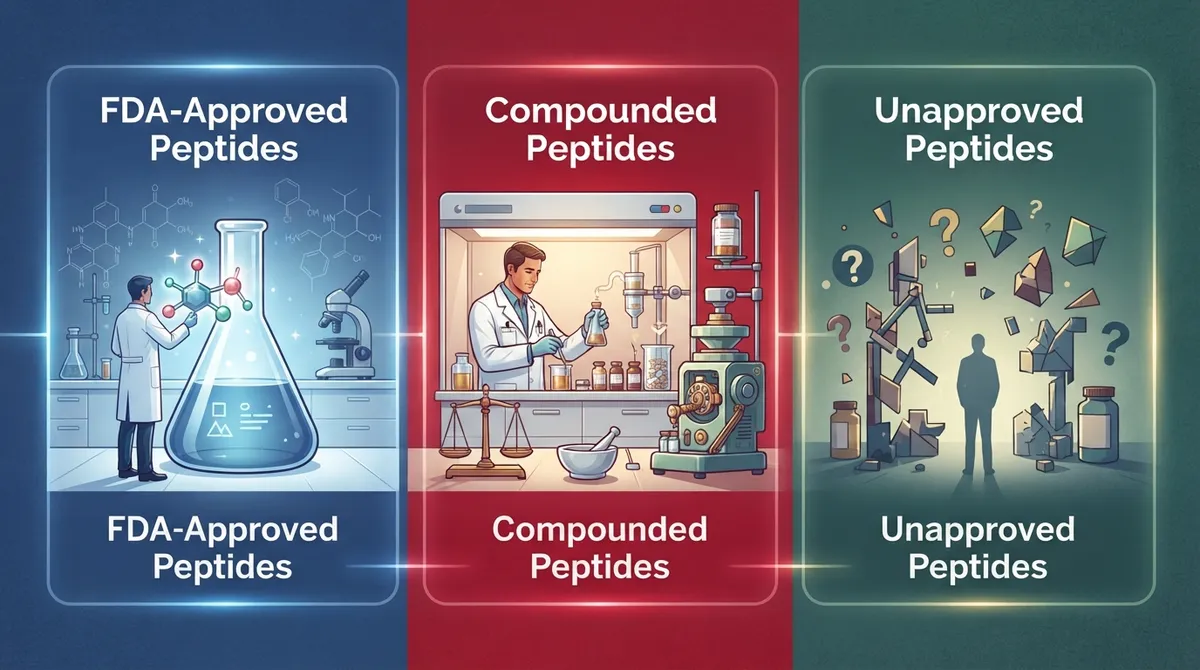
Understand the Difference: FDA-Approved vs. Compounded vs. Unapproved
This is the most important concept in the whole topic. Not every peptide product carries the same level of oversight. The table below shows the key differences.
|
Category |
FDA Review |
What It Means for You |
|---|---|---|
|
FDA-approved peptide medicine |
Reviewed for approved uses |
Safety and effectiveness were evaluated for specific conditions |
|
Compounded drug |
Not FDA-approved |
FDA does not review it for safety, effectiveness, or quality before marketing |
|
Unapproved or research-stage peptide |
No approval |
Clinical safety data may be limited or missing |
Compounding is not always wrong. FDA policy allows it for an individual patient when an approved medicine cannot meet that patient's medical need, subject to legal requirements. But it should be the exception, not the default. A good clinician will explain why an approved option does not fit before suggesting a compounded one.
Why this matters in real life
The FDA has warned about unapproved and compounded GLP-1 products used for weight loss. Reports have included dosing errors with compounded injectable semaglutide and adverse events that sometimes required medical attention. These risks are real, which is why you should always discuss the product, dose, administration, and monitoring with a licensed clinician.
Likewise, BPC-157 is not an FDA-approved drug. FDA materials note insufficient clinical safety information to characterize its safety profile. They also raise concerns about formulation, impurities, aggregation, and possible immune responses. Any claim of benefit should not be treated as established clinical fact.
How to Choose a Peptide Clinic in Riverview: 8 Steps
Use this checklist when you compare clinics. It works for any peptide-related service, from weight management to wellness support.
- Confirm the location. Make sure the clinic is in Riverview, Florida, and that you can reach it easily for follow-up visits.
- Verify clinician credentials. Check that the prescriber holds a current Florida license. Look up the clinician through the state licensing board.
- Ask who prescribes and monitors. You should know the name of the physician or licensed provider responsible for your care.
- Request the exact medication name. Ask for the specific substance, dose, and intended use. Vague labels like "healing blend" are a warning sign.
- Ask about FDA status. Find out whether the product is FDA-approved, compounded, or unapproved.
- Ask about the source. For compounded medication, ask which licensed pharmacy prepares it and why an FDA-approved option is not suitable.
- Review testing and monitoring plans. Ask what labs are needed before starting and how often you will be rechecked.
- Get the full cost in writing. Ask about consultation fees, medication costs, lab work, and follow-up visits.
Questions to Ask at Your First Consultation
A strong consultation should feel like a real medical visit. You should leave informed, not pressured. Bring this list with you.
- What condition or goal is this treatment meant to address?
- What is the evidence for this specific peptide?
- Is there an FDA-approved alternative, and why or why not?
- What side effects should I watch for?
- How will you monitor my response and safety?
- What happens if I want to stop?
- How does this fit with my other medications and conditions?
If a clinic dodges these questions or promises dramatic results, treat that as a red flag. Honest clinicians discuss limits as openly as benefits.
Why a Primary Care Setting Is Often the Safest Starting Point
Peptide therapy should not exist in isolation. Your overall health picture affects what is safe for you. Blood pressure, blood sugar, hormone levels, kidney and liver function, current medications, and family history all matter.
A primary care clinic already tracks these factors. That makes it easier to spot interactions and to adjust a plan if something changes. If you are new to preventive care, our guide on what happens during an annual wellness visit explains the baseline picture a good clinician builds.
At InCare primary care, preventive services, urgent care, and wellness programs sit under one roof. That coordination is a real advantage. Your peptide-related questions can be answered by a team that also knows your full history, not a standalone shop that only sees one slice of your health.
Services that often pair with peptide evaluation
Many patients explore peptides as part of a larger wellness plan. A comprehensive clinic can support that plan with tools such as:
- Medical weight loss programs built around your labs and goals
- DNA gene testing for personalized health insights
- Metabolic breath analysis to understand how your body uses energy
- Body composition analysis to track real changes over time
- Cancer screenings as part of preventive care
These tools give your clinician objective data. That data helps you and your provider decide what to try, what to skip, and how to measure progress.
Red Flags to Avoid
Not every clinic operates with the same standards. Watch for these warning signs:
- Claims that a peptide "cures" or "reverses" a disease
- No physician review or no lab work before treatment
- Refusal to name the exact product or the pharmacy that prepares it
- Products labeled "for research use only" being offered for human use
- High-pressure sales or prepaid packages with no clear medical plan
- No follow-up schedule or monitoring plan
Remember that no reliable local statistic on peptide-therapy outcomes in Riverview was identified in current research. Be cautious of any clinic that advertises specific success rates without a verifiable source.
What to Expect From a Safe Peptide Evaluation
A well-run visit follows a clear path. Here is what a responsible process generally looks like.
- Medical history review. Your clinician asks about symptoms, past conditions, medications, supplements, and goals.
- Physical exam and baseline testing. Labs help identify what is going on and whether treatment is appropriate.
- Option discussion. You review lifestyle changes, FDA-approved treatments, and any peptide options, including risks and unknowns.
- Shared decision. You choose a plan, or choose not to treat. Both are valid outcomes.
- Follow-up and monitoring. Your clinician rechecks your response, side effects, and labs on a set schedule.
If weight management is your focus, it also helps to compare options before you commit. Our guides on choosing the best injection for weight loss in 2026 and weight loss injection costs can help you plan with realistic expectations.
Why Riverview Residents Choose InCare
Riverview families, professionals, and health-conscious adults want care that is convenient and modern. InCare operates in Riverview and Tampa and also offers virtual visits. That flexibility fits busy schedules, whether you are juggling work, kids, or both.
The Riverview clinic lists office hours of Monday through Friday, 8 a.m. to 5 p.m. Patients also praise the friendly staff and the quality of care. InCare holds a 4.8 out of 5 rating on Google across hundreds of reviews. You can read what patients say and visit InCare on Google to see the feedback for yourself.
Our team includes experienced physicians. You can learn more about them on the providers page. For a deeper look at hormone-related and peptide options in the area, read our guide to choosing a peptide clinic near you, or explore how peptide therapy in Riverview may support your wellness.
Stay Connected and Informed
Good health decisions come from good information. Follow InCare on Instagram, Facebook, and TikTok for wellness updates and clinic news. Social media is a helpful starting point, but your own clinician should always guide medical decisions.
Conclusion: Start With Evaluation, Not Hype
The best peptide clinic in Riverview is the one that puts your safety first. Look for licensed clinicians, clear explanations of FDA status, honest discussion of risks, lab-based decisions, and consistent follow-up. Be wary of big promises and vague product names.
If you are ready to talk with a physician about whether peptide care fits your goals, we are here to help. Book your visit with InCare today, or contact our team with questions. Your first step is a conversation, not a prescription.
This article is for educational purposes and is not medical advice. Always consult a licensed clinician before starting any treatment.
FAQs
Q: Where can I find a peptide clinic in Riverview, Florida?
A: InCare lists peptide-related care at its Riverview clinic, located at 11922 Boyette Road, Riverview, FL 33569. Office hours are Monday through Friday, 8 a.m. to 5 p.m. Add "FL" to online searches, since Riverview is also a place name in other states.
Q: Are peptide treatments FDA-approved?
A: Some peptide medicines are FDA-approved for specific uses, but many peptide products are compounded or unapproved. Compounded drugs are not reviewed by the FDA for safety, effectiveness, or quality before marketing. Always ask your clinician which category a product falls into.
Q: What should I ask a doctor before starting peptide therapy?
A: Ask for the exact medication name, its intended use, the evidence behind it, and whether it is FDA-approved or compounded. Also ask who monitors your care, which pharmacy prepares the medication, what side effects to expect, and what the total cost will be.
Q: Does peptide therapy require lab testing and monitoring?
A: A responsible clinic reviews your symptoms, health history, and testing needs before treatment and monitors you afterward. Lab work helps confirm whether treatment is appropriate and tracks your safety over time. A clinic that skips testing and follow-up is a red flag.
Q: Is BPC-157 safe and approved?
A: BPC-157 is not an FDA-approved drug. FDA materials report insufficient clinical safety information to characterize its safety profile and raise concerns about impurities and possible immune responses. Claims of benefit should not be treated as established clinical fact.