Key Takeaways
- KP-10 (kisspeptin-10) activates the KISS1R receptor in the brain, triggering a chain reaction that releases GnRH, LH, and FSH hormones affecting reproductive function, but it clears from the body quickly and is not FDA-approved for any routine clinical use.
- Research shows KP-10 produces measurable hormone responses in small studies, but long-term safety data is lacking and no established dosing standards exist; online products may be unregulated, mislabeled, or poorly sourced.
- KP-10 remains a research compound only—established alternatives like testosterone replacement therapy or BHRT have decades of evidence and regulatory approval, making them safer, better-studied options for hormone concerns.
- Consult a licensed primary care provider before considering KP-10, and ask about peptide sourcing, independent lab testing, approved alternatives, and required monitoring rather than relying on wellness clinics or online marketing claims.
You may have heard about KP-10 in wellness circles or peptide clinics online. Maybe a friend mentioned it for fertility support. Maybe you saw it discussed on social media as a hormone-boosting peptide. Before you consider it, you need to understand exactly how it works in the body. This guide breaks down the science in plain language, so you can make an informed decision with your primary care provider.
KP-10 stands for kisspeptin-10. It is a small peptide studied for its effects on reproductive hormones. It is not a vitamin. It is not an approved treatment you can pick up at a pharmacy. It remains a research compound, and understanding how it works matters before you consider using it. At InCare, our providers in Tampa and Riverview believe patients deserve clear, accurate information about emerging peptides before making health decisions.

What Is KP-10?
KP-10 is short for kisspeptin-10. Scientists also call it metastin 45–54 or kisspeptin-1 112–121. It is a fragment of a larger molecule called kisspeptin, which the body naturally produces.
Kisspeptin plays a key role in the reproductive system. It acts as a messenger between the brain and the pituitary gland. KP-10 is the smallest active piece of this molecule, and researchers use it because it triggers the same hormonal effects as the full-length kisspeptin protein.
Here are the basics you should know:
- KP-10 is a peptide, not a hormone itself, though it influences hormone release
- It is derived from a naturally occurring substance in the human body
- It has been studied mainly in research settings, not as an approved therapy
- It should not be confused with potassium or any product using a similar code name
- Quality and sourcing vary widely among peptides sold online
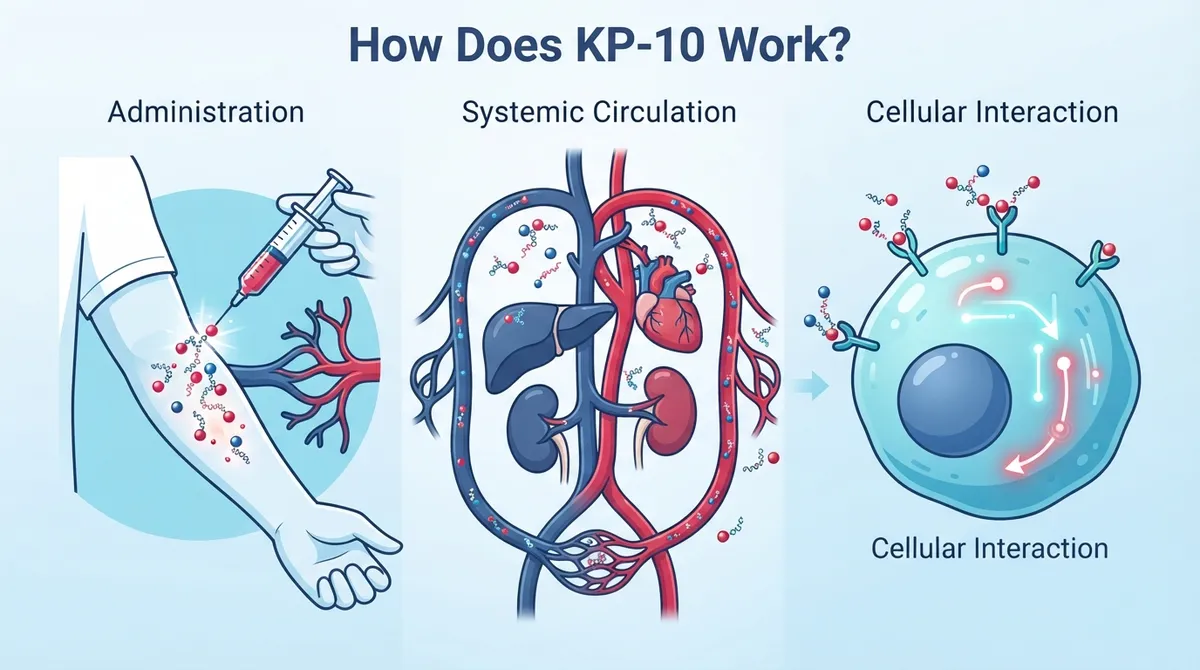
How Does KP-10 Work in the Body?
To understand how KP-10 works, you need a basic picture of the hormone pathway it affects. This pathway is called the hypothalamic-pituitary-gonadal axis, or HPG axis for short.
Step-by-Step: The KP-10 Hormone Pathway
- KP-10 binds to a receptor called KISS1R, also known as GPR54, found on certain brain cells
- This binding activates neurons in the hypothalamus that produce gonadotropin-releasing hormone (GnRH)
- GnRH is released and travels to the pituitary gland
- The pituitary gland responds by releasing luteinizing hormone (LH) and follicle-stimulating hormone (FSH)
- LH and FSH then signal the ovaries or testes to produce sex hormones like testosterone and estrogen
- This chain reaction can influence ovulation, sperm production, and overall reproductive function
This process happens quickly. Studies show KP-10 produces a fast, dose-dependent rise in LH. However, it clears from the body relatively fast compared to longer-acting kisspeptin forms, such as kisspeptin-54. This shorter action window limits how KP-10 might be used for any sustained treatment approach.
What Does the Research Actually Show?
Human studies on KP-10 remain limited but informative. Most research has focused on how the peptide affects hormone levels over short time periods, often through IV infusion in controlled clinical settings.
|
Study Detail |
Finding |
|---|---|
|
Dose-titration study (Endocrine Abstracts, 2012) |
IV doses of 0.3 and 1 microgram/kg produced strong LH stimulation in six healthy men |
|
12-hour infusion study |
Mean LH rose from about 5.2 to 14.1 IU/L; pulse frequency increased from 0.7 to 1.0 pulses per hour |
|
Men with type 2 diabetes and hypogonadism |
LH increased from about 3.9 to 20.7 IU/L; testosterone rose from about 8.5 to 11.4 nmol/L |
|
ClinicalTrials.gov study (NCT03771326) |
0.5 microgram/kg bolus given to seven obese men to study insulin secretion effects |
These numbers show real hormonal responses. But they come from small, short-term studies. None of this data proves that KP-10 works as a safe or effective long-term treatment for any condition. It simply shows the biological pathway is active and measurable in controlled research.
Is KP-10 Approved for Use?
No. There is no broadly approved KP-10 product on the market. This is one of the most important facts to understand before considering it.
Here is what that means in practice:
- No major regulatory body has approved KP-10 for routine treatment of infertility, low testosterone, or any other condition
- Products sold online or through some wellness clinics may be unregulated, mislabeled, or inaccurately dosed
- There is no established clinical dosing standard based on large-scale trials
- Long-term safety data in humans is still lacking
- Sourcing and purity can vary significantly between suppliers
If you have questions about hormone health, a conversation with a licensed provider is the safest starting point. Our team explains options like DNA gene testing and hormone evaluations that use established, evidence-based methods.
Common Reasons People Ask About KP-10
Interest in KP-10 usually falls into a few categories. Understanding these can help you evaluate whether the science actually applies to your situation.
1. Fertility and Reproductive Health
Because KP-10 stimulates LH and FSH, some fertility researchers have studied it as a tool to assess or influence the HPG axis. It has been explored in assisted reproduction research, but this use remains experimental rather than standard practice.
2. Low Testosterone or Hypogonadism
Small studies in men with hypogonadism showed measurable testosterone increases after KP-10 infusion. This has led to interest in whether kisspeptin-based peptides could someday support testosterone production. However, current evidence does not support KP-10 as a replacement for established treatments like testosterone replacement therapy.
3. Metabolic and Weight-Related Research
One exploratory study looked at KP-10's effect on insulin secretion in men with obesity. This research is still in early stages and should not be interpreted as evidence for weight management benefits.
KP-10 vs. Established Hormone Therapies
|
Factor |
KP-10 |
Established Hormone Therapy (e.g., TRT, BHRT) |
|---|---|---|
|
Regulatory status |
Not FDA-approved for routine use |
FDA-approved formulations available |
|
Clinical evidence |
Small, early-phase human studies |
Decades of research and clinical use |
|
Dosing standards |
No established standard |
Well-defined dosing protocols |
|
Duration of action |
Short, requires frequent dosing or infusion |
Varies by formulation, often longer-lasting |
|
Where to access safely |
Limited to research settings |
Licensed medical clinics |
If you are exploring hormone-related concerns, your primary care doctor can walk you through options that have a stronger track record. Learn more about how testosterone therapy works to restore vitality or explore the differences between BHRT and traditional HRT in a separate guide.
Potential Side Effects and Safety Concerns
Because KP-10 remains investigational, safety data is limited compared to approved medications. Reported concerns from research settings include:
- Headache and flushing after administration
- Nausea, particularly with higher doses
- Injection-site reactions
- Hormonal imbalance from unmonitored use
- Unknown risks tied to unregulated or poorly sourced formulations
People who are pregnant, have hormone-sensitive conditions, or experience unexplained reproductive symptoms should talk to a specialist before considering any peptide therapy. Animal studies have looked at safety thresholds, but these numbers cannot be directly applied to human dosing.
Questions to Ask Before Considering Any Peptide
If you are researching KP-10 or similar compounds, bring these questions to your provider:
- What is the source and quality of this peptide?
- Is there independent lab testing available for purity?
- What does current research actually show about safety and effectiveness?
- Are there approved alternatives that address my specific health concern?
- What monitoring would be needed if I were to use this compound?
- How does this fit into my overall health picture, including bloodwork and history?
A trustworthy provider will walk through these questions honestly rather than pushing a product. If you want a broader look at emerging peptides, our team has also covered related topics like how kisspeptin works for fertility and general peptide basics for longevity and wellness.
Why Primary Care Is the Right Starting Point
Emerging compounds like KP-10 can be confusing to navigate alone. A primary care visit gives you a place to ask questions, get proper testing, and receive guidance grounded in evidence rather than marketing claims.
At InCare, our providers combine advanced diagnostic tools with a personalized approach. Whether you are curious about hormone health, fertility concerns, or general wellness optimization, our team of providers in Tampa and Riverview can help you separate fact from hype. We also offer services like body composition analysis and IV hydration and vitamin drips that use proven, well-studied approaches to support your health goals.
Many patients also follow us on Facebook and Instagram for updates on wellness research and clinic news. You can also check out our videos on TikTok for quick, digestible health tips.
What This Means for You
KP-10 works by activating a specific receptor in the brain, which sets off a chain of hormone signals affecting reproduction. The science behind it is real and measurable in short-term studies. But real science does not always mean ready-for-use treatment.
Until larger, longer studies confirm safety and effectiveness, KP-10 remains a research tool rather than a proven wellness solution. If you are dealing with fertility concerns, low testosterone, or hormone imbalance, safer and better-studied options already exist.
Our patients consistently share positive experiences with our team, and you can visit us on Google — InCare to read real reviews from people in Tampa and Riverview who found answers to their health questions here.
Take the Next Step Toward Informed Hormone Health
Understanding how KP-10 works is just the first step. The next step is talking to a provider who can review your specific health history and goals. Our team is ready to answer your questions and guide you toward options backed by real clinical evidence.
Ready to talk to a provider about hormone health or wellness optimization? Book your appointment today and get answers you can trust.
FAQs
Q: What is KP-10 or kisspeptin-10?
A: KP-10 is a short peptide derived from kisspeptin, a molecule that helps regulate reproductive hormones. It activates a receptor called KISS1R in the brain, triggering the release of GnRH, which then stimulates LH and FSH production from the pituitary gland.
Q: Is KP-10 FDA approved or available by prescription?
A: No. KP-10 does not have broad regulatory approval for routine clinical use. It remains a research compound studied primarily in small human trials, and products sold online may lack proper testing, quality control, or accurate labeling.
Q: Can KP-10 help with low testosterone or hypogonadism?
A: Early research shows KP-10 can raise LH and testosterone levels in small study groups, including men with hypogonadism. However, these findings are preliminary and do not establish KP-10 as a proven treatment compared to established therapies.
Q: What are the side effects and risks of kisspeptin-10?
A: Reported effects include headache, flushing, nausea, and injection-site reactions. Because long-term human safety data is limited, people with pregnancy, hormone-sensitive conditions, or reproductive symptoms should consult a specialist before considering it.
Q: How is KP-10 administered, and how long does it last?
A: In research settings, KP-10 has been given through IV infusion or bolus injection. It produces a fast LH response but clears from the body quickly, making it less suitable for sustained treatment without specialized dosing strategies.