
Key Takeaways
- Prepare properly for a metabolic breath test by avoiding recent food, caffeine, nicotine, alcohol, and exercise, and always follow your clinic's written instructions.
- Your resting metabolic rate is not your total daily calorie need; activity and other factors add to it, so have a clinician or nutrition professional turn the number into a practical plan.
- Breath analysis is a measurement tool, not a diagnosis or weight-loss guarantee, so it works best as one part of a broader care plan with a physician.
- Choose the right test for your goal: an RMR test estimates resting calorie burn, while an exercise test measures oxygen use during activity and fitness markers like VO2 max.
You have probably heard that a simple breathing test can reveal how your body burns energy. That is partly true. But many people in Tampa walk into a breath analysis appointment unprepared, expect too much, or misread the numbers afterward. The result is a test that looks impressive on paper but does little to help.
In primary care and wellness, breath analysis metabolism Tampa usually means indirect calorimetry. This is a noninvasive test that measures the oxygen you use and the carbon dioxide you breathe out. From those numbers, a clinician can estimate how many calories your body burns. Done well, it can guide nutrition, weight management, and fitness talks. Done poorly, it can mislead you.
This guide walks through eight common mistakes. It also explains what the test can and cannot do, so you can get real value from it in 2026.

What Metabolic Breath Analysis Actually Measures
Before the mistakes, it helps to know the basics. Your body uses oxygen to turn food into energy. It releases carbon dioxide as a byproduct. Indirect calorimetry tracks both gases while you breathe into a mask or mouthpiece. The ratio between them helps estimate your energy use.
There are two common versions of the test:
- Resting metabolic rate (RMR) testing: Estimates the calories you burn while at rest.
- Exercise testing: Measures oxygen use during activity. It may report fitness markers such as VO2 max or heart-rate training zones.
These two tests are related, but they answer different questions. Knowing which one you need is the first step. You can read more about the clinic-based version on the metabolic breath analysis page at InCare.
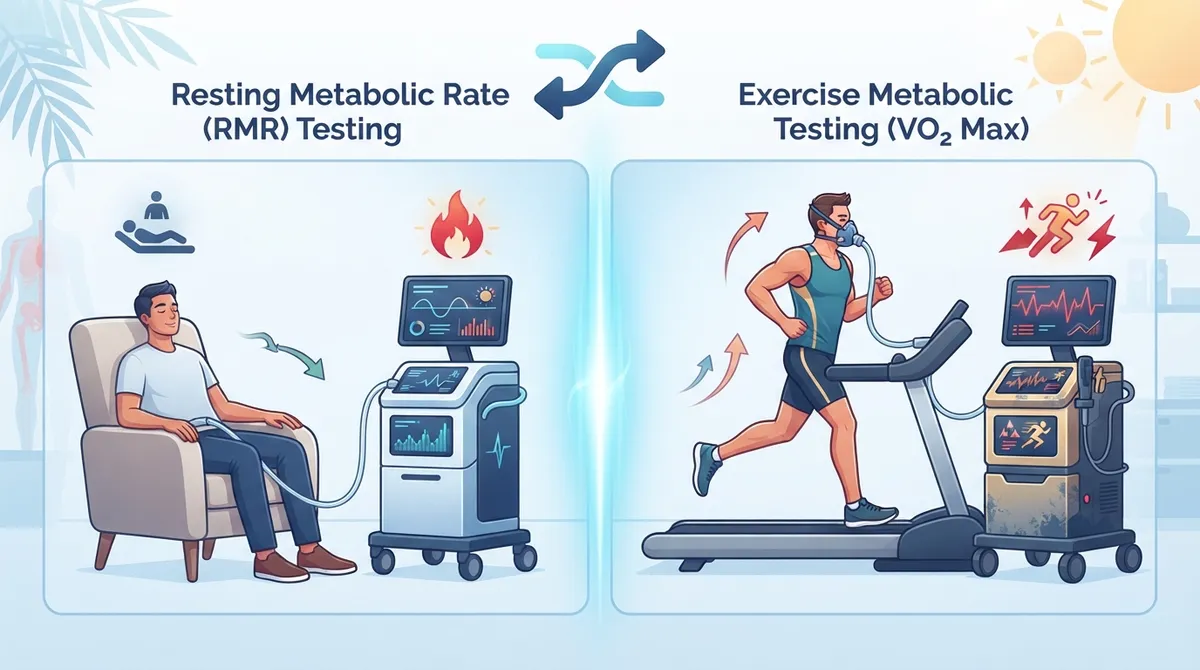
Quick Comparison: RMR Testing vs. Exercise Testing
|
Feature |
RMR Test |
Exercise Test |
|---|---|---|
|
Main goal |
Estimate calories burned at rest |
Measure oxygen use during activity |
|
Body position |
Resting, calm, still |
Moving, often on a treadmill or bike |
|
Typical outputs |
Resting energy expenditure |
VO2 max, training zones |
|
Best for |
Nutrition and weight planning |
Fitness and performance goals |
Appointment length depends on the clinic and device. Clinical guidance notes that a resting measurement can often be done in about 30 minutes under controlled conditions.
Mistake 1: Ignoring the Preparation Rules
Preparation changes your results. This is the most common error, and it is easy to avoid.
Published clinical guidance recommends standardized resting conditions. That usually means avoiding recent food, caffeine, nicotine, alcohol, and exercise before the test. A morning coffee or a quick workout can push your numbers off. Exact instructions vary by device and clinic, so always follow your provider's directions.
Here is a simple way to get ready:
- Ask the clinic for written prep instructions when you book.
- Plan your meals and caffeine around those instructions.
- Skip hard exercise before the appointment.
- Arrive a little early so your heart rate can settle.
- Tell the clinician about any medications you take.
Mistake 2: Confusing Resting Metabolic Rate With Daily Calorie Needs
Your RMR is not the same as the total calories you burn in a day. This mix-up is very common.
RMR covers what your body uses at rest. Your total daily energy use also includes physical activity, digestion, and other factors. A person with a desk job and a person who lifts weights daily may share the same RMR but need very different calorie totals.
That is why a clinician or qualified nutrition professional should turn your result into a practical plan. The number alone is not a meal plan.
Mistake 3: Expecting a Diagnosis or a Weight-Loss Guarantee
A breath test is a measurement tool. It is not a diagnosis. It cannot promise a certain amount of weight loss.
Your RMR is one input. A good provider will also review your health history, medications, sleep, stress, activity, and goals. Think of the test as one piece of a larger picture. For many patients, that picture also includes a structured weight loss plan guided by a physician.
Mistake 4: Assuming Every Device Is Equally Accurate
Not all metabolic devices perform the same. Indirect calorimetry is commonly treated as a reference method for measuring resting energy use. But performance varies by device and testing conditions.
A 2025 systematic review looked at 22 studies and 10 devices in adults with overweight or obesity. It found that standard desktop devices showed inconsistent validity and weight-loss prediction. Handheld devices showed poor validity and reliability in the reviewed evidence.
The takeaway is simple. Ask the clinic what equipment they use and how they run the test. A careful protocol matters as much as the machine.
Mistake 5: Skipping the Equation Backup When Testing Is Not an Option
Sometimes a measured test is not available. In that case, predictive equations can fill the gap, though they are less precise.
The Academy of Nutrition and Dietetics recommends using a measured RMR by indirect calorimetry when available to estimate energy needs in adults with overweight or obesity. When it is not available, it recommends the Mifflin-St Jeor equation using actual weight.
If you are weighing options, remember that a measured result is generally preferred when it can be done well. Still, an equation is better than guessing.
Mistake 6: Treating the Test as a One-Time Event
Your metabolism is not fixed. It can shift with weight changes, muscle mass, medications, age, and lifestyle. A single result is a snapshot.
If you are working on a goal, ask your provider whether a repeat test makes sense later. Pairing breath analysis with other tools can also give a fuller view. For example, body composition scanning shows how much of your weight is muscle versus fat. Together, the two give you more context than either one alone.
Mistake 7: Mixing Up RMR Testing and VO2 Max Testing
Many Tampa adults book the wrong test for their goal. If you want to know how many calories you burn at rest, you need an RMR test. If you want to understand your cardiovascular fitness or set training zones, you need an exercise-based test.
Tell your provider your goal up front. A weight-management patient and a runner training for a race need different information. Clinics that offer both can match the test to your needs. You can learn more about fitness-focused testing in this guide to VO2 max testing.
Mistake 8: Not Confirming Details Before You Book
Services, protocols, and pricing can change. Do not assume every clinic runs the test the same way.
Before you book, confirm these points:
- Which type of test is offered: resting, exercise, or both
- How long the appointment will take
- What you need to do to prepare
- What the cost is and what it includes
- Who will explain your results and help you use them
InCare offers metabolic breath analysis at its Tampa location, 1213 N Franklin St, and at its Riverview location, 11922 Boyette Rd. Its service description says testing may assess energy use at rest or oxygen use during exercise. Please confirm current availability, protocol, preparation steps, and pricing directly with the clinic. You can review all locations before you choose.
Who Can Benefit From Breath-Based Metabolic Testing in Tampa
This type of testing may appeal to several groups of people:
- Busy professionals and young families who want a data-based start to a nutrition plan instead of guessing.
- Wellness-minded adults who like tech-driven tools and want to track their health over time.
- Young adults and women new to preventive care who want to understand their bodies before problems start.
- People working on weight management who need a clearer starting point for calorie planning.
For all of these groups, the best results come when testing sits inside a bigger care plan. That is where a primary care team helps most. A physician can connect your metabolic data to lab work, screenings, and lifestyle goals. Learn how this fits into primary care at InCare.
How to Turn Your Results Into Action
A number on a page is only useful if it leads somewhere. Use this simple path after your test:
- Review your result with a clinician, not just on your own.
- Compare it with your goals, such as weight change or fitness.
- Build a practical calorie and nutrition plan around it.
- Add movement and sleep habits that match your lifestyle.
- Schedule a follow-up to check progress and adjust.
This approach keeps the test in its proper role. It informs your plan. It does not replace good medical judgment.
Why Choose InCare for Metabolic Testing in Tampa
InCare is a personalized healthcare clinic that blends advanced technology with medical expertise. The Tampa and Riverview teams focus on prevention and whole-body optimization. That means your breath analysis is not a standalone gadget visit. It can be part of a plan that may include primary care, weight management, body composition scanning, and gene testing.
Patients also value the human side of care. InCare holds a strong rating on Google, and you can see what our InCare patients say on Google. To follow clinic news and wellness tips, you can find InCare on Instagram, Facebook, and TikTok.
Final Thoughts
Metabolic breath analysis can be a smart, noninvasive way to understand how your body uses energy. The value depends on how well you prepare, which test you choose, and how your results are used. Avoid these eight mistakes, and you give yourself a much better shot at useful answers.
If you live in or near Tampa and want to explore metabolic testing, book your appointment with InCare today. You can also contact our team with questions about preparation, pricing, and which test fits your goals.
FAQs
Q: What is metabolic breath analysis, and how does it work?
A: Metabolic breath analysis, also called indirect calorimetry, is a noninvasive test. It measures the oxygen you use and the carbon dioxide you breathe out to estimate how much energy your body burns. A clinician then uses the result to guide nutrition and fitness planning.
Q: How should I prepare for a metabolic breath test?
A: Clinical guidance generally recommends standardized resting conditions, which often means avoiding recent food, caffeine, nicotine, alcohol, and exercise. Exact instructions vary by device and clinic, so follow the directions your provider gives you.
Q: How long does a metabolic breath test take?
A: A resting metabolic rate measurement can often be completed in about 30 minutes under controlled conditions. The full appointment length depends on the clinic, the device, and whether you are doing a resting or exercise test.
Q: What is the difference between RMR testing and VO2 max testing?
A: An RMR test estimates the calories you burn at rest and helps with nutrition and weight planning. A VO2 max or exercise test measures oxygen use during activity and may provide fitness markers and heart-rate training zones.
Q: Is metabolic breath analysis accurate?
A: Indirect calorimetry is commonly treated as a reference method for resting energy use, but accuracy varies by device and testing conditions. A 2025 systematic review found inconsistent validity for standard desktop devices and poor validity for handheld devices, so careful protocol and equipment matter.