Key Takeaways
- GHK-Cu shows meaningful results only after 8-12 weeks of consistent use, not overnight; expect gradual improvements in firmness and fine lines rather than dramatic transformations.
- Topical GHK-Cu products are well-researched and safe, but injectable peptides purchased online carry contamination and dosing risks—only use injections under medical supervision.
- Product formulation quality directly impacts effectiveness; check peptide concentration, packaging type (airless pumps preferred), stability, and storage conditions before purchasing.
- Skip baseline skin assessment and you cannot accurately track progress; take consistent photos in natural lighting at weeks 0, 4-8, and 8-12 to measure real changes.
- GHK-Cu benefits are modest and work through tissue repair mechanisms, not rapid cell turnover like retinol; it is less effective for deeper wrinkles or significant sun damage.
- Hair growth claims lack strong clinical evidence compared to skin benefits; focus on skin-backed results and consult providers about hair concerns with more established treatments.
Copper peptide skincare has become one of the most talked-about topics in wellness circles this year. Many people search for GHK-Cu before and after photos hoping for quick, dramatic results. But without understanding how this peptide actually works, it is easy to waste money, misjudge progress, or even risk your skin health. This guide breaks down what GHK-Cu really does, what results you can honestly expect, and the common mistakes that keep people from seeing the changes they want.
GHK-Cu stands for glycyl-L-histidyl-L-lysine copper complex. It is a naturally occurring copper-binding peptide that your body already produces, though levels decline as you age. Researchers have studied it for decades because of its role in skin repair, wound healing, and tissue remodeling. Understanding the science behind it helps you set realistic expectations and avoid falling for exaggerated marketing claims.
What Does GHK-Cu Actually Do for Your Skin?
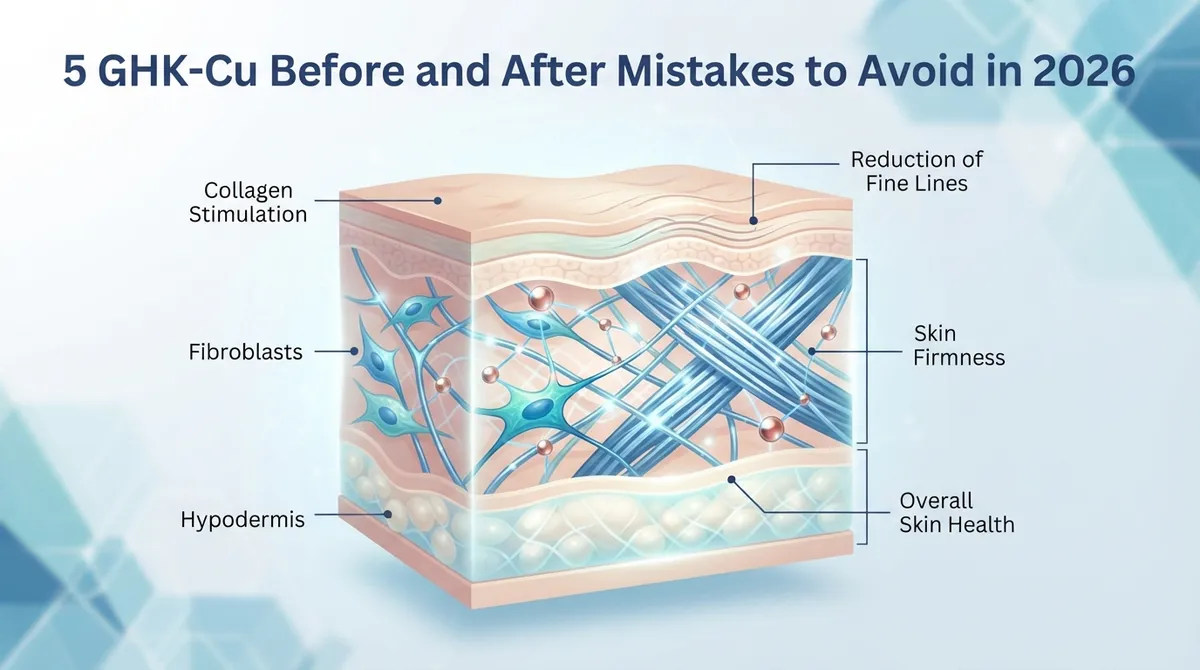
GHK-Cu works by supporting your skin's natural repair processes. It is associated with stimulating collagen and elastin production, which are the proteins that keep skin firm and smooth. A widely cited 2018 review published in PubMed Central described GHK as a "safe, inexpensive" compound with broad regenerative effects across many tissue types.
Most of the strong evidence for GHK-Cu comes from topical skincare use, not injections. This distinction matters because many people confuse cosmetic peptide creams with medical-grade injectable treatments. At InCare, our primary care team can help you understand which category any peptide product actually falls into before you try it.
Common Before and After Changes People Report
People who use GHK-Cu consistently often report these changes over time:
- Improved skin firmness and elasticity
- Softer appearance of fine lines
- Better hydration and smoother texture
- More even skin tone
- Faster recovery after cosmetic procedures
These changes are usually gradual. They are not dramatic transformations that happen overnight, despite what some marketing images suggest.

Mistake 1: Expecting Results Too Quickly
The biggest mistake people make is expecting overnight results. Commercial and clinical sources commonly describe visible skin changes appearing after about 4 to 8 weeks of consistent use. Some studies report measurable improvements in skin density and wrinkle appearance over 8 to 12 weeks.
Skin renewal takes time because your body needs to build new collagen fibers and remodel the extracellular matrix. Rushing this process, or giving up too early, means you may never see the results you were hoping for.
Realistic Timeline for GHK-Cu Results
|
Time Period |
Typical Changes Reported |
|---|---|
|
Weeks 1-3 |
Minimal visible change; skin may feel more hydrated |
|
Weeks 4-8 |
Subtle improvement in texture and firmness |
|
Weeks 8-12 |
More noticeable reduction in fine lines and improved density |
|
3+ months |
Continued gradual improvement with consistent use |
Mistake 2: Choosing Injectable Peptides Without Medical Guidance
Some people try to speed up results by using injectable copper peptide products they find online. This is risky. The strongest consumer-facing evidence for GHK-Cu supports topical use, not unregulated injections. Injectable peptide products sold without medical oversight can carry contamination risks, incorrect dosing, and unknown side effects.
If you are curious about peptide-based wellness treatments, it is far safer to consult a licensed provider. Our peptide therapy program in Tampa is supervised by medical professionals who can explain what is appropriate for your specific goals and health history.
Topical vs Injectable: A Quick Comparison
|
Factor |
Topical GHK-Cu |
Injectable Peptides |
|---|---|---|
|
Evidence Strength |
Well-supported for skin benefits |
Less established, higher uncertainty |
|
Regulation |
Cosmetic product oversight |
Often unregulated when purchased online |
|
Safety Profile |
Generally low risk when used as directed |
Higher risk without medical supervision |
|
Best Use Case |
Skin firmness, texture, fine lines |
Should only be considered under clinical guidance |
Mistake 3: Ignoring Formulation Quality
Not all GHK-Cu products are created equal. Formulation matters just as much as the active ingredient itself. Poor stability, incorrect concentration, or low-quality packaging can all reduce effectiveness before the product even reaches your skin.
Here are factors that influence how well a GHK-Cu product performs:
- Concentration of the peptide in the formula
- Stability of the copper complex when exposed to air and light
- Presence of supporting ingredients like antioxidants
- Packaging that limits oxidation, such as airless pumps
- Storage conditions recommended by the manufacturer
If a product breaks down before you even apply it, you will not see the before and after changes you are expecting, no matter how long you use it.
Mistake 4: Overlooking Hair Growth Claims Without Evidence
Marketing materials sometimes promote GHK-Cu for hair growth alongside skin benefits. While there is some interest in this area, the evidence is less established than the skin-related research. Much of the hair-growth data comes from smaller studies or preclinical research rather than large human trials.
If hair thinning or shedding is a concern for you, it may be worth exploring options with more direct evidence. Our hair restoration services use approaches with stronger clinical backing, and our providers can walk you through what realistically works.
Questions to Ask Before Trying a Hair-Focused Peptide Product
- What clinical studies support this specific claim?
- Is the evidence based on human trials or lab studies only?
- How long did participants use the product before seeing changes?
- Are results consistent across different studies?
- Does the product have any independent third-party testing?
Mistake 5: Skipping a Professional Skin Assessment First
Many people jump straight to buying a copper peptide serum without ever getting a baseline assessment of their skin health. This means you have no accurate way to measure real progress. A proper before and after comparison requires consistent photos, similar lighting, and ideally, a professional evaluation at the start.
Skipping this step also means you might miss underlying issues, like sun damage or early signs of skin conditions, that a peptide serum alone cannot fix. A wellness-focused evaluation gives you a clearer picture of what results are realistic for your skin type and history.
Steps for Tracking Your Own Before and After Results
- Take baseline photos in consistent, natural lighting
- Note your skin concerns and goals in writing
- Apply the product consistently as directed, usually once or twice daily
- Take follow-up photos every 2 to 4 weeks under the same conditions
- Compare texture, firmness, and tone changes at the 8 to 12 week mark
- Discuss results with a healthcare provider if you have concerns
This structured approach removes guesswork and helps you judge whether a product is actually working for you.
How GHK-Cu Compares to Other Popular Skin Ingredients
People often want to know how copper peptides stack up against other well-known skincare actives like retinol. Both can improve fine lines and firmness, but they work through different mechanisms. Retinol speeds up cell turnover, while GHK-Cu supports tissue repair and the extracellular matrix. Some people use both together, though this should be introduced carefully to avoid skin irritation.
Reviews of topical studies note that GHK-Cu benefits are typically modest rather than dramatic, especially for deeper wrinkles or significant sun damage. This is an important expectation to set before you start any regimen.
Why Whole-Body Wellness Matters More Than a Single Product
Skin health does not exist in isolation. Hydration, nutrition, sleep, and hormone balance all affect how your skin looks and how well it responds to any topical treatment. This is why a comprehensive approach often produces better before and after results than relying on one product alone.
At InCare, we look at wellness holistically. Services like our IV hydration and vitamin drips support overall skin hydration from the inside, while our DNA gene testing can reveal how your body processes collagen and responds to environmental stressors. Combining these insights with topical care often leads to more meaningful, lasting change.
For patients also managing weight or metabolic goals, our medical weight loss programs and body composition analysis can support skin elasticity as part of a broader health strategy, since rapid weight changes can affect skin firmness too.
Safety Considerations Before You Start
Topical GHK-Cu is generally considered low risk for cosmetic use. However, some people experience mild redness, itching, or irritation, especially when combining it with other active ingredients. Always patch test a new product before applying it to your full face.
If you experience unusual reactions or are considering any peptide therapy beyond basic skincare, speak with a licensed provider first. Our team at InCare providers can help you evaluate any wellness product with a clinical lens rather than relying solely on marketing claims found online.
You can also learn more about our approach to preventive wellness by following us on Facebook, Instagram, or TikTok, where we regularly share education on skincare science and whole-body wellness trends.
When to Involve Your Primary Care Provider
Skin changes can sometimes signal something beyond cosmetic concern, such as hormonal imbalance, nutritional deficiency, or an underlying health condition. If you notice unexplained skin changes alongside fatigue, weight changes, or other symptoms, it is worth discussing with your primary care doctor rather than assuming a peptide cream will resolve it.
InCare's Tampa and Riverview locations offer comprehensive wellness visits that go beyond skin-deep concerns. Patients consistently share positive feedback about their experience, and you can visit us on Google — InCare to read real reviews from people in your community.
Final Thoughts on Setting Realistic Expectations
GHK-Cu can be a valuable addition to a skincare routine when used correctly and with patience. The key is understanding that meaningful before and after results take consistent use over 8 to 12 weeks, not days. Avoiding the five mistakes above, unrealistic timelines, unsupervised injections, poor formulations, unproven hair claims, and skipping a baseline assessment, will help you get the most out of any peptide product you try.
If you want personalized guidance on skincare, peptide therapy, or your overall wellness plan, our team is ready to help. Reach out to our team today or schedule your appointment now to start building a wellness plan grounded in real science, not just marketing hype.
FAQs
Q: What does GHK-Cu do for skin?
A: GHK-Cu is a copper peptide that supports collagen and elastin production, helping improve skin firmness, hydration, and texture over time. It is best supported by evidence in topical skincare rather than injectable use.
Q: How long does GHK-Cu take to show results?
A: Most people notice initial changes after about 4 to 8 weeks of consistent use, with more measurable improvements in firmness and fine lines appearing around 8 to 12 weeks. Results are gradual, not immediate.
Q: Is GHK-Cu safe for topical use?
A: Topical GHK-Cu is generally considered low risk for cosmetic use, though some people may experience mild irritation. It is always wise to patch test a new product and consult a healthcare provider if you have sensitive skin.
Q: Does GHK-Cu help with hair growth?
A: Some evidence suggests GHK-Cu may support hair health, but this research is less established than its skin benefits. Claims are often based on smaller or preclinical studies, so results can vary significantly.
Q: Can GHK-Cu be injected, and is that safe?
A: While injectable copper peptide products exist, the strongest consumer evidence supports topical use rather than injections. Unsupervised injectable use carries more uncertainty and risk, so medical guidance is strongly recommended.