

Key Takeaways
- Biological age is an estimate of how your body functions compared with typical peers your age, and no single test is the accepted standard, so results from different tests can differ.
- Epigenetic clocks can estimate chronological age very closely, but strong age-estimation accuracy does not mean a test can predict your personal health or lifespan.
- Population studies link higher biological age estimates with poorer outcomes, but a result is not a diagnosis; discuss it with your clinician alongside labs, vitals, and history.
- Practical markers like blood pressure, lab trends, and fitness are clearer measures of progress than repeat biological age scores, which are hard to interpret reliably.
Your birthday says how many years you have lived. It does not say how well your body is aging. Two people who are both 50 can have very different blood pressure, fitness, and metabolic health. That gap is why more people in 2026 are asking about a biological vs chronological age test.
The idea is simple. Chronological age is a count of years. Biological age is an estimate of how your body is functioning compared with what is typical for your age. The tools used to estimate it vary widely, and no single test is the accepted standard.
This guide gives you 12 clear facts. You will learn how these tests work, what they can and cannot tell you, and how to use the results wisely. Whether you are a busy parent, a health-minded professional, or a young adult focused on prevention, the goal is the same. Understand your numbers, then turn them into steps that help.
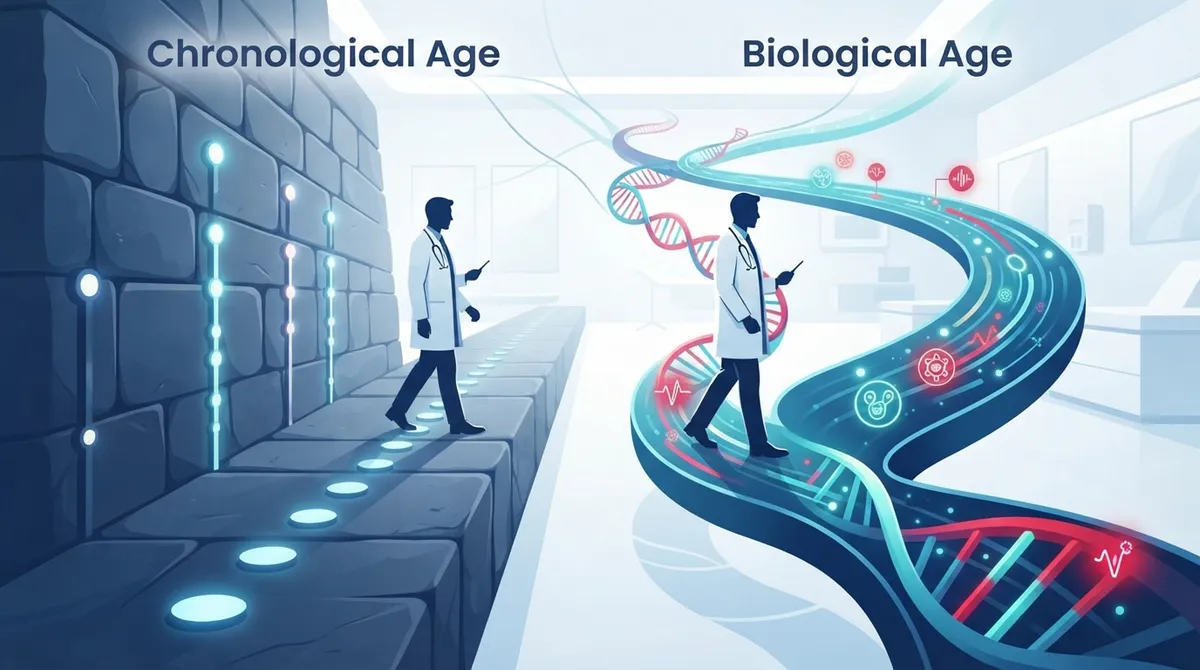
Fact 1: Chronological Age Is Fixed, Biological Age Is an Estimate
Chronological age is the time since birth. You cannot change it, and it is easy to measure. Biological age is different. It is an estimate of your physiological or functional state compared with what is typical for your chronological age.
It is not a single, directly visible number. There is no universally agreed definition. That is why one biological vs chronological age test can give a different answer than another.

Fact 2: There Is No Single Standard Test
Many people assume there is one official test. There is not. Different methods measure different parts of aging. They are not interchangeable.
The main approaches fall into three groups:
- Clinical biomarker scores: These use routine lab and exam data such as blood sugar, cholesterol, and blood pressure.
- Functional and frailty assessments: These look at strength, balance, walking speed, and daily function.
- Molecular tests: These include DNA methylation, also called epigenetic clocks, usually from a blood sample.
Fact 3: Epigenetic Clocks Read Chemical Tags on Your DNA
Epigenetic clocks look at DNA methylation at selected sites in your genome. These chemical tags change in patterns as people age. The test is often run on a blood sample.
Early clocks were built mainly to estimate chronological age. Later models, such as PhenoAge- and GrimAge-related clocks, were designed to capture health signals or predict outcomes. Their intended uses differ, so it helps to know which clock a test uses.
Fact 4: Your Result Is Usually an Age Gap
Most reports compare your biological estimate with your calendar age. The difference is often called an age gap or age acceleration. A higher estimate may be linked with poorer health outcomes in population studies.
That link is about groups of people. It is not a diagnosis. It does not prove your own future disease risk or how fast you are aging.
Fact 5: Accuracy at Estimating Age Is Not the Same as Predicting Health
Some epigenetic clocks match chronological age very closely. A 2024 systematic review reported correlations of 0.96 or higher in cited studies. That is impressive, but it measures how well a clock estimates age.
It does not mean the clock can predict your health or lifespan. A tool can be excellent at guessing age and still be limited for guiding individual care.
Fact 6: Clinical Biomarker Clocks May Predict Outcomes Better in Some Studies
The same 2024 review found that phenotypic clocks, which use clinical biomarkers, predicted mortality better than chronological age in some studied settings. Epigenetic clocks showed more moderate links with mortality and disease.
Results varied by clock, population, and outcome. This is one reason clinicians often value routine measures that are already well understood.
Fact 7: Research Links Aging Clocks to Real Health Outcomes
A 2025 review of epigenetic clocks in preventive medicine described associations in large groups. Faster epigenetic aging was linked with frailty, metabolic syndrome, cardiovascular events, mortality, and cognitive decline.
The same review noted limits in clinical use and standardization. Association at the population level is a starting point. It is not proof that a test should drive your treatment.
Fact 8: These Tests Have Real Limitations
Before you pay for a test, know the weak spots. Researchers have flagged several problems:
- Results can differ by tissue, so a blood result may not reflect every organ.
- Results can vary by population, lab platform, and data processing.
- Illness, medications, and environment can all shift the numbers.
- It is unclear how to interpret changes on repeat testing.
A 2022 review also noted that many clocks are not trained on long-term follow-up data. That means they do not directly measure your future rate of aging.
Fact 9: Compare the Test Types Side by Side
This table gives a quick comparison of common approaches.
|
Test Type |
What It Measures |
Sample Needed |
Main Strength |
Main Limit |
|---|---|---|---|---|
|
Clinical biomarker score |
Labs and vitals such as glucose, lipids, blood pressure |
Blood and exam |
Uses well-known measures |
Depends on which markers are chosen |
|
Functional assessment |
Strength, balance, walking speed, frailty |
In-person testing |
Reflects daily function |
Less sensitive in younger adults |
|
Epigenetic clock |
DNA methylation patterns |
Usually blood |
Detailed molecular signal |
Not standardized for individual care |
Fact 10: Primary Care Measures Are Often More Actionable
A commercial age score is interesting. A clear plan is more useful. In primary care, your clinician can review your symptoms, medical and family history, blood pressure, standard lab results, medications, and physical function.
Those findings point to specific actions. Examples include managing blood pressure, improving blood sugar, or scheduling the right screenings. At InCare, primary care is built around this kind of prevention-focused, whole-body review.
Fact 11: Lifestyle Matters, but Tracking It Is Tricky
Habits such as exercise, sleep, nutrition, and stress control influence long-term health. Many people hope to see a lower biological age after making changes. That hope is reasonable, but the science is not settled.
Because repeat testing is hard to interpret, a small shift may not mean much. Better markers of progress are often practical ones. These include blood pressure, lab trends, body composition, and fitness.
Tools that give concrete data can help. Options such as body composition analysis and metabolic breath analysis measure body fat, lean mass, and metabolic function. You can also explore DNA gene testing for personalized health insights. These tools describe your current state and risk factors. They do not replace a clinician's judgment.
Fact 12: A Test Result Should Start a Conversation, Not End One
The best use of any biological age result is as a prompt. Bring it to your clinician and ask what it means for you. A good provider will place it next to your full health picture.
Here is a simple way to approach it:
- Decide what you hope to learn, such as prevention, fitness, or peace of mind.
- Get a baseline with standard labs, vitals, and a physical exam.
- If you choose a biological age test, ask which method it uses and what its limits are.
- Review the result with your clinician, not alone.
- Turn findings into specific steps, such as screenings, nutrition changes, or exercise goals.
- Recheck on a schedule your clinician recommends.
A annual wellness visit is a strong starting point. It covers many of the checks that matter most for healthy aging.
Who Might Find These Tests Most Useful
Interest in aging tests spans many groups. Tech-savvy professionals like data. Wellness-focused adults want to optimize health early. Busy parents want to stay strong for their families. Young adults want to build good habits before problems start.
For all of these readers, the same rule applies. Use a test as one input. Pair it with proven prevention, including routine screenings and a trusted primary care relationship. InCare serves patients in Tampa and Riverview, and you can read what patients say about their care on our InCare Google profile. You can also follow our health updates on Instagram, Facebook, and TikTok.
Why InCare Is a Strong Partner for Healthy Aging
InCare combines modern technology with personal medical care. The clinic offers primary care, cancer screening, weight loss programs, and advanced wellness services in one place. That means your data, your history, and your goals are handled by one team.
This matters because aging well is not about one number. It is about steady, informed choices backed by a clinician who knows you. If you are curious about your own aging profile, the safest path is to start with a complete health review and build from there.
Conclusion
A biological vs chronological age test can be interesting, but it is not a verdict. Chronological age counts your years. Biological age is an estimate, and different tests can give different answers. Current evidence does not support treating any single score as a diagnosis or a replacement for primary care.
Your best move is to focus on proven measures: blood pressure, labs, physical function, and recommended screenings. If you want to explore advanced tools, do it with guidance from a clinician who can explain the results in context.
Ready to take a clear, evidence-based look at your health? Book your visit with InCare today, or contact our team to ask which services fit your goals.
FAQs
Q: What is the difference between biological age and chronological age?
A: Chronological age is the number of years since you were born. Biological age is an estimate of how your body's physiological or functional state compares with what is typical for your age. It is not a single, universally agreed measurement.
Q: Are biological age tests accurate for an individual?
A: Some tests estimate chronological age very closely, but that does not mean they accurately predict your personal health or lifespan. Results can vary by test method, lab, and population. They are best interpreted alongside standard clinical assessment.
Q: What does it mean if my biological age is higher than my chronological age?
A: In population studies, a higher estimate has been linked with poorer health outcomes. For an individual, it is not a diagnosis and does not establish future disease risk. Discuss the result with your primary care clinician for context.
Q: Can lifestyle changes lower biological age?
A: Healthy habits such as regular exercise, good sleep, and balanced nutrition support long-term health. However, it is still uncertain how to reliably interpret changes on repeat biological age testing. Practical markers like blood pressure, lab results, and fitness are often clearer measures of progress.
Q: Should I talk to my primary care doctor about a biological age test?
A: Yes. A clinician can explain what the test measures, note its limits, and place the result next to your history, labs, and exam. A commercial age score should never replace routine screening or clinical judgment.


