
Key Takeaways
- MOTS-c lacks FDA approval and has no established safe dose or long-term human safety data, unlike approved treatments like GLP-1 medications that have completed clinical trials.
- Most human MOTS-c research is observational, measuring natural levels rather than proving cause-and-effect; promising animal studies often don't translate to human biology.
- Compounded MOTS-c products carry unverified purity, incorrect dosing risks, and unknown interactions, while synthetic analogs like CB4211 behave differently than natural MOTS-c.
- MOTS-c is produced from mitochondrial DNA and is prohibited by the World Anti-Doping Agency, making it fundamentally different from standard supplements and legal for competitive athletes.
MOTS-c has become one of the most talked-about peptides in wellness circles. Patients ask about it after reading online forums or watching social media videos. But there is a big gap between what people hear and what science actually proves. Understanding the real mots-c differences between lab findings and human results can protect your health and your wallet.
This guide breaks down what MOTS-c really is, how it differs from other peptides, and why primary care providers stay cautious about its use. If you are exploring wellness options in Tampa or Riverview, this information will help you ask smarter questions at your next visit. Our team at InCare believes in giving patients clear, honest facts before they consider any experimental therapy.
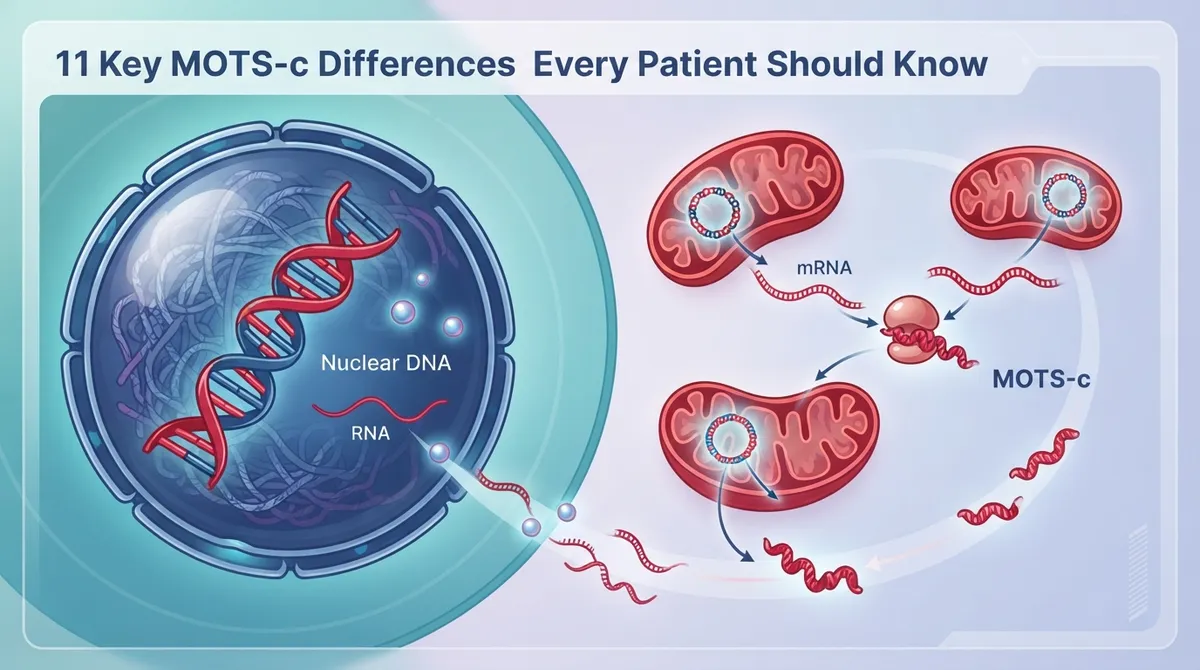
1. MOTS-c Comes From Mitochondrial DNA, Not Nuclear DNA
MOTS-c is a small peptide made of just 16 amino acids. Unlike most hormones in your body, it is coded by mitochondrial DNA instead of the DNA in your cell's nucleus. This makes it a mitochondria-derived peptide, or MDP. This origin is a major difference that sets it apart from typical wellness hormones and supplements discussed in a primary care setting.

2. Animal Studies Show Promise, But Humans Are Different
Much of the excitement around MOTS-c comes from mouse studies. Researchers have seen improved glucose tolerance, better insulin sensitivity, and protection against diet-induced metabolic problems in animals. These results sound impressive. However, animal biology does not always translate to human biology. This is one of the most important mots-c differences patients need to understand before getting excited about the peptide.
3. Human Research Is Mostly Observational
Most human studies on MOTS-c simply measure natural levels of the peptide in blood or muscle tissue. They look at how MOTS-c levels connect to age, exercise, obesity, or insulin resistance. These are called observational studies. They can show a pattern, but they cannot prove that giving someone MOTS-c will treat or prevent any condition.
- Observational studies measure what already exists in the body
- They do not test cause and effect
- They cannot confirm a safe or effective dose
- They do not track long-term outcomes from injections
This distinction matters a lot. A treatment that looks promising on paper may not hold up once tested properly in controlled human trials.
4. Natural MOTS-c Levels Differ by Age, Sex, and Fitness
Your body already makes MOTS-c. But levels vary depending on several factors. Some studies report lower MOTS-c in older adults and in people with obesity or insulin resistance. Other research shows differences based on physical activity and sex. However, measurement methods are not always consistent across studies, so these findings should be viewed carefully.
If you are curious about your own metabolic health, a metabolic breath analysis or body composition assessment can give you real, measurable data instead of relying on unproven peptide claims.
5. MOTS-c Analogs Are Not the Same as Natural MOTS-c
One confusing mots-c difference involves synthetic analogs like CB4211. These lab-made versions are structurally similar to MOTS-c but are not identical. They may behave differently in the body, and they carry their own separate safety and research profile. Patients sometimes assume all MOTS-c products are the same, but this is not true.
6. How MOTS-c Compares to Other Experimental Peptides
MOTS-c is often mentioned alongside other peptides being studied for wellness and recovery. Below is a simple comparison to help clarify some key differences.
|
Peptide |
Origin |
Main Research Focus |
FDA Approval Status |
|---|---|---|---|
|
MOTS-c |
Mitochondrial DNA |
Glucose metabolism, exercise adaptation |
Not approved |
|
SS-31 |
Synthetic mitochondrial-targeted peptide |
Mitochondrial protection |
Not approved |
|
Humanin |
Mitochondrial DNA |
Cellular stress response |
Not approved |
|
BPC-157 |
Synthetic, derived from stomach protein |
Tissue repair |
Not approved |
|
GLP-1 receptor agonists |
Synthetic hormone analogs |
Blood sugar and weight management |
FDA approved for specific uses |
Notice how GLP-1 medications stand apart because they have gone through formal clinical trials and received FDA approval for specific conditions. If you are interested in a medically supervised option for weight management, ask your provider about weight loss programs that use approved treatments.
7. MOTS-c Is Not FDA Approved for Any Wellness Use
This is one of the clearest mots-c differences compared to standard primary care treatments. MOTS-c has not been approved by the FDA for weight loss, diabetes, anti-aging, or athletic performance. There is no established dose, no proven treatment schedule, and no verified long-term safety data for repeated use.
Because of this, providers who follow evidence-based medicine tend to avoid recommending MOTS-c for routine care. Instead, they focus on proven approaches backed by clinical research.
8. Compounded MOTS-c Products Carry Real Risks
Some clinics and online sellers offer compounded MOTS-c products. These are not regulated the same way as approved medications. Concerns include:
- Unverified peptide purity and potency
- Incorrect or inconsistent dosing
- Possible immune reactions
- Injection-site irritation or infection
- Unknown interactions with glucose-lowering medicines
- Unclear long-term safety data
Early reports mostly describe mild, short-lived injection-site symptoms. But small, short studies cannot rule out rare or long-term risks. This is why regulatory reviews continue to flag insufficient human evidence for compounded MOTS-c products.
9. Athletes Should Know the Anti-Doping Rules
MOTS-c is listed by the World Anti-Doping Agency in its prohibited category for non-approved substances and metabolic modulators. If you compete in sports at any level, check current anti-doping rules before considering any peptide product. This detail is often overlooked but is a critical mots-c difference from legal supplements.
10. How MOTS-c Differs From Proven Metabolic Care
Instead of chasing unproven peptides, many patients get better, faster results from proven primary care strategies. These include supervised weight management, chronic disease monitoring, and lifestyle coaching. A trusted provider can help you build a plan based on real evidence, not internet trends.
Programs like IV hydration and vitamin drips or DNA gene testing offer measurable, well-studied ways to support your health goals. These services come with more transparency than experimental peptides sold outside regulated clinics.
11. Why Talking to a Primary Care Provider Matters Most
The biggest mots-c difference to remember is this: preclinical promise is not the same as proven treatment. A knowledgeable provider can help you separate real science from marketing hype. At InCare, our team reviews the latest research so patients get honest, current answers about peptides and other wellness trends.
Our patients trust the guidance they receive, and you can visit us on Google — InCare to read reviews from people in Tampa and Riverview who have found real answers here. We also share health updates through Facebook, Instagram, and Tik Tok, so you can stay informed between visits.
For general background on mitochondrial peptides and metabolic research, resources from the National Institutes of Health offer helpful context on how these compounds are studied.
Making Smart, Informed Wellness Choices
MOTS-c is an interesting area of research. But interesting does not mean ready for everyday use. The differences between animal studies, observational human data, and actual clinical treatment are wide. Patients deserve honest guidance instead of exaggerated claims.
If you want to explore proven wellness options that fit your goals, our team is ready to help. You can reach out to our care team with questions, or schedule your visit today to start a wellness plan built on real science, not guesswork.
FAQs
Q: What is MOTS-c and how does it work?
A: MOTS-c is a small peptide made of 16 amino acids, produced from mitochondrial DNA rather than nuclear DNA. Preclinical research suggests it may influence energy metabolism through pathways involving AMPK and insulin signaling, but these effects are not proven in humans.
Q: What are the main differences between MOTS-c and GLP-1 medications?
A: GLP-1 medications have gone through formal clinical trials and hold FDA approval for specific uses like diabetes and weight management. MOTS-c has no such approval, no established dosing, and limited human safety data, making it an experimental compound rather than a proven treatment.
Q: Does MOTS-c help with weight loss or insulin resistance?
A: Animal studies show MOTS-c may improve glucose tolerance and insulin sensitivity, but this has not been confirmed in well-designed human trials. Current evidence is insufficient to recommend MOTS-c for weight loss or insulin resistance treatment.
Q: What is the difference between naturally occurring MOTS-c and injected MOTS-c?
A: Naturally occurring MOTS-c is produced by your body and varies with age, sex, and activity level. Injected MOTS-c products are not standardized, may vary in purity, and have not been proven safe or effective for long-term use.
Q: Is MOTS-c FDA approved or legal to use for wellness treatments?
A: MOTS-c is not FDA approved for weight loss, diabetes, anti-aging, or athletic performance. It is also listed by the World Anti-Doping Agency as a prohibited substance for competitive athletes, so anyone considering it should verify current regulations first.